
Mind Mapping of Homoeopathic Medicines: A Cognitive Learning Approach to Studying Materia Medica
Abstract
Homoeopathic materia medica contains a vast amount of information regarding the mental, physical, general and characteristic symptoms of homoeopathic medicines. It is a very tough task to memorize all those remedies and their symptoms and recalling those symptoms later is much tougher and challenging. Mind mapping is a visual and cognitive learning technique which is an effective way for organizing and understanding complex information. This article explores the concept of mind mapping in the study of homoeopathic medicines, its advantages in understanding, memorization and recall of symptoms and clinical applicability. Mind mapping helps the learners to grasp the essence of homoeopathic medicines and identify key relationships between symptoms through structured visual representation. The use of mind maps may enhance both academic learning and practical prescribing of Homoeopaths.
Keyword: Homoeopathy, Mind Mapping, Materia Medica, Learning technique, Memory, Memory retention, Visual learning, Cognitive learning.
Introduction
Homoeopathy is based on the principle of individualization, which means the selection of remedy depends on the totality of symptoms. The study of homoeopathic materia medica involves studying a huge number of remedies, and some remedies having innumerable symptoms of mental, physical and general sphere. For example, remedies like Apis has covered 64 pages(approx.) in Hering’s Guiding Symptoms, Sulphur has 99 pages in Allen’s Encyclopedia of Pure Materia Medica. Traditional way of studying materia medica is reading and memorizing lengthy textual description, which is a very difficult task and it is not possible for every homoeopath to memorize all the symptoms and retain that information for a long time. Even sometimes the novice practitioner or beginner students find difficulty in recalling the essential features of remedies.
Nowadays visual learning techniques are becoming popular due to the benefit of improving memory and comprehension. Mind mapping is one of them which organizes information in a structured and visual format. It presents the information in hierarchical and interconnected manner, so that it may help homoeopaths identify the core characteristics of remedies and their relationships with various symptoms.
In the view of homoeopathy, mind mapping can be used as a valuable tool for simplifying the study of materia medica.
Concept of Mind Mapping
Mind Mapping is a visual method of organizing and structuring information around a central entity. The technique was popularized by British Psychologist Tony Buzan as a cognitive learning strategy that helps individuals structure complex information in the form of interconnected branches. The core philosophy behind the mind mapping is that the brain doesn’t think in lists or paragraphs, rather than in complex webs of association.
A typical mind map contains:
Central Image: the main subject is placed in the centre of the map.
Main Branches: Primary themes that radiate from the centre, these are multiple in number and of different colors.
Sub-branches: main branch may further divide into smaller branches (sub-branches) representing detailed information.
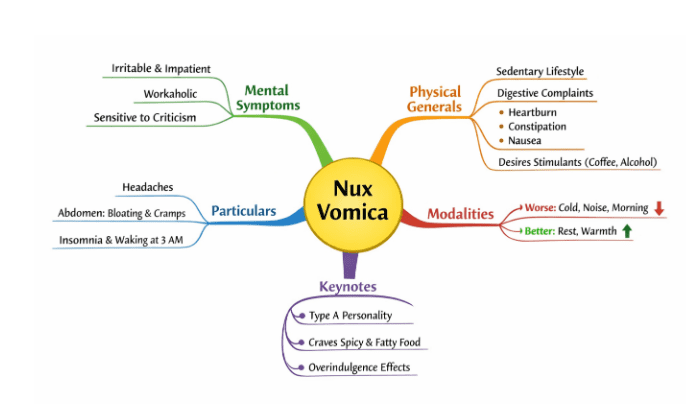
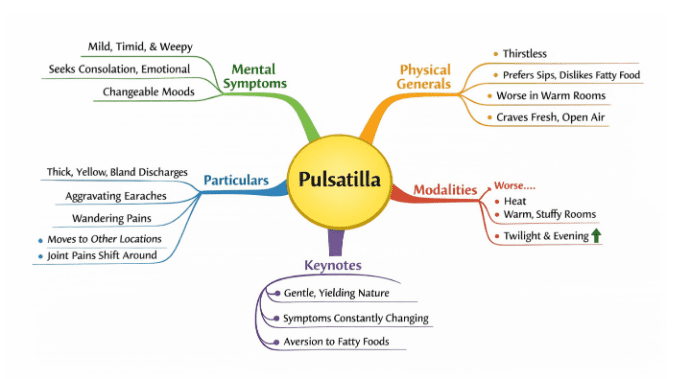
When applied to homoeopathy, the central image of the mind map will represent the remedy which we want to learn and the branches will represent different spheres of remedy e. g. mental symptoms, physical symptoms, modalities, keynotes and clinical indications. This kind of structure (mind map) will help the homoeopath to quickly visualise the remedy picture and understand its essential characteristics.
Application of Mind Mapping in Homoeopathic Materia Medica
Mind mapping can be effectively utilized in the study of homoeopathic medicines by organizing remedy information. The categories commonly include:
- Mental symptoms
- Physical generals
- Particular symptoms
- Modalities (aggravations and ameliorations)
- Keynotes
- Clinical indications
By arranging these features visually, mind maps allow the homoeopath to focus on the essence of the remedy rather than memorizing isolated symptoms.
For example, a mind map of Nux Vomica may contain branches/subbranches such as irritability, sedentary lifestyle, gastrointestinal disturbances and chilliness. Each of these feature can further branch into specific symptoms.
Similarly, in Pulsatilla we may highlight characteristics such as mild temperament, changeable symptoms, thirstlessness and amelioration in open air. Another commonly used remedy in homoeopathy Sulphur may include themes like burning sensation, standing agg, thinker personality, untidy appearance and aggravation from heat.
Such visual representations allows homoeopaths to quickly recall the distinguishing and characteristic features of remedies.
Here are some examples:
Method for Creating Mind Maps for Homeopathic Medicines
The process of creating a mind map for a homoeopathic medicine mentioned below:
- Select the remedy you want to learn
Write the name of the remedy at the centre of the diagram. - Create primary/main branches
Draw major branches representing key categories such as mental symptoms, generals, particulars, modalities, and keynotes. - Add secondary/sub branches
Expand each primary branch with relevant symptoms or characteristics. - Highlight keynotes
We can use symbols, colours, or emphasis to highlight important keynote symptoms. - Review and refine
Revise the mind map to ensure that it captures the essential remedy picture without unnecessary details.
This structured process helps condense large volumes of materia medica information into a compact and easily understandable format.
Advantages of Mind Mapping of Homoeopathic remedies
Improved memory retention: Homoeopaths can retain a much amount of symptoms for longer duration with this method.
Better understanding: Mind mapping helps in ascertaining and retaining the overall drug picture rather than some characteristic symptoms.
Quick revision: Mind maps are easy for quick revision for students before examination and viva.
Discussion/ Conclusion
The study of homoeopathic materia medica is difficult and cumbersome due to the large number of remedies and these remedies include a vast number of symptoms and overlapping symptoms between two or more remedies. Traditional way of studying materia medica through reading and memorizing again and again doesn’t provide lasting memory and Homoeopaths are often unable to recall symptoms. The difficulties in studying materia medica can be overcome by Group study, keynote approach, clinical approach, comparative study. But still homoeopaths find it difficult to recall the symptoms, in such scenarios we may get help from Mind Mapping technique which can provide a much better comprehension and lasting memory. Mind Mapping offers a modern educational approach based on cognitive learning principles.
Mind mapping can be utilised in homoeopathic colleges and institutes in teaching fresher students. Homoeopathic professors may encourage the students to create mind maps of commonly and frequently used remedies / polychrest remedies. Which may help students in better understanding and long term retention of symptoms of remedies.
References
| 1. Hahnemann S. Organon of medicine. New Delhi, India: B Jain; 2023. |
| 2. Kent JT. Lectures on homoeopathic materia medica: Together with Kent’s “new remedies” incorporated & arranged in one alphabetical order. New Delhi, India: B Jain; 2023. |
| 3. JD. Gems of homeopathic materia medica. B Jain Publishing Group, editor. New Delhi, India: B Jain; 2023. |
| 4. Buzan B, Buzan T. The mind map book. Harlow, England: BBC Active; 2003. |
| 5. Grant E. Mind map mastery: Simple tips for building better study habits. Independently Published; 2023. |
| 6. Buzan T. Mind map mastery: The complete guide to learning and using the most powerful thinking tool in the universe. London, England: Watkins Publishing; 2018. |
Authors
Dr. Zaide Khan
MD Scholar.
Dept. of Practice of Medicine
Govt. Homoeopathic Medical College & Hospital, Bhopal.
Prof. (Dr.) Rajeev Sengar
MD (Hom)
Professor & HOD
Department of Physiology
Govt. Homoeopathic Medical College & Hospital, Bhopal.