Abstract
Sciatica is a frequently encountered clinical condition characterized by radiating pain along the distribution of the sciatic nerve, commonly associated with lumbar disc pathology, nerve compression, or degenerative spinal changes. Conventional management primarily emphasizes structural diagnosis and symptomatic relief through analgesics, physiotherapy, or surgical intervention. However, recurrence and chronic progression remain common challenges. Homeopathy, based on holistic principles, approaches disease from a dynamic and constitutional standpoint. The miasmatic theory, as propounded by Dr. Samuel Hahnemann, provides a deeper understanding of chronic disease processes. This article explores Sciatica from a miasmatic perspective and attempts to correlate its varied clinical expressions with psoric, sycotic, and syphilitic miasms. Acute neuralgic manifestations may reflect psoric activity, recurrent inflammatory and proliferative tendencies may indicate sycosis, while degenerative and destructive changes often suggest syphilitic predominance. Understanding the underlying miasmatic background assists in individualization and supports long-term management through constitutional and anti-miasmatic prescribing. A miasmatic interpretation thus broadens the therapeutic scope of homeopathy in the management of Sciatica.
Key Words: Sciatica, Neurological Pain, Miasm, Psora, Sycosis, Syphilis, Nerve compression, Individualization, Homeopathy.
Introduction
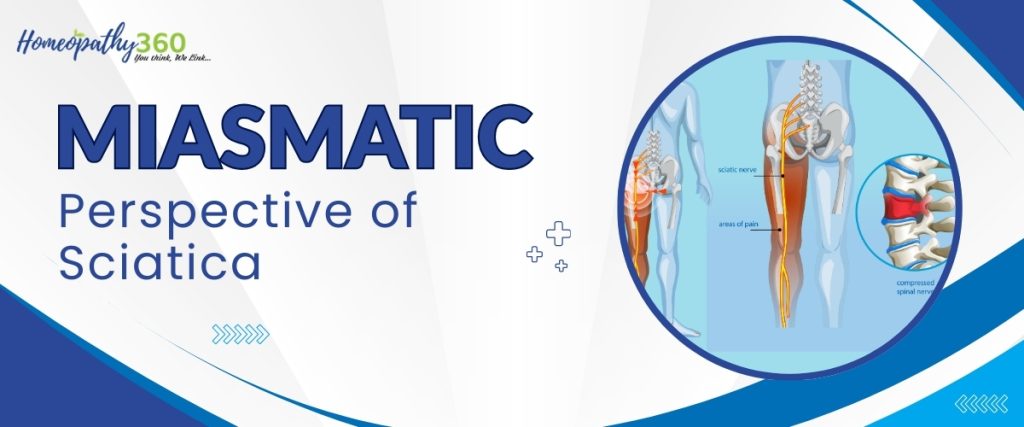
Sciatica refers to pain radiating along the course of the sciatic nerve, typically extending from the lower back to the buttock and down the posterior aspect of the lower limb. The most common causes include lumbar disc herniation, spinal stenosis, degenerative disc disease, and nerve root compression. Patients often present with pain, numbness, tingling, or weakness in the affected limb.
Conventional medical management largely focuses on structural abnormalities and symptomatic relief. While such approaches may provide temporary comfort, recurrence and chronicity are frequently observed. Structural pathology alone does not explain variations in susceptibility, recurrence, or individual response to treatment.
Homeopathy views disease as a dynamic disturbance of the vital force. Chronic diseases are understood through the doctrine of miasms. Therefore, evaluating Sciatica solely on structural grounds may be incomplete. A miasmatic understanding allows deeper interpretation of the patient’s constitutional background and chronic tendencies.
Overview of Miasmatic Theory
Dr. Samuel Hahnemann introduced the theory of chronic miasms to explain the persistence and recurrence of disease. According to classical homeopathy, three fundamental miasms underlie chronic disorders:
Psora
Represents functional disturbances, hypersensitivity, and deficiency states. It is considered the fundamental miasm underlying many acute and chronic conditions.
Sycosis
Characterized by overgrowth, infiltration, proliferation, and recurrent inflammatory tendencies.
Syphilis
Associated with destruction, degeneration, ulceration, and irreversible pathological changes.
In clinical practice, diseases often present with mixed miasmatic expressions. Understanding the dominant miasmatic influence helps in selecting appropriate constitutional and anti-miasmatic remedies.
Miasmatic Interpretation of Sciatica
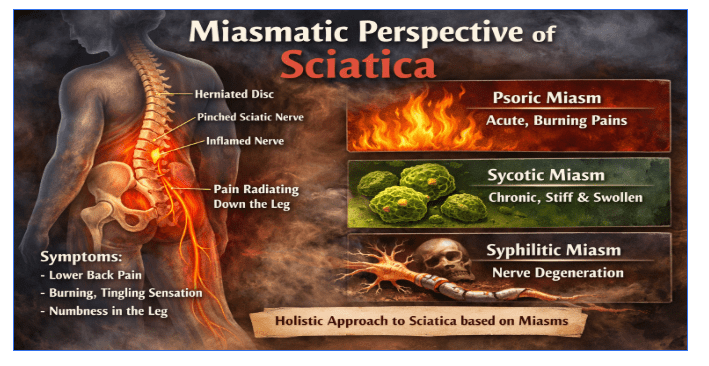
Sciatica can manifest differently in different individuals. These variations may be interpreted through miasmatic dominance.
Psoric Expression of Sciatica
In psoric predominance, Sciatica may present as:
- Neuralgic pain without marked structural damage
- Marked hypersensitivity to pain
- Aggravation from slight movement
- Functional disturbances without severe degenerative findings
- Pain may be intense but investigations show minimal pathological changes. Such cases often respond well to remedies addressing functional imbalance.
Sycotic Expression of Sciatica
Sycotic influence may be suspected in cases presenting with:
- Recurrent episodes of Sciatica
- Disc prolapse or bulging
- Thickening of ligaments or inflammatory infiltration
- Aggravation from damp weather
There may be a history of suppressed conditions or recurrent inflammatory disorders. The pathology shows proliferation or structural overgrowth. Management requires remedies covering both local symptoms and underlying sycotic tendencies.
Syphilitic Expression of Sciatica
- Syphilitic dominance may be seen in:
- Degenerative disc disease
- Severe structural destruction
- Chronic resistant cases
- Progressive neurological deficit
Pain may be intense, tearing, or associated with marked structural deterioration on imaging. There is often a tendency toward chronicity and tissue destruction. Anti-syphilitic remedies may be required in such deeply seated cases.
Clinical Implications of Miasmatic Evaluation
A purely diagnostic label such as “lumbar disc prolapse” does not provide complete therapeutic guidance in homeopathy. Two patients with identical MRI findings may require entirely different remedies based on their totality and miasmatic background.
Miasmatic assessment helps in:
- Understanding susceptibility
- Preventing recurrence
- Selecting constitutional remedies
- Managing chronic and resistant cases
- Planning long-term treatment strategy
It also explains why some patients recover quickly while others experience frequent relapses despite similar structural pathology.
Miasmatic Basis of Remedy Selection in Sciatica
In homeopathic practice, remedy selection in Sciatica should not rely solely on pathological diagnosis but must consider the underlying miasmatic background. The clinical presentation often reflects a dominant miasmatic influence, which guides constitutional and anti-miasmatic prescribing. The following classification represents a conceptual correlation between miasmatic expressions and commonly indicated remedies in Sciatica.
1. Remedies Predominantly Indicated in Psoric Expression
Psoric dominance is usually reflected in functional disturbances, hypersensitivity, and neuralgic pains without marked structural destruction.
Remedy
Characteristic Indications in Sciatica
Miasmatic Hint
Rhus toxicodendron
Stiffness, pain worse on first motion, better by continued motion
Functional rheumatic tendency
Magnesia phosphorica
Spasmodic, cramping pain, better by warmth and pressure
Neuralgic functional disturbance
Chamomilla
Intense pain with irritability and oversensitivity
Hyper-reactive state
Coffea cruda
Acute neuralgic pain with heightened sensitivity
Nervous excitability
These remedies are often useful in early or acute presentations where pathology is minimal and symptoms are predominantly functional.
2. Remedies Corresponding to Sycotic Expression
Sycotic influence is associated with recurrence, inflammatory thickening, infiltration, and structural overgrowth.
Remedy
Characteristic Indications in Sciatica
Miasmatic Hint
Thuja occidentalis
Chronic fixed complaints, recurrent episodes
Proliferative tendency
Medorrhinum
Marked recurrence, restlessness, chronicity
Deep sycotic background
Ruta graveolens
Ligamentous strain, periosteal pain
Connective tissue involvement
Natrum sulphuricum
Aggravation in damp weather, chronic lumbar complaints
Damp-related chronic tendency
Such remedies are often indicated in cases with disc bulge, ligament thickening, or recurrent inflammatory episodes.
3. Remedies Suggesting Syphilitic Expression
Syphilitic dominance is reflected in degeneration, destruction, and progressive pathology.
Remedy
Characteristic Indications in Sciatica
Miasmatic Hint
Mercurius solubilis
Inflammatory pain with destructive tendency
Tissue breakdown
Syphilinum
Chronic, obstinate neuralgia resistant to treatment
Deep destructive miasm
Aurum metallicum
Bone involvement, deep-seated pain
Structural degeneration
Kali iodatum
Severe progressive pain with destructive pathology
Advanced degenerative process
These remedies may be considered in long-standing, progressive, or structurally degenerative cases of Sciatica.
Clinical Interpretation
It is important to emphasize that no remedy is exclusively confined to a single miasm. However, understanding the predominant miasmatic expression assists in:
Deepening constitutional analysis
Explaining recurrence and chronicity
Planning long-term anti-miasmatic treatment
Preventing progression of pathology
Thus, miasmatic evaluation serves as a guiding framework rather than a rigid classification, enabling more precise and individualized prescribing in Sciatica.
Discussion
The structural model of disease explains the “what” but often fails to explain the “why.” Why does one patient develop recurrent Sciatica while another recovers permanently? Why do symptoms vary so widely despite similar radiological findings?
Homeopathy addresses these questions through its dynamic and miasmatic framework. Sciatica is not merely nerve compression; it represents the individual’s internal predisposition expressed through a particular pathological pathway.
A miasmatic perspective does not negate structural findings but interprets them as expressions of deeper constitutional imbalance. By integrating miasmatic evaluation with individual symptom totality, the homeopathic physician can prescribe more precisely.
This approach broadens the therapeutic scope beyond symptomatic palliation and aims at long-term stabilization of the patient’s health.
Conclusion
Sciatica, though commonly attributed to structural spinal pathology, presents with varied clinical expressions reflecting deeper constitutional tendencies. A miasmatic perspective provides a comprehensive understanding of its chronicity, recurrence, and progression. Evaluating psoric, sycotic, and syphilitic influences enables individualized and anti-miasmatic prescribing, thereby enhancing the scope of long-term management in homeopathic practice. Thus, miasmatic interpretation serves as a valuable tool in deepening the clinical approach to Sciatica.
References
- Hahnemann S. Organon of Medicine. 6th ed. New Delhi: B. Jain Publishers; 2002.
- Hahnemann S. The Chronic Diseases: Their Peculiar Nature and Their Homeopathic Cure. New Delhi: B. Jain Publishers; 2005.
- Kent JT. Lectures on Homoeopathic Philosophy. New Delhi: B. Jain Publishers; 2004.
- Kent JT. Lectures on Homoeopathic Materia Medica. New Delhi: B. Jain Publishers; 2002.
- Boericke W. Pocket Manual of Homoeopathic Materia Medica. New Delhi: B. Jain Publishers; 2007.
- Allen HC. Keynotes and Characteristics with Comparisons of Some of the Leading Remedies of the Materia Medica. New Delhi: B. Jain Publishers; 2005.
- Boger CM. Boericke & Boger’s Synoptic Key of the Materia Medica. New Delhi: B. Jain Publishers; 2004.
- Davidson S. Davidson’s Principles and Practice of Medicine. 23rd ed. Edinburgh: Elsevier; 2018.
- Maheshwari J. Essential Orthopaedics. 6th ed. New Delhi: Jaypee Brothers; 2019.
- Longo DL, Fauci AS, Kasper DL, et al. Harrison’s Principles of Internal Medicine. 20th ed. New York: McGraw Hill; 2018.