Abstract
Lycopodium clavatum is one of the most frequently prescribed constitutional remedies in homoeopathic practice. It represents the deep conflict between inner weakness and outer show of strength. This article explores the botanical background, doctrine of signature, historical evolution, mental constitution, psychodynamic patterns, core delusions, child picture, sexual sphere, physical generals, modalities, and clinical applications of Lycopodium. The remedy typifies individuals who compensate for inner insecurity and fear of failure by developing ambition, authoritarian behavior, intellectual pride, and a strong need for respect and power. Understanding Lycopodium constitutionally allows more accurate individualisation in chronic diseases.
Keywords
Lycopodium clavatum, constitutional remedy, self-esteem, cowardice and egotism, ambition, homoeopathic psychology
Introduction
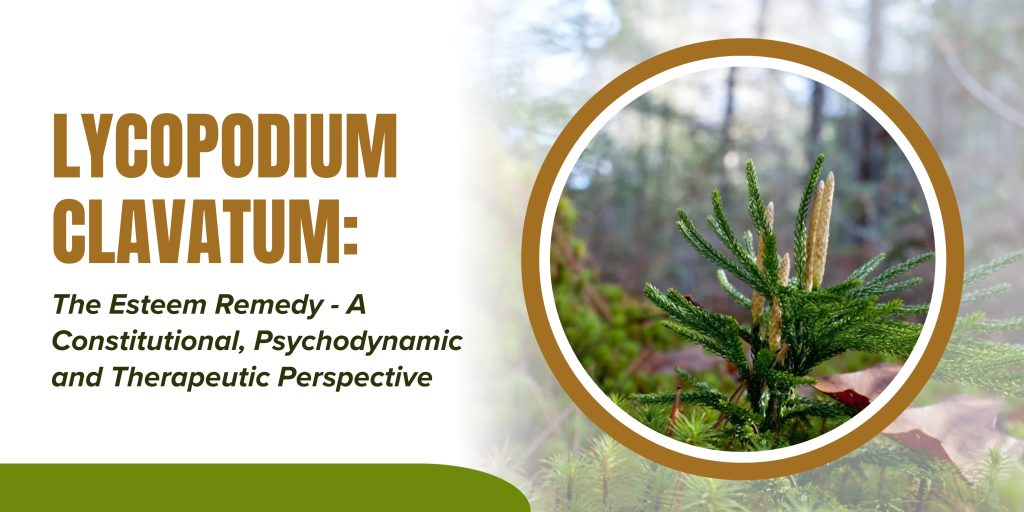
Lycopodium clavatum (Club Moss) belongs to the Plant kingdom
•Family: Lycopodiaceoe.
•Prover: Dr Hahnemann
The spores of this plant are used in the preparation of the homoeopathic medicine. Historically, Lycopodium plants were giant trees during the Carboniferous period but are now small creeping mosses. This evolutionary regression symbolically reflects the Lycopodium personality — once powerful, now struggling for survival through intellectual compensation. The spores were historically used in stage lightning and early photography because of their inflammable nature, giving Lycopodium the name ‘vegetable sulphur’. This reflects sudden flashes of brilliance and ego inflation in Lycopodium personalities.
Doctrine of Signature and Evolutionary Symbolism
The doctrine of signature of Lycopodium shows a parallel between plant evolution and human psychology. The plant once stood tall and dominant but now creeps and survives by adaptation. Similarly, Lycopodium individuals often feel small inside, fear humiliation, and strive to grow big socially and intellectually. They replace physical strength with mental strength – ‘Brains instead of Brawn’. Their survival strategy is intellectual superiority and achievement-oriented behavior.
Psychodynamic Core
The fundamental conflict of Lycopodium is self-devaluation with fear of failure. The core need is esteem and respect. The patient feels unloved unless he achieves. Early childhood domination, especially by the father or authority figures, leads to loss of self-confidence. This inner weakness gives rise to compensatory ambition and a desire for power and control. The personality oscillates between cowardice and dictatorship.
Mental and Emotional Constitution
Lycopodium presents with two opposite poles. On one hand, there is timidity, bashfulness, anticipatory anxiety, fear of undertaking new ventures, fear of public speaking, fear of failure, fear of being unable to reach goals, and fear of disease and death. On the other hand, there is authoritarian behavior, egotism, love of power, ambition, competitiveness, sensitivity to contradiction, boastfulness, dictatorial attitude toward inferiors, and flattery toward superiors. This inner-outer conflict forms the characteristic Lycopodium personality.
Delusional State
Core delusions include: being doomed; everything will vanish; being pursued or persecuted; being murdered; seeing ghosts or phantoms; hearing voices; feeling someone is present in the room; belief of having done wrong or neglected duty; delusion of impending death; delusion of being injured or poisoned. These delusions represent deep existential insecurity and fear of destruction and exposure.
Child Constitution
The Lycopodium child is well-behaved in public and at school but dominating and rude at home. The child is fearful of examinations, new situations, and new people. There is aversion to play due to physical weakness. The child dominates playmates, gives instructions, and becomes angry when contradicted. On waking, the child is irritable, kicks and scolds, and wants warm drinks. When sick, the child becomes more rude and obstinate, showing the compensatory dictatorial state.
Sexual Sphere
There is increased sexual desire with performance anxiety. The patient may seek gratification without responsibility. Fear of intimacy and responsibility leads to superficial relationships. In married life, sexual dysfunction may occur due to fear of failure. There may be impotence with strong desire in men and painful coition or vaginismus in women. Sexual weakness reflects deep insecurity.
Physical Constitution and Generals
Typical physical features include: emaciated upper body with distended abdomen; right-sided complaints progressing to left; one foot hot and the other cold; aggravation from 4–8 pm; desire for sweets and warm food and drinks; flatulence; red sand in urine in children; premature greying of hair; dryness of skin; weakness after mental exertion. The patient is intellectually keen but physically weak.
Modalities
Aggravation: 4–8 pm, anticipation, mental exertion, contradiction, humiliation, cold food, emotional stress. Amelioration: warm food and drinks, warmth, after performance begins, reassurance in a supportive environment.
Clinical Applications
Lycopodium is indicated in chronic liver disorders, hepatic dysfunction, right-sided pneumonia, digestive disorders with flatulence and bloating, inguinal hernia, impotence, chronic debility, hypochondriasis, anxiety-related gastrointestinal complaints, and psychosomatic disorders arising from anticipation, fear of failure, wounded honour, and prolonged mental exertion.
Therapeutic Significance
Lycopodium patients fall ill when their esteem needs are threatened. Ailments arise from wounded honour, mortification, contradiction, humiliation, long-standing domination, fear of failure, and mental overwork. Constitutional prescription restores self-esteem, reduces anticipatory anxiety, and harmonises the inner conflict between weakness and ambition.
Conclusion
Lycopodium clavatum represents the eternal struggle between cowardice and egotism, timidity and dictatorship, inner weakness and outer pride. The homoeopathic physician must perceive the vulnerable inner child behind the arrogant exterior. When prescribed constitutionally, Lycopodium acts deeply on the mental, emotional, and physical planes, restoring balance, confidence, and inner security.