Individualized Homeopathic Management Of Primary Dysmenorrhea With Carcinosin: A Case Report
Abstract
Primary dysmenorrhoea is a common condition affecting young females, often leading to significant discomfort and reduced quality of life. Homoeopathy emphasised individualised treatment based on the totality of symptoms. A 26-year-old female has presented with severe spasmodic pain in the lower abdomen during menses for a long time. Based on the individualised totality of symptoms, Carcinosin 200CH was prescribed, and marked improvement was seen in the next menstrual cycle.
Keywords
Primary dysmenorrhoea, individualised, totality of symptoms, Carcinosin.
Introduction
Dysmenorrhoea is the medical term for painful periods or menstrual cramps[1]. There are two types of dysmenorrhoea: primary and secondary. Primary dysmenorrhoea is a common gynaecological condition characterised by painful menstruation in the absence of pelvic pathology. It predominantly affects adolescent and young adult females, significantly impacting their quality of life, daily activities and academic performances.
Diagnostic criteria for primary dysmenorrhoea: pain starting a few hours before or at time of bleeding, pain stopping before or with conclusion of bleeding, midline pain that can radiate to back or thighs. Gastrointestinal symptoms: nausea, vomiting, diarrhoea. Neurological symptoms: headache, dizziness, muscle cramps[2].
Treatment of dysmenorrhoea is aimed at providing symptomatic relief. Medications used may include NSAIDs (non-steroidal anti-inflammatory drugs) and opioid analgesics, as well as hormonal contraceptives. Homeopathy offers a holistic and individualised approach to treatment, focusing on the totality of symptoms, including mental, emotional and physical aspects of the patient. Individualisation remains the cornerstone of homeopathic prescribing, aiming to address the root cause rather than merely alleviating symptoms. This case report aims to demonstrate the effectiveness of individualised homeopathic treatment in the management of primary dysmenorrhoea.
Assessment tools: Pain scales like the Visual Analogue Scale (VAS) and the Numerical Rating Scale (NRS).
According to The Third Eye of Prescription [3]: dysmenorrhoea is disliking menstruation and not accepting menses.
Case history
Chief complaints
A 26-year-old unmarried female presented to the clinic on 17/8/2025 with complaints of severe spasmodic pain in the lower abdomen during menses. The pain was predominantly experienced on the first day of menstruation and was intense enough to interfere with her daily activities. Pain was associated with nausea, anorexia, headache and marked mental irritability.
Despite the severity of pain, the patient reported that she did not take any analgesics and preferred to tolerate the discomfort. She is employed and continues her professional duties even during episodes of severe pain.
There was no significant past history of any pelvic pathology, and her menstrual cycles were otherwise regular.
Physical generals
Appetite: the patient had a normal appetite on regular days; however, during menstruation, she experienced a sensation of hunger but was unable to eat due to associated nausea.
Thirst: Adequate, with an intake of approximately 3 litres of water per day.
Desires/aversion: marked desire for ice cream.
Urine: not significant
Stool: regular with satisfactory stool.
Sleep: sound and refreshing
Thermal reaction: chilly patient
Menstrual history: regular cycle with normal flow lasting for 3-4 days, though associated with severe spasmodic pain on the first day. Mild leucorrhea two days before menstruation. Menarche at the age of 14 years.
LMP: 1/8/2025
Past History: no major illnesses in the past
Family History: Father (type 1 diabetes)
Mental and emotional background
The patient is a single child with a significant history of grief and responsibility. Her father passed away 8 years ago, followed by the death of her grandfather 4-5 years ago during a crucial phase of her MBA studies. Despite these challenges, she successfully completed study and secured a job. Currently, she is the sole earning member of the family and bears the responsibility of caring for her mother and grandmother.
She is highly responsible and deeply attached to her family. She experiences a strong sense of duty. After her grandfather’s death, she developed concerns about her ability to manage all responsibilities single-handedly, leading to internal stress and overthinking. But as time passes, she manages that all very well.
By nature, she is helpful and empathetic. In her workplace (banking sector), she interacts with people throughout the day and readily assists others, driving satisfaction from helping others. Emotionally, she is very sensitive, particularly to distressing situations such as cruelty and accidents. She has a strong inclination towards nature and feels calm in places which are surrounded by greenery. Her interests include travelling, especially to natural places, as well as reading, artwork and drawing, reflecting a creative personality.
Diagnosis of disease: Primary dysmenorrhoea
Analysis of case
1. Mental Generals
· Ailments from grief (death of father and grandfather)
· High sense of responsibility; duty bound (sole earning member)
· Caring and helpful nature; enjoys helping others
· Sensitive to cruelty, accidents and emotional situations
· Love for nature, desire for greenery
· Creative inclination: reading, artwork, drawing
2. Physical Generals
· Thirsty
· Chilly patient
· Appetite normal otherwise but cannot eat during menses due to nausea.
· Sleep sound and refreshing
3. Particular Symptoms
· Severe spasmodic pain in the lower abdomen during menses
· Pain on the first day of menses associated with – nausea, anorexia, headache, irritability
Totality of Symptoms
· Ailments from grief
· Taking too much responsibility
· Sensitive, duty-bound and helpful personality
· Desire for ice cream
· Nausea before menses
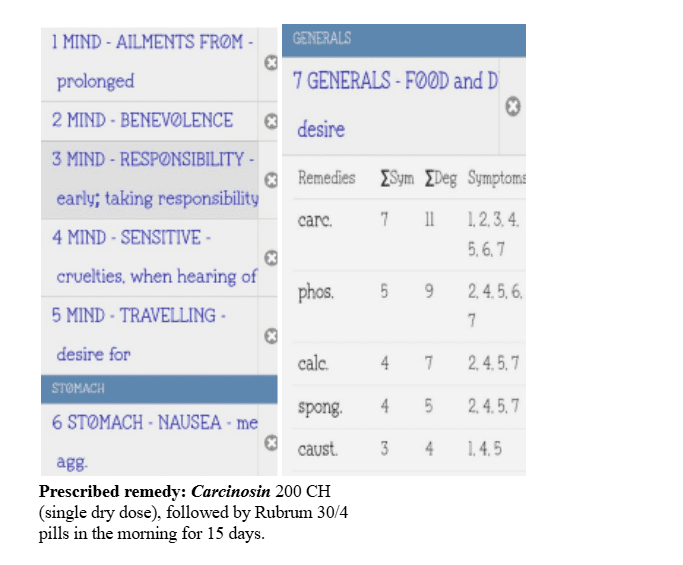
Repertorial Totality
Mind: Ailments from grief – prolonged Mind: Benevolence
Mind: Responsibility early; taking responsibility too
Mind: Sensitive; cruelties
Mind: Travelling – desire for
Stomach: Nausea menses during – beginning of menses, agg
Generals: Food and drinks, ice cream – desire
Repertorial sheet
By using synthesis repertory
Follow-up table
| Date | Clinical findings | Prescription |
| 4/9/2025 | LMP: 1/9/2025 • Marked improvement in spasmodic lower abdominal pain; nausea reduced significantly. • Mental irritability is also reduced during menses. • Appetite improved. | Rubrum 30/TDS for a month. |
| 5/10/2025 | LMP: 30/9/2025 • No complaints during menstruation; complete relief in pain and associated symptoms. | Rubrum 30/BD for a month. |
| 7/11/2025 | LMP: 2/11/2025 • This time she only felt nauseated on 1st day. • Otherwise no complain. | Carcinosin 200CH single dose followed by Rubrum 30/OD for a month. |
Result
Marked improvement in the case of primary dysmenorrhoea within the very first cycle after starting medicines. And in subsequent follow-ups, pain and associated symptoms disappear and become almost nil. Sleep and other general symptoms also improved.
Remedy discussion [4]
Carcinosinum is prepared from cancerous breast tissue.
Strong family history of cancer, tuberculosis, diabetes, pernicious anaemia or when there is severe whooping cough or pneumonia in early life.
It represents the very centre of the cancer miasm (which falls between the miasms sycosis and syphilis). The main feeling of the cancer miasm is that one’s survival depends upon performing tasks, which one feels incapable of performing. There is need to be something that is almost beyond one’s capacity.
Carcinosin people often have a history of taking on too much at a young age, having too many expectations placed on them, and too strict parental control. In the patient whose life has been one long hard struggle, or where there is a background of prolonged fear and/or unhappiness, as if all the grief and suffering of the world were piled upon and concentrated in this one individual.
Carcinosin’s high degree of commitment and seriousness leads to an easy assumption of guilt.
Set high standards or goals that are nearly impossible to achieve. The disease cancer itself represents a breakdown of all control mechanisms within the body, with chaotic behaviour of the cells.
Conclusion
This case highlights the effectiveness of individualised homeopathic treatment in the management of primary dysmenorrhoea. A detailed case-taking emphasising mental and physical generals, along with the totality of symptoms, led to the selection of an appropriate constitutional remedy, Carcinosin.
Reference1. Dysmenorrhea. Cleveland Clinic. Available from: https://my.clevelandclinic.org/health/ diseases/4148-dysmenorrhea�
Accessed 2026 May 12.
2. Diagnosis and management of primary dysmenorrhea. Contemporary OB/GYN. Available from: Contemporary OB/GYN article� Accessed 2026 May 12
3. Mahajan MS. The Third Eye of Prescription. Part 1. New Delhi: B. Jain Publishers
4. Catherine R. Coulter. Portraits of Homoeopathic Medicines. Vol. 2, Psychophysical analyses of selected constitutional types. 3rd ed. Pondicherry: French Institute of Pondicherry; 2002.