Immunomodulatory Effects of Bowel Nosode Dysenteric Compound in the Management of Allergic Rhinitis: A Case Study.
Abstract – According to the World Health Organisation and the World Allergy Association, allergic disorders affect approximately 4 billion people worldwide by 2050 (1). Allergic rhinitis is a heterogeneous condition defined by the presence of sneezing, nasal congestion, pruritus, and rhinorrhoea(2) The critical symbiosis established between the developing gut microbiome and the maturing immune system during early life plays a pivotal role in metabolism and pathogen protection, with any disruption during the neonatal period significantly increasing long-term susceptibility to infections, food allergies, asthma, and autism(3). Bowel nosodes are medicines prepared by attenuating the cultures of non-lactose-fermenting bacilli of intestinal flora(4). Dysenteriae Co. consists of Bacillus dysenteriae or Shigella dysenteriae, a Gram-negative, non-motile bacterium from the Enterobacteriaceae family(5).
This case study shows the action of Bowel nosode Dysenteriae co on immunomarkers –immunoglobulin E (IgE) and Absolute Eosinophilic Count (AEC) in an Allergic rhinitis case, followed by Constitutional medicine.
Key words:- Bowel nosode, Dysenteriae compound, Allergic rhinitis, Immunomarkers.
Introduction
The most important allergens in allergic rhinitis come as airborne particles that are proteins in nature. Asthma and conjunctivitis may be associated with allergic rhinitis (6). In case of seasonal allergic rhinitis, pollens or moulds are the outdoor allergens. Indoor allergens for perennial allergic rhinitis include house dust mites, cockroaches, and animal dander. The majority of patients experience multiple sensitivities and symptoms that persist year-round. Allergens that are seasonal in one region or country may be perennial in another, and vice versa (7)
Long-term physical effects result in allergic face, which include visible signs like “allergic shiners” – dark circles and puffiness under the eyes due to blood vessel changes, and the “allergic salute” – a nasal crease from repeated nose rubbing, as well as a reduced sense of smell (8).
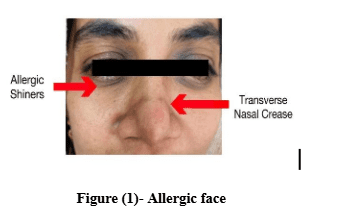
The gut microbiome is a dynamic ecosystem influenced by lifestyle and environmental factors, where an imbalance—or dysbiosis—can weaken immune regulation and increase susceptibility to age-related and inflammatory disorders. Emerging research specifically links this intestinal dysbiosis to allergic rhinitis, suggesting that the disruption of microbial metabolites impairs immune homeostasis and fuels the systemic inflammation characteristic of respiratory diseases(9).
The gut-lung axis represents a critical bidirectional communication pathway where intestinal microbiota directly influence the pulmonary immune environment and the progression of respiratory diseases(10). In patients with allergic rhinitis, dysbiosis—specifically a reduction in beneficial bacteria like Bacteroidetes and Proteobacteria—correlates with elevated IgE levels, suggesting that restoring microbial balance through interventions like probiotics or faecal transplants can modulate systemic immune responses and improve clinical outcomes(11-12).
Bowel nosodes are specialised Homoeopathic preparations derived from the potentisation of cultures containing non-lactose fermenting bacilli found within the intestinal flora. In the early 20th century, British bacteriologist Edward Bach identified a correlation between non-lactose fermenting, gram-negative intestinal bacteria and the persistence of chronic illness, a discovery that led to the creation of the “bowel nosodes”—Homoeopathic preparations that practitioners have since found to be remarkably effective in addressing long-term systemic conditions. (4).
In this case study of chronic allergic rhinitis, the administration of the bowel nosode Dysenteriae compound 12C resulted in significant clinical improvement. Beyond providing symptomatic relief, the treatment produced remarkable reductions in key immunological markers, specifically Serum Immunoglobulin E (IgE) and the Absolute Eosinophil Count (AEC). The constitutional approach is needed to overcome, when the symptoms become stagnant.
Case study
Name – JJJ
Age – 11years
Gender – Male
Address- TVPM
DOE – 13-02-2023
Presenting complaints
Sneezing – continuous, 10-12 times, soon after awakening, after bathing, if exposed to dust. Watering of the nose and eyes is associated. Itching of the throat, nose, and eyes starts before sneezing. Blockage of both nostrils after sneezing. Aggravation of symptoms for 10 days.
History of presenting complaints
He had repeated attacks of sneezing for the last one and a half years. Now suffers from severe nasal obstruction after sneezing.
History of previous illness
History of Pneumonia three years back
Treatment History
Took allopathic treatment for Pneumonia, now under Homoeo medicines for allergic symptoms.
Family History
Father- nothing particular
Mother- had childhood asthma
Sister- has allergic rhinitis
Personal History
Place of birth – TVPM
Milestone development -normal
Education – 5th std
Immunisation status – good
Physical generals
Appetite – good, prefers cold, sweets
Thirst – increased, prefers cold water
Bowels – regular
Sweat – more on head
Sleep – normal
Psychic features
Fear of darkness
Physical examination
Nose – congested, turbinate swollen
Eyes – red, congested, watering
Respiratory system – NAD
Investigations
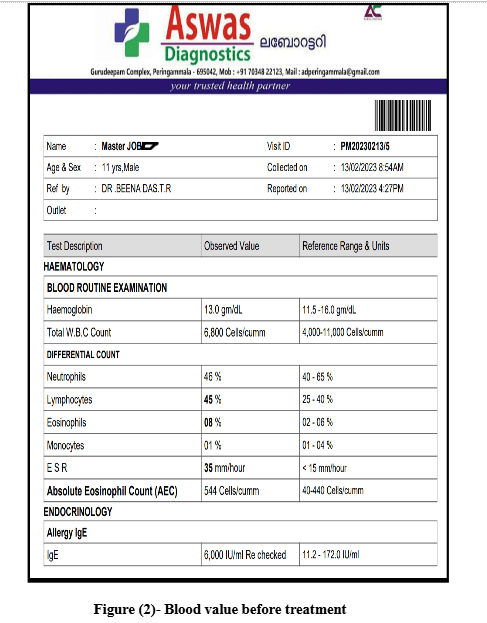
13/02/2023
IgE – 6000IU/ml (Re-checked)
AEC – 544 cells/cumm
Medicines Given
| Dates | Observation | Medicines Given |
| 13/2/23 | Sneezing,<-morning, Eyes- redness,lachrymation, Itching of nose, obstruction | Dysenteriae co 12C/2d (4-0-4)Sac Lac – 2d (1-0-1) |
| 14/2/23 | Sneezing persists, lachrymation present, nose feels blocked, itching present | Dysenteriae co 12C/2d (4-0-4)Sac Lac – 2d (1-0-1) |
| 15/2/23 | Slight relief for sneezing, itching and lachrymation persists. Nose feels blocked | Dysenteriae co 12C/2d (4-0-4)Sac Lac – 2d (1-0-1) |
| 10/3/23 to 13/3/23 | Symptoms < after taking ice creams | Dysenteriae co 12C/2d (4-0-4)Sac Lac – 2d (1-0-1) |
| 26/4/23 to 29/4/23 | Sneezing and coryza +++Severe nasal block+++ | Dysenteriae co 12C/2dhttps://www.homeopathy360.com/psychodynamic-perspective-of-sigmund-freud/ (4-0-4) |
| 17/7/23 | Mild sneezing, lachrymation,Itching of throat | Dysenteriae co 12C/2d (4-0-4)Sac Lac – 2d (1-0-1) |
| 18/7/23 | Sneezing, throat itching | Dysenteriae co 12C/2d (4-0-4)Sac Lac – 2d (1-0-1) |
| 10/8/23 | Sneezing on waking with lachrymation | Dysenteriae co 12C/2d (4-0-4)Sac Lac – 2d (1-0-1) |
| 02/09/2023 | Sneezing+++, nasal obstruction+++,Hoarseness, pain in ears, coryza | Cal.carb 200/ 2d(1-0-1)BT /3d(1-1-1) |
| 16/9/2023 | Sneezing >, No ear pain, mild nasal blockage at night | Sac lac 2d (1-0-1)BT 3d (1-1-1) |
| 25/03/2024 | Symptoms of allergic rhinitis as had exposure to dust | Cal. Carb 1M /1d (1-0-0)BT 3d(1-1-1) |
| 4/10/2024 | Occasional sneezing in the morning. Gen> | Cal. Carb 1M /1d (1-0-0)BT 3d(1-1-1) |
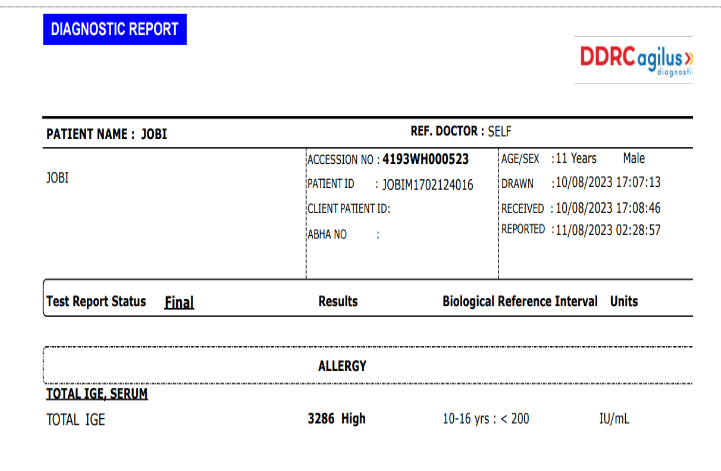
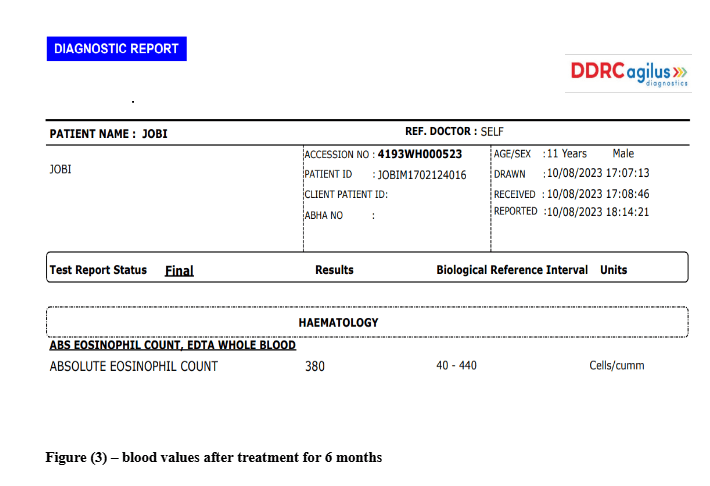
Blood test after 6 months (10/08/2023)
IgE – 3286 IU/ml
AEC – 380 cells/cumm
Totality of symptoms
Fear of darkness
Prefers sweets
Prefers cold water
Increased sweat on head
Sneezing , < dust, morming
Eyes – itching with redness and lachrymation
Obstruction of nose
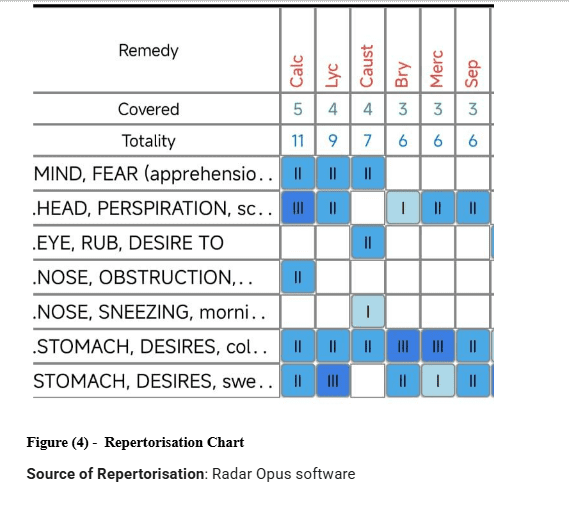
Rubric taken
Mind, fear , dark of
Stomach, desire, sweets
Stomach, desires, cold drinks
Head, perspiration, scalp sleep during
Nose, sneezing, morning, rising after
Eye, lachrymation, coryza during
Eyes, rub, desire to
Nose, obstruction, morning on waking
Repertorisation Result
1. Cal.carb -5/11
2.Lyco – 4/9
3.Caust – 4/7
4. Bry – 3/6
5. Mer.sol – 3/6
6. Sepia – 3/6
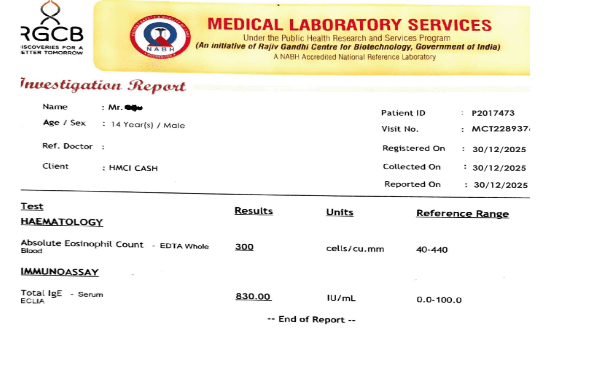
Blood report after administration of the constitutional medicine
IgE -830 IU/mL
AEC – 300cell/cu.mm
Discussion.
In Aphorism 72, Hahnemann discusses the acute and Chronic diseases, and in Aphorism 5, points out exciting causes in acute diseases and the fundamental cause, which is due to the chronic miasms. Allergic Rhinitis is a chronic disease due to chronic miasm and has multiple exacerbations. In Aphorism 7, Hahnemann insists on removing the exciting or maintaining cause of the disease. Similarly, in Aphorism 78, Hahnemann clearly discusses the need to treat by the employment of remedies that are specific to them(13).
Even though the Bowel nosode is producing symptomatic relief and changes in immune markers, the symptoms of allergic rhinitis are reappearing. This is due to the tendency of chronic disease, which is due to the underlying chronic miasm, Psora. Hahnemann had given the series of Antipsoric remedies as “Sulphur-Cal.carb-Lycopodium”. Here, the Repertorised result shows Calcarea carb, which had given relief.
Acute diseases manifest with prominent, rapidly evolving symptoms that demand immediate attention. Chronic illness requires a detailed search into the patient’s past and present to capture a complete clinical picture that is often difficult to ascertain.
CONCLUSION.
This case study demonstrates that the Bowel Nosode Dysenteriae compound 12C is an effective immunomodulatory agent in the management of chronic allergic rhinitis. The reduction in objective markers, specifically Serum IgE and Absolute Eosinophil Count (AEC), alongside subjective symptomatic relief, validates its action in Allergic rhinitis. But to prevent the relapses, an individualised constitutional remedy is needed. In certain cases anti-miasmatic or intercurrent remedy is also needed.
Informed Consent: Written informed consent was obtained from the patient before conducting the study.
Conflict of Interest & Additional Information: This article is a single case from a three-arm study conducted as part of my PhD research work. The study has been granted permission by the Institutional Ethical Committee and is registered with the CTRI. I confirm there are no conflicts of interest to declare.
References:-
1. Manda S. Literature Review: Rising Allergy Rates Caused by Gut Dysbiosis. University of Toronto’s Journal of Scientific Innovation. 2023 Dec 11;33–51.
2. Skoner DP. Allergic rhinitis: Definition, epidemiology, pathophysiology, detection, and diagnosis. Journal of Allergy and Clinical Immunology. 2001 Jul 1;108(1, Supplement):S2–8.
3. Sanidad KZ, Zeng MY. Neonatal gut microbiome and immunity. Current Opinion in Microbiology. 2020 Aug 1;56:30–7.
4. Cummings S. History and development of the bowel nosodes. Br Homeopath J. 1988 Apr;77(02):72–7.
5. Combrink-Potter D. A MATERIA MEDICA COMPARISON OF BOWEL NOSODES AND RELATED HOMOEOPATHIC REMEDIES.
6. Liva GA, Karatzanis AD, Prokopakis EP. Review of Rhinitis: Classification, Types, Pathophysiology. Journal of Clinical Medicine. 2021 Jan;10(14):3183.
7. Demoly P, Allaert F ‐A., Lecasble M, Bousquet J, PRAGMA. Validation of the classification of ARIA (allergic rhinitis and its impact on asthma). Allergy. 2003 Jul;58(7):672–5.
8. Ziering RW. Immediate and late side effects of hay fever: Physical and psychosocial problems. Postgraduate Medicine. 1989 May;85(6):183–90
9. Liu HL, Chen HF, Wu YD, Yan YJ, He XC, Li ZZ, et al. Xiaoqinglong decoction mitigates nasal inflammation and modulates gut microbiota in allergic rhinitis mice. Front Microbiol [Internet]. 2024 May 15 [cited 2024 Dec 22];15. Available from: https://www.frontiersin.org/journals/microbiology/articles/10.3389/fmicb.2024.1290985/full
10. Zhang M, Qin Z, Huang C, Liang B, Zhang X, Sun W. The gut microbiota modulates airway inflammation in allergic asthma through the gut-lung axis related immune modulation: A review. Biomolecules and Biomedicine [Internet]. 2024 Oct 26 [cited 2024 Dec 22]; Available from: https://www.bjbms.org/ojs/index.php/bjbms/article/view/11280
11. Zhu L, Xu F, Wan W, Yu B, Tang L, Yang Y, et al. Gut microbial characteristics of adult patients with allergy rhinitis. Microb Cell Fact. 2020 Sep 1;19(1):171.
12. Huang J, Zhang J, Wang X, Jin Z, Zhang P, Su H, et al. Effect of Probiotics on Respiratory Tract Allergic Disease and Gut Microbiota. Front Nutr [Internet]. 2022 Feb 22 [cited 2024 Dec 22];9. Available from: https://www.frontiersin.org/journals/nutrition/articles/10.3389/fnut.2022.821900/full
13. Samuel Hahnemann, Organon of Medicine (fifth & sixth edition) , M. Bhattacharyya & Co.(P) LTD, eight Indian Edition.
Authors:-
Dr. Mansoor Ali KR, Professor & HOD, Dept. of Repertory, Govt. Homoeopathic Medical College, Kozhikode
Dr. Beena Das TR, Professor (CAP), Dept. of Materia Medica, Govt. Homoeopathic Medical College, Thiruvananthapuram.
Dr. Aghosh B Prasad, Junior Resident, White Memorial Homoeopathic Medical College, Attoor.
Dr Arya B Prasad, 2nd MD Scholar, Dept. of Psychiatry, National Homoeopathy Research Institute in Mental Health, Kottayam.