
Abstract –
Homoeopathy offers a valuable result in cases of female infertility. Here this case report of OPD case of State KGK homoeopathic medical college & hospital, Moradabad, UP; showing a female patient, aged 25 yrs married for 6 years had complain of uterine fibroid with history of 2 miscarriages, was successfully treated for infertility and even after conceiving, the patient has trusted the homoeopathic treatment during the pregnancy till the birth of her healthy baby as a part of the antenatal care. This shows that with homoeopathy, a treatment of infertility as well as the antenatal care is possible if proper, well indicated remedy given on the basis of symptom similarity. Thus, homoeopathy can definitely help female to go through the beautiful phase of pregnancy.
Keywords –
Infertility, Miscarriage, Uterine Fibroid, Antenatal Care, Homoeopathy
Introduction
Infertility: “According to the World Health Organization (WHO), infertility is a condition characterized by the inability to achieve pregnancy after 12 months or more of regular, unprotected sexual intercourse.” 9
According to the WHO (2024), “one in six individuals experiences infertility globally.”
Infertility can be primary or secondary:
- Primary infertility denotes those patients who have never conceived.
- Secondary infertility indicates previous pregnancy but failure to conceive subsequently
Hiralal Konar and DC Dutta (2013) in the textbook of Gynaecology extensively outline the Causes of infertility,
Causes of female infertility are as follows:
- Ovarian factors: The ovulatory dysfunctions
- Anovulation or oligo-ovulation Decreased ovarian reserve
- Luteal phase defect (LPD)
- Luteinized unruptured follicle (LUF).
- Tubal (obstruction of the tubes)
- Uterine factors: uterine hypoplasia, inadequate secretory endometrium, fibroid uterus, endometritis (tubercular in particular), uterine synechiae or congenital malformation of uterus.
- Cervical factors:
- Anatomic: congenital elongation of the cervix, second degree uterine prolapse and acute retroverted uterus.
- Physiologic: fault in the composition of the cervical mucus, so much that the spermatozoa fail to penetrate the mucus. Scanty mucus following amputation, conization or deep cauterization of the cervix. The abnormal constituents include excessive, viscous or purulent discharge as in chronic cervicitis. Presence of antisperm or sperm immobilizing antibodies (immunological factor)
- Vaginal factors:
- Atresia of vagina (partial or complete), transverse vaginal septum, septate vagina, or narrow introitus
- Vaginitis and purulent discharge (pregnancy too often occurs in presence of vaginitis, specific, or nonspecific)
- Dyspareunia
- General factors:
- Advanced age of the wife beyond 35 years
- Infrequent intercourse, lack of knowledge of coital technique and timing of coitus to utilize the fertile period
- Anxiety and apprehension.
- Use of lubricants during intercourse, which may be spermicidal.
Antenatal Care
Definition: “Systematic supervision of a woman during pregnancy called antenatal (prenatal care)”.
Objective: To ensure a normal pregnancy with delivery of a healthy baby from a healthy mother.
Criteria of a normal pregnancy are: Delivery of a single baby in good condition at term (between 38 and 42 weeks), with foetal weight of 2.5. kg or more and with no maternal complication.
Minor ailments in pregnancy:
- Nausea and vomiting (morning sickness)
- Backache
- Constipation
- Leg cramps
- Acidity and heartburn
- Varicose veins
- Hemorrhoids
- Carpal tannel syndrome (10%)
- Round ligament pain
- Ptylism
- Syncope
- Ankle edema
- Vaginal discharge
Case Report-
NAME OF THE PATIENT- Mrs. xyz
AGE-25 Years
SEX- Female
MARITAL STATUS- Married for 6 years
Date of first visit – 27th Feb 2024
Present Complaints-
C/O- Pain in lower extremities, as if broken since long
Pain in upper back, between scapula since long
Recurrent Cramping pain in lower abdomen with involuntary stool since last 1 year
Married for 6 years but not able to carry a full-term healthy pregnancy (h/o- 2 miscarriage at 2 months and 3 weeks of pregnancy)
Menstrual History– LMP- 5/2/24, irregular menses, Heavy bleeding, lasting for 6 days
Obstetric History– G2P0A2, Married for 6 years and she has no child.
Past History– 2 Miscarriages
Family History– She has 5 brothers and 2 sisters and her parents. All are keeping good health.
Personal History–
- APPETITE-Decreased
- THIRST- Thirsty
- BOWELS- Irregular
- DESIRE- Spicy food, oily food, Non- veg
- AVERSION- Banana
- SLEEP- Alert sleep
- THERMALS- Hot patient
- MENTALS – Answers abruptly, feels prostrated in morning, dullness whenever she is alone at home, very anxious because she is not able to conceive
General Physical Examination-
- APPEARANCE OF THE PATIENT- Dull complexion, Dark colour appearance, lean, Dark hair
- WEIGHT- 41kg
- TEMPERATURE- afebrile
- PULSE RATE- 74 beats/min
- RESPIRATORY RATE- 20 breaths/min
- BP- 124/82 mmHg
Gynaecological Examination-
P/S= Not Significant
P/V= Not Significant
Investigations – RBS- 228 mg/dl
Case Processing:
Symptom totality:
- Pain in lower extremities, as if broken since long
- Pain in upper back, between scapula since long
- Recurrent Cramping pain in lower abdomen with involuntary stool since last 1 year
- Irregular menses, Heavy bleeding, lasting for 6 days
- Decreased appetite
- Thirsty
- Irregular bowels
- Desire for Spicy food, oily food, Non- veg
- Banana to banana
- Hot patient
- Answers abruptly
- Feels prostrated in morning
- Dullness whenever she is alone at home,
- very anxious because she is not able to conceive
Diagnosis of disease (Nosological) : Secondary infertility + menorrhagia
Diagnosis of disease according to Homoeopathy: Chronic Fully developed miasmatic disease
Miasmatic diagnosis: Psora+ Syphilis
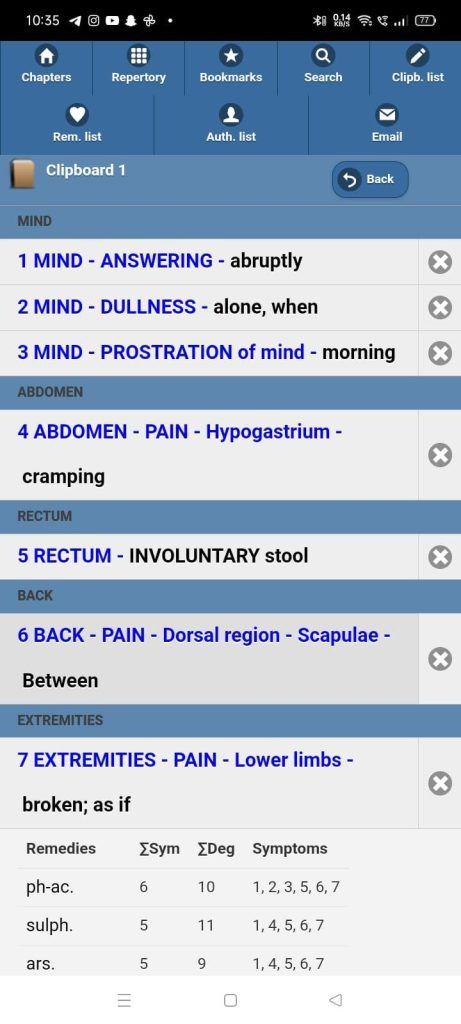
Totality of symptoms:
- Answers abruptly
- Feels prostrated in morning
- Dullness whenever she is alone at home,
- very anxious because she is not able to conceive
- Irregular menses, Heavy bleeding, lasting for 6 days
- Decreased appetite
- Thirsty
- Irregular bowels
- Desire for Spicy food, oily food, Non- veg
- Banana to banana
- Hot patient
- Pain in lower extremities, as if broken
- Pain in upper back, between scapula
- Recurrent Cramping pain in lower abdomen with involuntary stool
Selection of medicine by repertorial approach:
Prescription:
Rx – Phosphoricum Acidum 200 BD X 3days
Sac lac 200 BD x 7days
FOLLOW UP –
| Sr.no. | Date | Follow up | Prescription |
| 1 | 5/03/24 | Patient got better in pain in the back | Phosphoricum acidum 200 OD x 7days |
| 2 | 12/03/24 | Patient got pregnant UPT Positive | Sulphur 1M (Stat dose)Sac lac 200 BD x7days |
| 3 | 19/03/24 | First ANC- Pain in lower abdomenRBS- 228 mg/dl | Colocynthis 200 BD Magnesium phosphoricum 200 TDS |
| 4 | 02/04/24 | In First Trimester Morning Sickness (Nausea and Vomiting)FBS- 150 mg/dl, PP2BS- 221 mg/dl | Ipecacuanha 200 BD |
| 5 | 29/05/24 | Pain in lower abdomen and frequent urination and nausea. | Phosphoricum acidum 200 OD x15 daysFerrum phosphoricum 200 BD weekly (As to prevent Iron deficiency in both mothers and foetus. |
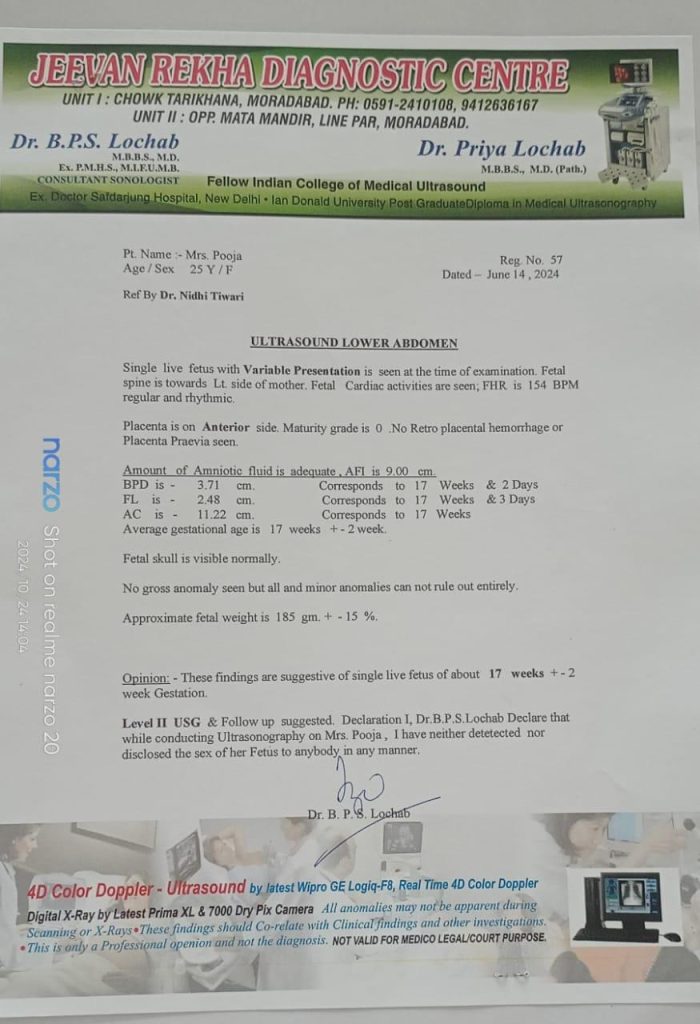
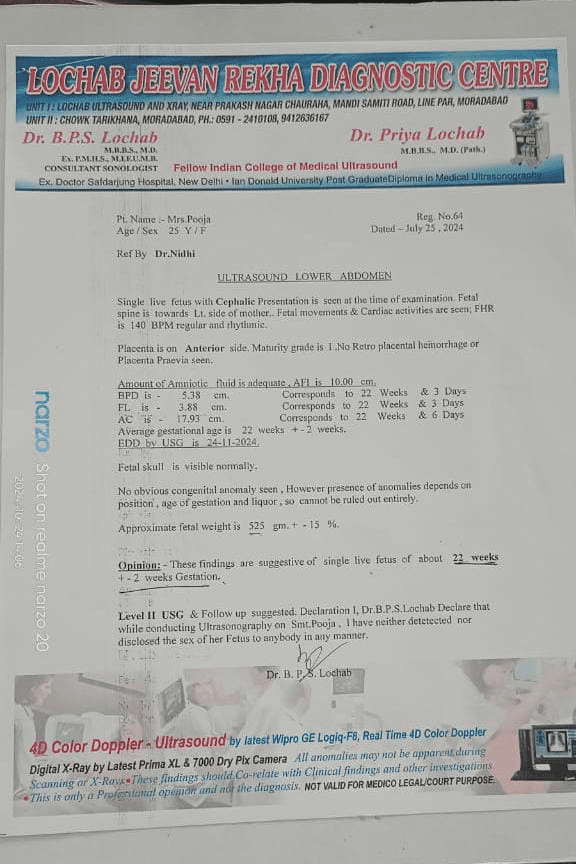
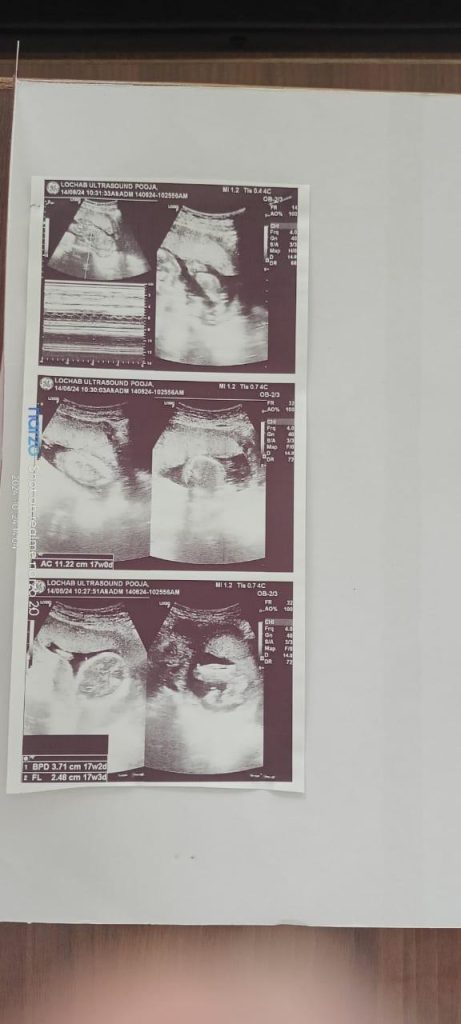
| 6 | 06/08/24 | Pain in lower back Desire sour things USG LOWER ABDOMEN-14/6/2024Findings are suggestive of single live fetus of about 17 weeks +- 2 weeks of gestation USG LOWER ABDOMEN-25/7/2024Findings are suggestive of single live fetus of about 22 weeks +- 2 weeks of gestation | Medorrhinum 1M (Stat dose)Kali phos 30 HS |
| 7 | 16/10/24 | Aching pain in back and bones of extremities weaknessconstipation USG LOWER ABDOMEN-15/10/2024Findings are suggestive of single live fetus of about 32 weeks +- 2 weeks of gestation | Eupatorium perfoliatum 200 BD x3days |
| 8 | 23/10/24 | loose motions | Aloe socotrina 200 every hour x 4 drops |
| 9 | 2/1/2025 | Delivered a healthy baby on 23/11/2024 | Advice to follow up if required. |
Conclusion
This case report shows that, an Integration of constitutional medicine and acute management offers a well rounded solution to treating infertility by combining long term, root cause focused therapies with targeted, symptom specific interventions. This dual approach leverages the strength of holistic medicine , which seeks to balance the body and mind and acute management which addresses immediate challenges that may arise during treatment. Patient benefit from personalised care plans that not only aim to improve fertility outcomes but also promote comprehensive antenatal care for well being of pregnant mother and foetus both.
Bibliography
- Konar, H., & Dutta, D.C. (2013). Textbook of Gynaecology (6th ed.). New Central Book Agency.
- World Health Organization. (2024). Infertility: Key facts. Retrieved from https://www.who.int
- Hahnemann, S., & Boericke, W. (2016). Organon of medicine (6th ed.). New Delhi: B. Jain.
- Dr. Frederik schroyens.,The Synthesis app (2009 v.2.1.8). zeus soft sprl.
Authors
Dr. Nidhi Tiwari 1, Dr. Shruti J. Vankar2 , Dr. Hemlata R. Pandey 3, Dr. Kajal M. Barad 4, Miss Riya5
1 Assistant Professor, Department of Human Physiology and Biochemistry, State KGK Homeopathic Medical College, Moradabad (UP)
2 H.O.D. & Professor, Department of Organon of Medicine & Homoeopathic philosophy & fundamentals of psychology, Noble Homeopathic College & Research Institute, Noble University, Junagadh (Gujarat)
3 Assistant Professor, Dept. of Organon of Medicine & Homoeopathic Philosophy & fundamentals of psychology, Noble Homoeopathic College &Research Institute, Noble University, Junagadh, Gujarat
4 Assistant Professor, Dept. of Organon of Medicine & Homoeopathic Philosophy & fundamentals of psychology, Noble Homoeopathic College &Research Institute, Noble University, Junagadh, Gujarat
5 Student, 4th B.H.M.S. (Batch 2020, A-201767), State KGK Homeopathic Medical College, Moradabad (UP)