Abstract
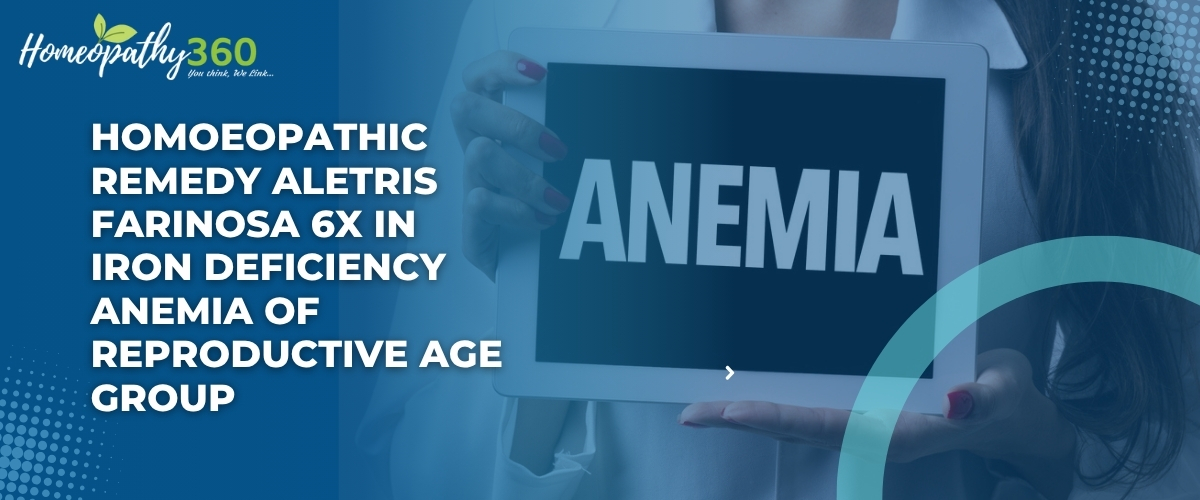
▪ Anaemia is defined as deficiency of hemoglobin in the blood, which can be caused by either too few red blood cells or too little hemoglobin in the cells. As the name implies, iron deficiency anaemia is due to insufficient iron.
▪ This form of anaemia is caused by insufficient iron due to a decreased supply, an increased loss, or an increased demand.
▪ Most common type of anaemia worldwide.
▪ According to WORLD HEALTH ORGANIZATION for under five years children, the threshold Hb level for being anemic is less than 11.0 g/dl.
▪ WHO-recommended Hb range of 12 g/dl, the prevalence of anemia rises to 80–90%.
▪ Iron deficiency anaemia has been the main cause of health burden in India for the past decade, based on a review of previous Global Burden of Disease (GBD) surveys.
Keywords: Homeopathy, Iron Deficiency Anaemia, Aletris Farinosa
Epidemiology:
▪ Iron deficiency anaemia is widely prevalent in young children.
▪ More common in women, especially pregnant women, than in men.
Etiology:
▪ Increased blood loss
▪ Increased requirements
▪ Inadequate dietary intake
▪ Decreased absorption
Clinical Features:
Symptoms:
▪ Weakness
▪ Fatigue
▪ Dyspnea on exertion
▪ Palpitations
Signs:
▪ Pallor of the skin, mucous membranes and sclerae ▪ Pica
▪ Brittle nails
▪ Hair loss
Diagnosis:
▪ Examination of eyes, sclerae, skin, mucous membrane
▪ Blood picture and red cell indices
▪ Decreased HB concentration
▪ Low serum iron level
▪ Total Iron Binding Capacity (TIBC) is HIGH ▪ Very low serum ferritin .
Behavioral Signs: In Infants and children
- Irritability or fussiness- The patient may cry more often or seem difficult to soothe.
- Lethargy or decreased activity- The infant may appear unusually quiet, less playful, or less interested in their surroundings.
- Poor feeding- Lack of interest in breast milk or formula, or shorter, less vigorous feeding sessions.
- Delayed developmental milestones – Slower to reach motor and cognitive milestones like sitting up, crawling, babbling, or making eye contact.
- Reduced attention span- Difficulty staying alert or engaged during interaction.
- Pica (in older infants and toddlers)- Craving or chewing on non-food substances like dirt, paper, or ice, though this is more typical after 12 months.
- Sleep disturbances- Trouble falling asleep or staying asleep, potentially linked to restless leg-like symptoms.
Behavioral Signs: In Adults
- Difficulty concentrating – Trouble focusing on tasks or feeling mentally “foggy.”
- Memory problems- Forgetfulness or slower thinking.
- Irritability-Feeling easily frustrated or more emotionally reactive.
- Depressed mood – Increased sadness or low mood, sometimes resembling clinical depression.
- Anxiety or restlessness – Feeling on edge or unable to relax.
HOMOEOPATHIC MANAGEMENT:
Aletris Farinosa:
▪ An anaemic, relaxed condition, especially of the female organism, is portrayed by this remedy. ▪ It is most suited for chlorotic girls and pregnant women.
▪ It affects the female organs.
▪ Remedy for anaemic, debilitated, relaxed females who always feel tired and suffer from prolapsus, leucorrhea, rectal distress.
▪ Frequently indicated in the complaints of women, especially in those predisposed to hemorrhages; uterine hemorrhages.
▪ The patient has pale sickly chlorotic face, would like to lie down all day and do nothing but rest.
▪ Weakness of the reproductive organs.
▪ Muscular pain during pregnancy.
▪ Uterus seems heavy.
Other Medicines for Iron Deficiency Anaemia:
▪ Vanadium Metalicum
▪ Trinitrotoluenum(TNT)
▪ Lecithinum
▪ Ferrum.Metallicum
▪ Calcarea phosphorica
▪ China
▪ Natrum mur
(1) Vanadium Metalicum
It acts as an oxygen carrier and a catalyst, it is used in wasting diseases.
It increases the amount of hemoglobin, also combines its oxygen with toxins and destroys their virulence. And increases and stimulates phagocytes.
This remedy in degenerative conditions of the liver and arteries. Anorexia and symptoms of gastro intestinal irritation; albumen, casts and blood in urine.
Anamia, emaciation.
(2) Trinitrotoluenum(TNT)
The destructive action of T. N. T on the red blood corpuscles is responsible for the anæmia and the jaundice with their secondary symptoms.
hemoglobin is changed so it cannot act satisfactorily as an oxygen carrier and as a result we have breathlessness,
dizziness, headache, faintness, palpitation, undue fatigue, muscle cramps and cyanosis; also drowsiness, depression and insomnia.
Later stages of the poisoning produce toxic jaundice and aplastic anemia.
(3) Lecithinum
Lecithin acts upon the nutritive condition and especially upon the blood so its use in anæmia and convalescence,
neurasthenia and insomnia.
It increases the number of red corpuscles and amount of hemoglobin.
Excellent nourishment and increases quantity. Causes an immediate decrease in the excretion of the
phosphates.
(4) Ferrum.Metallicum
young weak persons, anæmic and chlorotic, with pseudo-plethora, who flush easily; worse after any active effort.
Pallor of skin, mucous membranes, face,and it alternates with flushes. Irregular distribution of blood. Pseudo-plethora.
(5) Calcarea phosphorica
It is especially indicated in dentition and troubles. Bone disease non-union of fractured bones, and the anæmias after acute diseases and chronic wasting diseases.
Anemia in children who are peevish, flabby, have cold extremities and feeble digestion. It has a special affinity where bones form sutures or symphyses.
(6) China
Debility and Anemia after exhausting discharges, from loss of vital fluids. Periodicity is most marked. Sensitive to draughts. indicated in the earlier stages of acute disease..l
Chronic suppurative pyelitis.
(7) Natrum.Muraticum
excessive salt causes profound nutritive changes in the system and alteration in the blood causing a condition of Anemia and leucocytosis. Retention of sodium and potassium produces symptoms of gouty diathesis or rheumatic gout.
Use for the intermittent fever, anæmia, chlorosis, many
disturbances of the alimentary tract and skin. Great debility; weakness and Coldness. Emaciation with Great Dryness of mucous membranes.
(8) Ferrum.Phosphoricum
Endicated in the early stages of febrile conditions and , it stands midway between sthenic activity of Aconite and Bell, and the asthenic sluggishness and torpidity of Gels.
The typical Ferr-phos subject is not full blooded and robust, but nervous, sensitive, anæmic with the false plethora and easy flushing of Ferrum.
Prostration marked; face more active than Gels. The superficial redness never assumes the dusky hue of Gels. Pulse soft and flowing; no anxious restlessness of Acon. Susceptibility to chest troubles. Bronchitis of young children. In acute exacerbation of tuberculosis, a fine palliative of wonderful power. Corresponds to Grauvogl’s Oxygenoid Constitution, the inflammatory, febrile, emaciating, wasting consumptive.
The remedy for the first stage of all febrile disturbances and inflammations before exudation sets in; especially for catarrhal affections of the respiratory tract. Ferr phos. 3x increases hemoglobin. In pale, anæmic subjects, with violent local congestions. Hamorrhages, bright from any orifice.
References
1.Ralston SH, Penman ID, Strachan MWJ, Hobson RP. Davidson’s Principles and Practice of Medicine. 24th edition. Edinburgh: Elsevier; 2023. p. 940–945. 2.Loscalzo J, Fauci AS, Kasper DL, Hauser SL, Longo DL, J Larry Harrison’s Principles of Internal Medicine. 21st edition. New York: Mcgraw Hill; 2022. p. 683–685
3.Boericke W. Pocket Manual of Homeopathic Materia Medica with Indian medicine and Repertory. 9th ed. Revised and enlarged. New Delhi: Indian Books and Periodicals Publishers. Reprint ed. 2018. p. 26
4.Kent JT. Lectures on Homoeopathic Materia Medica. New Delhi B Jain Publishers, 2002. p. 53–54
5.Phatak SR. Materia Medica of Homoeopathic Medicines. 2nd ed. Revised and enlarged. New Delhi: B Jain Publishers (P) Ltd; 1999. p. 25–26
- John Henry Clarke. A Dictionary of Practical Materia Medica. 1900
- National Library of Medicine. PubMed [Internet]. PubMed Labs. 2024. Available from: https://pubmed.ncbi.nlm.nih.gov/
- Lecturio.com | Study medicine from anywhere. [Internet]. Lecturio. Available from: https://www.lecturio.com/
- Medscape. Latest Medical News, Clinical Trials, Guidelines – Today on Medscape [Internet]. Medscape.com. 2023. https://www.medscape.com/
Author
Dr. Aditya Narayan Bhai Vekariya BHMS- L.R Shah Homoeopathy college- Rajkot , Gujrat
ajkot , Gujrat