Abstract:
Tinea versicolor (Pityriasis versicolor) is a common superficial fungal infection caused by Malassezia species, characterized by hypo- or hyper-pigmented patch mostly affecting the trunk. Although many antifungal agents are used nowadays, recurrence is common. As Homoeopathy is based on individualization ,it offers effective and sustained relief. This article presents a detailed homoeopathic case of tinea versicolor treated with SEPIA 200, selected from totality of symptoms and guided by Synthesis repertory. The case highlights repertorial analysis, remedy selection, follow-up, and outcome, emphasizing the role of constitutional treatment in chronic fungal disorders.
Keywords:
Tinea versicolor, Ptyriasis versicolor, Synthesis Repertory, Sepia, Homoeopathy, Individualization.
Introduction:
Tinea versicolor is caused by fungus called Malassezia furfur, a normal inhabitant of the skin. Two triggering factors for the expression of infection is heat and humidity. The lesions consist of oval scaly macules, papules, and patches mainly on the chest, shoulders, and back and sometime rarely on the face or distal extremities. On dark skin the lesions often appear as hypopigmented areas, whereas on light skin leason often appear as hyperpigmented area.
From Homoeopathic point of view disease is nothing but external manifestation of internally deranged vital force. As emphasis is laid by Hahnemann in organon of medicine that treatment should be based on totality of symptoms and individuality rather than pathological diagnosis . The present state demonstrate tha efficacy of synthesis repertory in arriving at simlimum.
Case Record:
Name : Xyz
Age : 36 years
Sex : Male
Occupation :Job
Religion : Hindu
Chief Complaints:
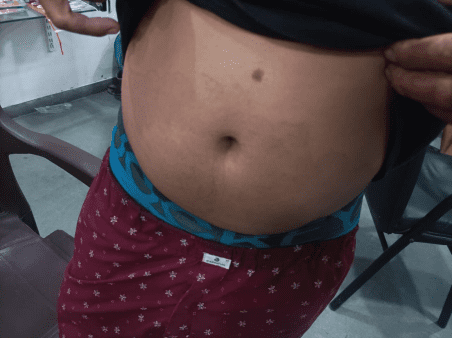
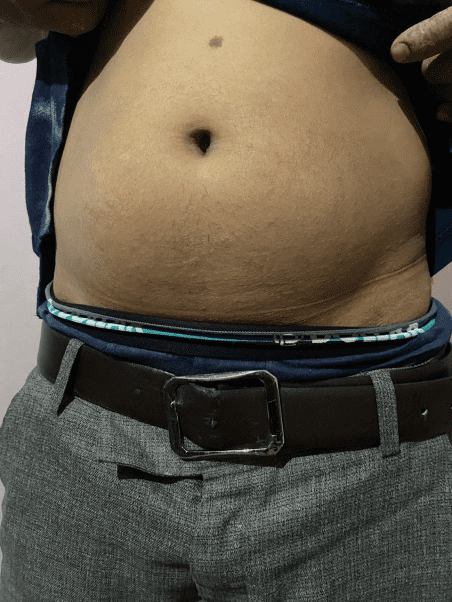
∙ The patient had brownish-black patches over the abdomen, gradually spreading since 8 months. The discoloration became more evident after bathing and sweating.
∙ There was mild but persistent itching, markedly aggravated by perspiration and heat.
∙ He used topical antifungal preparations which suppressed the itching temporarily, but the complaint recurred after stopping them. Hence he approached for homoeopathic treatment.
Past History:
∙ History of scabies in childhood.
Family History:
∙ Father :D.M.
∙ Mother: Healthy
Mental Generals:
∙ Anxiety about health.
∙ Worries that disease may spread.
∙ Indifferent to surroundings takes least interest in any work or activity.
∙ Prefers to remain alone.
Physical Generals:
∙ Appetite: Normal.
∙ Desire: Sour food and acids.
∙ Aversion: Not specific.
∙ Thirst: 2-3 litres per day.
∙ Perspiration: Profuse, especially on trunk.
∙ Thermal: Hot patient.
∙ Sleep: Disturbed occasionally due to itching.
Local Examination:
∙ Hyperpigmented patch (brown-black) over abdomen . ∙ Fine furfuraceous scaling on scratching.
∙ No raised margins.
∙ Mild itching < perspiration.
Diagnosis:
∙ Tinea Versicolor (Ptyriasis versicolor)
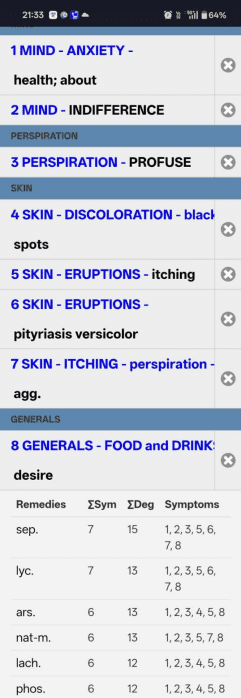
Totality Of Symptoms:
∙ Anxiety About Health.
∙ Indifference to surroundings.
∙ Perspiration profuse.
∙ Skin discoloration – black spots.
∙ Skin eruptions with itching.
∙ Pityriasis versicolor.
∙ Itching < perspiration.
∙ Desire For Sour Food And Acids.
Repertorial Totality:
Prescription:
∙ Sepia 200 1 dose stat
∙ S.L. for 15 days
∙ Sepia covered the maximum rubrics with highest degree and matched the constitutional picture.
Marked indifference.
∙ Tendency to pigmentary skin disorders.
∙ Useful in chronic fungal and scaly eruptions.
∙ Profuse perspiration.
∙ Acts deeply on constitutional level.
Thus Sepia was selected as the simillimum.
FOLLOW UP:
1.After 15 days
∙ Itching minimally reduced.
∙ Hyperpigmented patch slightly fading.
∙ Anxiety and indifference as it is.
RX:
∙ Sepia 200 1 dose stat
∙ S.L. for 1 month
After 1 month
∙ Itching only after heavy sweating.
∙ Anxiety about disease reduced.
∙ Patches slightly fading.
RX:
∙ S.L. for 1 months
After 2 months
∙ No itching.
∙ Comfortable even in hot weather.
∙ Pigmentation decreased.
∙ Anxiety about disease reduced.
∙ Indifference as it is.
RX:
∙ SL for 1 month
After 3 months
∙ Itching increased.
∙ Hyperpigmented patch increased.
∙ Anxiety about disease increased.
RX:
∙ Sepia 200 1 dose
∙ SL for 1 month
After 4 months
∙ Itching reduced significantly.
∙ Hyperpigmented patch faded significantly.
∙ No anxiety about disease.
RX:
∙ SL for 1 month
After 5 months
∙ No itching.
∙ Skin color almost normal.
∙ No hyperpigmented patches.
∙ Now he meets people takes interest in activities, mixes with people easily.
RX:
∙ SL for 1 month
After 6 months
∙ Patient feels better.
∙ Skin colour normal.
∙ No hyperpigmented patch.
∙ Medicine stopped advised to maintain hygiene.
Discussion:
Hyperpigmented tinea versicolor chorinic fungal infection, if we remove the symptoms of this disesase by local application or by other suppressive method of treatment, then there is a tendency for the reccurence of symptoms. Homoeopathic remedy based on totality of symptoms and individualization often manages this type of cases very well and removes the internal tendency for fungal growth.
The inclusion of mental symptoms, physical generals and physical particulars along with local pathology and repertorisation through synthesis repertory helped to reach to the homoeopathic similimum Sepia 200, which helped in management of this case.
Conclusion:
This case highlights the role of individualized homoeopathic similimum in managing the hyperpigmented tinea versicolor. Here in this case sepia 200 was selected through synthesis repertory, which acted very well and helped in managing this cases of hyperpigmented tinea versicolor.
References:
1.Jameson, J Larry . Harrison’s Principles of Internal Medicine. 21st ed., vol. 1, New York Mcgraw-Hill Education, 2022, p. 336.
2. Hahnemann, Samuel. Organon of Medicine 5 and 6 Edition. B. Jain, 29 Mar. 2013.
3. Frederik Schroyens, and Jeremy Sherr. Synthesis : Repertorium Homeopathicum Syntheticum : The Source Repertory. India, B. Jain Publishers (P) Ltd, 2016.
4. W Boericke. Pocket Manual of Homeopathic Materia Medica and Repertory and a Chapter on Rare and Uncommon Remedies. Wazirpur, Delhi, India, B. Jain Publishers, 1998.
5. Allen, H C. Keynotes : Rearranged and Classified with Leading Remedies of the Materia Medica and Bowel Nosodes Including Repertorial Index. Noida, U.P., India, B. Jain Publishers (P) Ltd, 2017.