Abstract
Oedema is the result of an imbalance in the filtration system between the capillary and interstitial spaces. The kidneys play a key role in regulating extracellular fluid volume by adjusting sodium and water excretion. Major causes of oedema include venous obstruction, increased capillary permeability, and increased plasma volume secondary to sodium and water retention.
Keywords
homoeopathy, oedema, swelling, materia medica
Definition
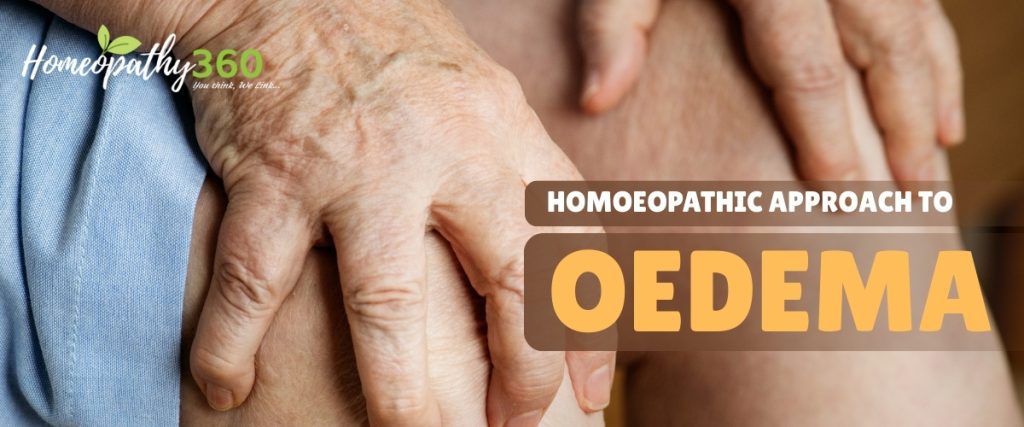
Oedema is defined as the swelling caused by excessive accumulation of fluid in the tissues. This happens primarily when there is an imbalance in the forces that control fluid exchange between blood vessels and tissues, leading to fluid leaking out of the capillaries.
Etiology
There is constant interchange of fluid between the two compartments of the extracellular fluid. The hydrostatic pressure within the capillaries and the colloid oncotic pressure in the interstitial fluid promote the movement of water and diffusible solutes from plasma to the interstitium. The interchanges of fluids are normally balanced so that the volumes of the intravascular and interstitial compartments remain constant.
Types Of Oedema
Oedema is categorised in two types:-
- On the basis of Location(e.g. generalized and localized oedema)
- On the basis of depression left after pressure is applied (e.g. pitting and non-pitting oedema)
- On the basis of body fluid compartment where accumulation of excess fluid occurs(e.g. intracellular and extracellular oedema)
Cause And Pathophysiology
A weight gain of several kilograms usually precedes overt manifestations of generalized oedema. Anasarca refers to gross, generalized oedema. Ascites and hydrothorax refer to accumulation of excess fluid in the peritoneal and pleural cavities, respectively, and are considered special forms of oedema.
Generalized Oedema:- Oedema that involves the entire body is known as Generalized edema.
Localized Oedema:- Oedema that occurs in specific areas of body such as abdomen, lungs and extremities is known as Localized oedema.
Pitting Oedema:- The swelled area is pressed with finger, displacement of fluid occurs producing or pit. When the finger is removed, the pit remains for few seconds or sometimes as long as 1 minute, till the fluid flows back into that area is known as pitting oedema.
Non-Pitting Oedema:-The swelled area is pressed with finger, here displacement of fluid does not occur and pit is not formed by pressing because it is hard is known as non-pitting oedema.
Intracellular Oedema:- Intracellular oedema occurs due to accumulation of fluid inside the cell. It occurs because of three reasons:
- Oedema due to Malnutrition
- Oedema due to Poor Metabolism
- Oedema due to Inflammation of Tissues
Extracellular Oedema:- Extracellular oedema occurs due to accumulation of fluid outside the cell. It occurs due to following reasons:
- Oedema due to Renal failure
- Oedema due to Hepatic cirrhosis
- Oedema due to cardiac failure
- Oedema due to lymphatic obstruction: Lymphoedema
- Oedema due to Increased Endothelial permeability
Clinical Features Of Oedema
- Obstruction of oedema and lymphatic drainage of a limb:- In this condition the hydrostatic pressure in the capillary bed upstream (proximal) to the obstruction increases so that an abnormal quantity of fluid is transferred from the vascular to the interstitial space. Since the alternative route (i.e., the lymphatic channels) may also be obstructed or maximally filled, an increased volume of interstitial fluid in the limb develops.
- Congestive heart failure:- In this disorder the impaired systolic emptying of the ventricle(s) and/or the impairment of ventricular relaxation promotes an accumulation of blood in the venous circulation at the expense of the effective arterial volume, and the aforementioned sequence of events is initiated.
- Cirrhosis:- This condition is characterized by hepatic venous outflow blockade, which, in turn, expands the splanchnic blood volume and increases hepatic lymph formation.
- Nephrotic syndrome:-The primary alteration in this disorder is a diminished colloid oncotic pressure due to losses of large quantities of protein into the urine. With severe hypoalbuminemia and the consequent reduced colloid osmotic pressure, the NaCl and H2O that are retained cannot be restrained within the vascular compartment, and total and effective arterial blood volumes decline.
Role of Homoeopathy In Oedema
Oedema is the abnormal accumulation of fluid in tissues due to various causes such as inflammation, venous obstruction, kidney or heart disease, liver failure, malnutrition, or local trauma. Homoeopathy focuses on treating oedema by stimulating the body’s self-healing mechanism, addressing both symptoms and the underlying cause.
Conventional Management
An important first question is whether the oedema is localized or Generalized. If it is localized, the local phenomena that may be responsible should be identified. If the oedema is generalized, one Should determine if there is serious hypoalbuminemia, e.g., serum Albumin <3.0 g/dL. If so, the history, physical examination, urinalysis, and other laboratory data will help evaluate the question of Cirrhosis, severe malnutrition, or nephrotic syndrome as the underlying disorder. If hypoalbuminemia is not present, it should be determined if there is evidence of heart failure severe enough to Promote generalized oedema. Finally, it should be ascertained as to whether or not the patient has an adequate urine output or if there is significant oliguria or anuria.
Commonly indicated remedies
- Acetic acid: oedema in extremities and oedematous skin
- Apis mellifica: oedematous skin, oedema of upper and lower eye lids and sometimes whole face
- Apocynum cannabinum: inflammation with oedema
- Arnica montana: oedema due to trauma, surgery or overexertion
- Arsenicum album: oedema in extremities, head and face, in genitals
- Graphites: oedema of feet and legs
- Ledum palustre: oedematous appearance on face, in genitals
- Lycopodium clavatum: oedema of feet
- Rhus toxicodendron: oedema in eye lids, in nose, in male genital
- Ruta graveolens: oedema due to sprain, injury
Refrences
- K Sembulingam Essentials of medical physiology 8th Edition.
- Harrison’s principles of internal medicine 21st Edition.
- Boericke, W. Pocket Manual of Homoeopathic Materia Medica. B. Jain Publishers.
- Allen, H.C. Keynotes and Characteristics with Comparisons. B. Jain Publishers
- Kent J. T. Lectures on Homoeopathic Materia Medica. B.Jain publishers