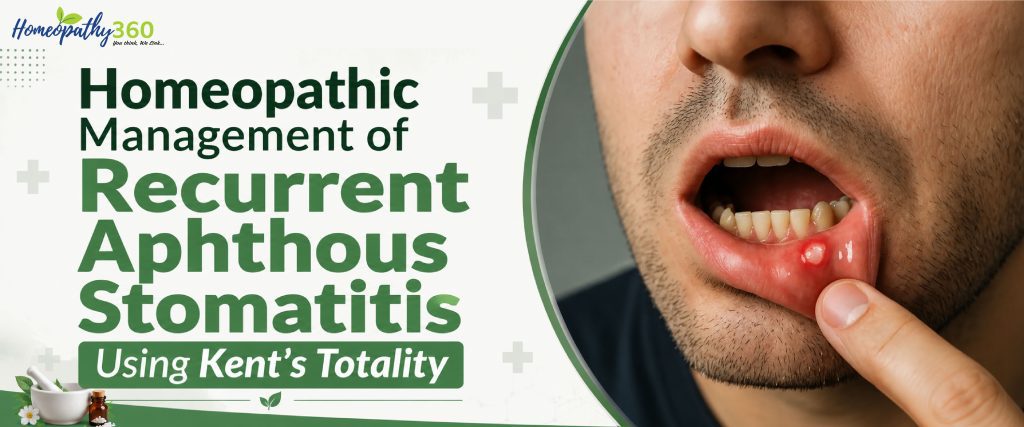
Homeopathic Management of Recurrent Aphthous Stomatitis Using Kent’s Totality
Abstract: Recurrent Aphthous Stomatitis (RAS) is one of the most common ulcerative disorders of the oral mucosa, characterized by painful, recurrent ulcers that significantly affect eating, speaking, and quality of life. Despite extensive research, its exact etiology remains unclear, although genetic predisposition, immune dysregulation, nutritional deficiencies, emotional stress, and systemic diseases have been implicated. Conventional treatment primarily focuses on symptomatic relief and prevention of secondary infection, often failing to address the patient’s constitutional susceptibility. Homoeopathy, based on the principle of individualization, offers a holistic therapeutic approach. Dr. James Tyler Kent’s concept of totality emphasizes the importance of mental generals, physical generals, and characteristic particulars in constructing a complete symptom picture. By applying Kent’s hierarchy of symptoms, the physician can identify the constitutional similimum, which acts at the level of the disturbed vital force. This article explores the application of Kent’s totality in the homeopathic management of RAS and highlights commonly indicated constitutional remedies such as Staphysagria, Sepia, Natrum muriaticum, Arsenicum album, and Borax. The Kentian method not only provides relief from acute symptoms but also reduces recurrence and enhances general health, making it a valuable approach in the long-term management of recurrent aphthous stomatitis.
Keywords: Recurrent Aphthous Stomatitis, Canker Sores, Kent’s Totality, Constitutional Homoeopathy, Individualization, Oral Ulcers
Introduction: Aphthous stomatitis, also known as canker sores, refers to painful, burning ulcers that appear in the mouth and can vary in size. The term “aphthae” is derived from the Greek word apathia, meaning “to set on fire” or “to inflame.” These sores commonly develop on the lips, cheeks, soft palate, gums, floor of the mouth, and tongue. Canker sores are not contagious.[1]
Recurrent Aphthous Stomatitis (RAS) is characterized by repeated episodes of one or more shallow, painful ulcers that occur at intervals ranging from a few days to a few months in individuals who are otherwise in good health.[2]
Oral ulcers are among the most common complaints of patients visiting outpatient departments (OPD). The prevalence varies from 5% to 60%, depending on the study, the population examined, the diagnostic criteria used, and environmental factors. However, it affects approximately 5% to 25% of the general population.[1]
The exact etiology of aphthous stomatitis is unknown, however, common risk factors that contributes are:
- Weak immunity
- Genetics
- Trauma
- Emotional stress
- Certain foods (individuals are allergic) Viral and bacterial infection
- Certain medication (aspirin, beta-blockers, penicillamine, sulfa Drugs, phenytoin)
- Deficiency of iron, folate, vitamin B6, D, zinc, or thiamine, and B12.
- Certain disease (celiac disease, GIT disorder, IBD, Crohn‟s disease, ulcerative colitis).[1]
Sign and Symptoms:
- Burning or discomfort in the oral mucosa.
- Fever
- Rash
- Headache
WHO classification of RAS is as presented below:
I. Minor aphthous ulcers
2. Major aphthous ulcers
3. Herpetiform ulcers.[3]
Kent’s Concepts of Totality
In Aphorism no.7, “The totality of symptoms is outwardly reflected picture of the internal essence of the disease, that is, of the affection of the vital force”.[4]
Dr. Kent says, “The totality of the symptoms written out carefully is all that we know of the internal nature of sickness. The things that lie closest to man and his life, and his vital force, are the things that are strictly general, and as they become less intimately related to man and less general until they become particular”.[5]
Dr. Kent stressed the importance of thoroughly observing the overall expressions of the individual who is ill. His comprehensive approach to understanding the manifestations of illness and the testing of remedies has offered reliable and precise directions for practitioners. His articulation of the principles of homeopathy has distinctly outlined the framework for understanding the totality of disease.[6]
Kent categorized symptoms into general, particular, and common to analyze the individual, specific body part, and disease respectively. Clearly, Kent places greater importance on the general symptoms and rare particulars, which define the individual and their illness.[6]
Dr. Kent said “ It is a man that is sick and needs to be restored to health, not his body, not the tissues. The tissues could not become sick unless something prior to them had been deranged and so make them sick”.[5]
Kent said, “Mind is the key to man. The Symptoms of the mind are the most important symptoms in a remedy & in a sickness. Man consists in what he thinks & what he loves & there is nothing else in man. If these two grand parts of man, the will& understanding, be separated it means insanity, disorder, death. All medicines operate upon the will & understanding first (sometimes extensively on both) affecting man in his ability to think or to will, and ultimately upon to the tissues. the functions & sensations.”[5]
Dr. Kent’s totality is erected by following the hierarchy given below:
Mind
- Will: Anger, irritability, love, hate, fear, grief, anxiety, sadness, indifference, loquacity, etc.
- Perversion of Understanding: Hallucination, illusion, absorbed, clairvoyance, confusion, dullness, comprehension, imbecility, mental activity, ailments from mental exertion, etc.
- Perversions.
Physical
- Perversion of sexual sphere including menstrual symptoms; general aggravation before, during and after menses; effects of coition, etc.
- Symptoms pertaining to appetite, food desires and aversions, and thirst.
- Things affecting the entire body like weather and temperature, food, positions and motions, etc.
Particulars
- Symptoms that relates to a region.
- Symptoms with clear modalities.[6]
F. Jack reviewed on Kent Minor Writings on Homoeopathy in the British Homoeopathic Journal “Kent apparently assumes that all illness starts in a person’s mind, and will first involve his loves, hates, desires, aversions etc. He deduces from this that these must be the prime areas to investigate.
According to Organon-
Aphorism 18:-The totality of symptoms must be the sole guide to direct in the choice of a remedy.
Aphorism 70:- Totality is nothing but the essence of the medicine to select the similar remedy and to facilitate a cure.
Aphorism 15 :- The affection of the morbidly deranged ,spirit like dynamis that animate our body in the invisible interior ,and the totality of outwardly cognizable symptoms produced by it in the organism and representing the existing malady ,constitute the whole , they are only and the same.
Aphorism 211: “The state of the disposition of the patient often chiefly determines the selection of the homoeopathic remedy, as being a decidedly characteristic symptom, which can least of all remain concealed from the accurately observing physician.”[8]
Also in aphorism 88: He has told “During case taking it is necessary to enquire the state of disposition of patients mind, his humor and his memory & other facts regarding it.[7]
Important Remedies for RAS
Below are the most commonly indicated homeopathic medicines for recurrent aphthous stomatitis.
1. Borax
- Aphthae in mouth, inner cheeks & tongue
- Extreme tenderness; slightest touch causes pain
- Aggravation from salty, sour food
- Children with painful mouth ulcers
- Fear of downward motion (characteristic)
2. Mercurius solubilis / vivus
- Ulcers with salivation, offensive breath
- Red, inflamed, irregular margins
- Metallic taste
- Worse at night, from heat of bed
3. Natrum muriaticum
- Recurrent aphthae triggered by emotional stress
- Cracked lips, vesicles, recurrent ulcers
- Aggravation from salt
- Reserved, emotional repression
4. Sulphur
- Chronic, recurrent tendency
- Burning pains
- Dirty-looking ulcers
- Aggravation from heat, morning
5. Nitric acid
- Sharp, splinter-like pains
- Bleeding ulcers
- Deep, dirty-looking aphthae
- Cracks in mouth corners
6. Kali bichromicum
- Round, punched-out ulcers
- Yellow coating, stringy mucus
- Aggravation from hot foods
- Slow healing ulcers
7. Arsenicum album
- Burning pain (better by warmth)
- Restlessness, anxiety
- Ulcers with dryness, excessive thirst
- Deep ulcerations
8. Nux vomica
- Stress-related ulcers
- Irritability, anger, sedentary lifestyle
- Aggravation from spicy food, stimulants
9. Lycopodium
- Recurrent mouth ulcers with digestive issues
- Sensation of dryness
- Intellectual but anxious personality
10. Hydrastis
- Raw, smarting ulcers
- Yellowish coating, stringy mucus
- Ulcers with debility
Kent’s Repertory provides extensive rubrics directly applicable to recurrent aphthous stomatitis, especially under Mouth – Aphthae, Mouth – Ulcers, and related pain and modality rubrics. These rubrics help identify key remedies such as Borax, Mercurius, Natrum muriaticum, Sulphur, Nitric acid, Kali bichromicum, and Arsenicum album, which are most frequently indicated in RAS. Modalities like aggravation from salt, touch, stress, or hot food further refine remedy selection, making Kent’s repertorial approach invaluable in individualized homoeopathic management of RAS.
Conclusion-
Recurrent Aphthous Stomatitis is a common and distressing condition that significantly affects the physical comfort, psychological well-being, and work efficiency of the working population. The recurrent nature of the disease, along with its association with stress, lifestyle factors, and individual susceptibility, makes its management challenging through conventional symptomatic approaches alone.
Homeopathic management of Recurrent Aphthous Stomatitis based on Dr. Kent’s approach of totality of symptoms is effective in reducing the frequency, severity, duration, and recurrence of aphthous ulcers. Individualized constitutional treatment, selected after thorough case taking and evaluation of mental generals, physical generals, and particular symptoms, produce favorable and sustained clinical improvement in the majority of cases.
Co-Author- Dr. Rakesh Sonkusare
References
- Jurge S, Kuffer R, Scully C, Porter SR. Recurrent aphthous stomatitis. Oral Dis.2006;12:1–21.
- Scully C, Porter S. Oral mucosal disease: Recurrent aphthous stomatitis. Br J Oral Maxillofac Surg. 2008;46:198–206.Ślebioda Z, Szponar E, Kowalska A. Recurrent aphthous stomatitis: genetic aspects of etiology. Advances in Dermatology and Allergology/Postępy Dermatologii i Alergologii. 2013 Apr;30(2):96-102.
- World Health Organisation. Guide to epidemiologyand diagnosis of oral mucosal diseases and conditions.Community Dent Oral Epidemiol 1980; 8: 1-26
- Hahnemann S. Organon of Medicine. 5th & 6th edition, New Delhi: B. Jain Publishers (P) Ltd; Reprint Edition 2007,2008. P55,110,195.
- Kent James Tyler Lecture on Homoeopathic Philosophy, New Delhi: B Jain Publishers Pvt. Ltd; Reprint Edition; 2004 P 21,24,51,55.
- Tiwari Shashikant Essentials of Repertorization, New Delhi: B Jain Publishers Pvt. Ltd; 5th edition: 2012. P 41, 148,257,273.Ship JA, Chavez EM, Doerr PA, Henson BS, Sarmadi M. Recurrent aphthous stomatitis. Quintessence international. 2000 Feb 1;31(2).
- Hahnemann S. Organon of Medicine. 5th & 6th edition, New Delhi: B. Jain Publishers (P) Ltd; Reprint Edition 2007,2008. P55,110,195