Abstract: External applications are not in the strict principle of Homoeopathy. Treatment of diseases by internal medication is the speciality of Homoeopathy. Diseases manifest by signs and symptoms, which are the sole guide of our homoeopathic method of treatment. Homoeopathy is primarily known for internal administration of potentized medicines based on the Law of Similar. However, Hahnemann also recognized the role of external applications in specific conditions.
Keywords: External application, Homoeopathy, Organon, Arnica, Calendula, Suppression, Topical use, Mother tincture.
Introduction: Homoeopathy is fundamentally based on the Law of Similars, Similia similibus curentur, and emphasizes internal administration of potentized medicines to stimulate the vital force. However, Dr. Hahnemann also recognized a distinct role for external applications, which he addressed in Aphorisms 284 to 291 of the sixth edition of the Organon of Medicine. According to Hahnemann, the most suitable mode of administering the homeopathic remedy is orally, but olfaction and external application are permissible when the oral route is not feasible or in certain local conditions. He specifically advised that in diseases of external parts arising from external causes, the local application of the same remedy that is given internally can hasten cure. External applications are not a substitute for the indicated similimum but serve as adjuvants in certain local, surgical, or one-sided diseases.
Hahnemann’s View – Organon References
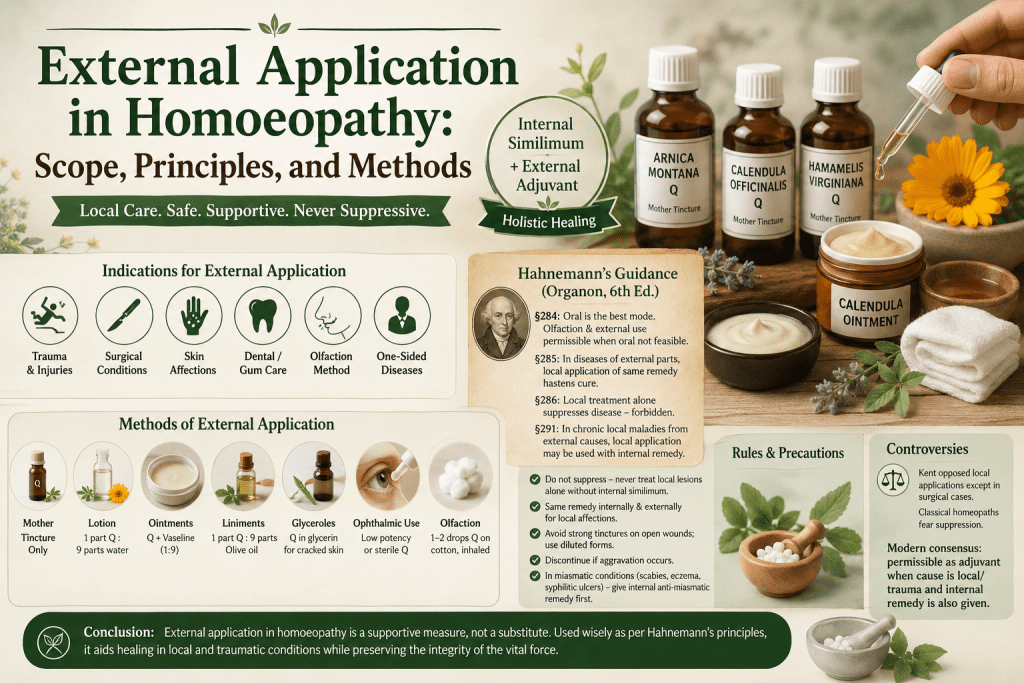
Aphorism 284: The most suitable mode of applying the homeopathic remedy is through the mouth. Olfaction and external application are permissible when oral route is not feasible.
Aphorism 285: In diseases of external parts, local application of the same remedy used internally hastens cure. Example: Arnica tincture 85for bruises, Calendula for cuts.
Aphorism 286: Warning against suppression. Local treatment alone of skin eruptions, ulcers, or exanthemata without internal medicine is forbidden, as it suppresses the external manifestation of internal disease.
Aphorism 291: In chronic local maladies from external causes, local application may be used alongside internal remedy.
Indications for External Application:
Traumatic conditions: Bruises, sprains, wounds – Arnica Q, Calendula Q, Hypericum Q.
Surgical conditions: Pre/post-operative care – Calendula lotion for wound healing, Ledum for puncture wounds.
Skin affections: When local lesions are due to external causes – Graphites ointment for fissures, Chrysarobinum for psoriasis patches, Thuja Q for warts.
One-sided diseases: Local diseases with few internal symptoms – Ruta tincture for ganglion.
Dental/Gum care: Plantago Q for toothache, Calendula mouthwash.
Olfaction method: For hypersensitive patients, pregnant women, infants – medicine in alcohol on cotton, inhaled.
Methods of External Application:
Mother tincture only.
Lotion: Prepared by mixing one part of mother tincture with nine parts of purified water.
Ointments: Prepared by mixing Q with vaseline in 1:9 ratio. Calendula, Hamamelis, Aesculus ointments.
Liniments: Prepared by mixing one part of mother tincture with nine parts of olive oil. For massage – Rhus tox for rheumatism.
Glyceroles: Q in glycerin for cracked skin – Graphites glycerol.
Cerates: Q + wax + oil base for ulcers.
Ophthalmic use: Very low potency or sterile Q dilutions – Euphrasia eye drops.
Olfaction: 1–2 drops Q on cotton, sniffed intermittently.
Rules & Precautions:
Do not suppress: Local treatment of psoric eruptions without internal similimum drives disease deeper (§197–203).
Same remedy internally and externally: Hahnemann advised using the same remedy both ways for local affections (§285).
Avoid strong tinctures on open wounds: Use diluted forms to prevent irritation.
Discontinue if aggravation: Local aggravation means stop the external use, continue the internal one.
In case of miasmatic conditions: Scabies, eczema, syphilitic ulcers need internal anti-miasmatic treatment first.
Controversies: Classical homeopaths debate external use, fearing suppression. Kent opposed local applications except surgical cases. Modern consensus: permissible as adjuvant when cause is local/trauma and internal remedy is also given.
Conclusion: External application has a defined but limited role in homoeopathy. When used per Hahnemannian guidelines – non-suppressive, adjuvant to internal similimum, and for local/traumatic causes – it enhances healing. Indiscriminate topical use without constitutional treatment violates homeopathic philosophy.
Co-Author:-

References:
- Hahnemann, S. Organon of Medicine, 6th Edition.
- Mandal & Mandal. A Textbook of Homoeopathic Pharmacy.
- Banerjee, D.D. Augmented Textbook of Homoeopathic Pharmacy.
- Central Council for Research in Homoeopathy (CCRH). Standardisation of Homoeopathic Drugs, Vol I–IV. New Delhi.
- Roberts, H.A. The Principles and Art of Cure by Homoeopathy. Chapter: External Applications.
- Boericke, W. Pocket Manual of Homoeopathic Materia Medica & Repertory. – External use of Q potencies.