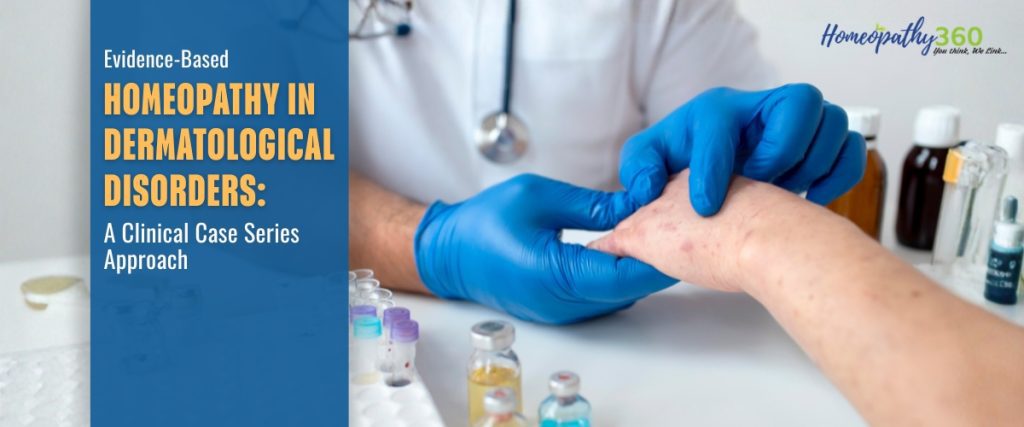
Evidence-Based Homeopathy in Dermatological Disorders: A Clinical Case Series Approach
Abstract
Dermatological disorders are among the most prevalent chronic conditions, often associated with recurrence and significant impact on quality of life. Conventional treatments provide symptomatic relief but may not prevent relapse. Homeopathy, founded by Samuel Hahnemann, offers a holistic and individualized approach to
disease management. This article presents a clinical case series demonstrating the effectiveness of homeopathic treatment in chronic dermatological conditions. The findings indicate significant improvement in symptoms, reduction in recurrence, and enhancement of overall well-being.
Keywords
Homeopathy, Dermatology, Chronic Skin Disease, Individualization, Case Series, Holistic Medicine
Introduction
Dermatological conditions such as eczema, psoriasis, and xerosis are chronic in nature and often resistant to conventional treatment. These disorders not only affect the skin but also influence the patient’s psychological and social well-being.
From a biomedical perspective, many skin diseases involve inflammatory, immunological, and barrier dysfunction mechanisms. However, despite advancements in dermatology, recurrence remains a major challenge.
Homeopathy approaches disease differently. As explained in Organon of Medicine, treatment is based on the totality of symptoms and the individuality of the patient rather than the disease label alone. This allows for a deeper therapeutic action aimed at restoring internal balance.
Brief Overview of Dermatological Disorders
The skin, the largest organ of the human body, serves as a protective barrier and reflects internal physiological and pathological processes. Dermatological disorders are often chronic, recurrent, and influenced by both internal and external factors.
Common dermatological conditions include:
Eczema (Atopic Dermatitis):
A chronic inflammatory condition characterized by intense itching, erythema, vesicles, and oozing in acute stages, followed by dryness and lichenification in chronic cases. It is often associated with allergic tendencies and immune hypersensitivity.
Psoriasis:
A chronic autoimmune disorder marked by hyperproliferation of keratinocytes leading to well-defined, erythematous plaques covered with silvery scales. It commonly affects extensor surfaces and is associated with systemic inflammation and genetic predisposition.
Acne Vulgaris:
A disorder of pilosebaceous units involving increased sebum production, follicular hyperkeratinization, bacterial colonization, and inflammation. It presents as comedones, papules, pustules, and sometimes nodules, often affecting adolescents and young adults.
Fungal Infections (Dermatophytosis):
Superficial infections caused by dermatophytes affecting skin, hair, and nails. They present with itching, circular lesions, and scaling, commonly aggravated by humidity and poor hygiene.
Urticaria:
A hypersensitivity reaction characterized by transient wheals, itching, and redness. It may be acute or chronic and is often triggered by allergens, stress, or underlying systemic conditions.
Vitiligo:
A depigmentary disorder resulting from the destruction of melanocytes, leading to well-defined white patches on the skin. It has autoimmune and genetic associations and significant psychological impact.
Xerosis (Dry Skin):
Characterized by rough, scaly, and cracked skin due to impaired barrier function and reduced hydration. It may be idiopathic or associated with systemic conditions and environmental factors.
Warts (Verruca):
Benign proliferations caused by human papillomavirus (HPV), presenting as rough, hyperkeratotic lesions commonly on hands and feet.
Etiological and Contributing Factors
Dermatological disorders are multifactorial in origin and may involve:
● Genetic predisposition
● Immune system dysregulation
● Hormonal imbalance
● Environmental triggers (climate, allergens, irritants)
● Nutritional deficiencies
● Psychological stress and emotional disturbances
Limitations of Conventional Management
Conventional dermatological treatments—such as corticosteroids, antihistamines, antifungals, and immunosuppressants—primarily aim at symptomatic control. While effective in the short term, they may:
● Lead to recurrence after discontinuation
● Cause adverse effects with prolonged use
● Fail to address the underlying susceptibility
Homeopathic Perspective
Homeopathy views skin diseases as external manifestations of internal imbalance. According to Samuel Hahnemann, true cure involves addressing the root cause
rather than suppressing symptoms. Individualized remedies based on totality of symptoms aim to restore harmony at both physical and मानसिक (mental-emotional) levels.
Case Presentations
Case 1: Chronic Eczema
Patient Profile:
● 24-year-old male
● Complaints of itching, burning, and oozing eruptions since 3 years Characteristic Symptoms:
● Worse at night and from heat
● Scratching gives temporary relief
Mental State:
Irritable, restless, untidy
Prescription:
Sulphur 200C
Outcome:
● Rapid reduction in itching within 2 weeks
● Significant healing of lesions in 6 weeks
● No recurrence during follow-up
Case 2: Psoriasis
Patient Profile:
● 35-year-old female
● Chronic scaly eruptions on elbows and knees
Characteristic Symptoms:
● Worse in winter
● Dryness with burning sensation
Mental State:
Anxiety, fear regarding illness
Prescription:
Arsenicum album 200C
Outcome:
● Reduction in scaling within 1 month
● Improvement in skin texture
● Better emotional stability
Case 3: Xerosis (Chronic Dry Skin)
Patient Profile:
● 23-year-old male
● Severe dryness and cracks on soles and palms since childhood Characteristic Symptoms:
● Worse after washing
● Thickened, rough skin
Mental State:
Indifferent, low motivation
Prescription:
Graphites 200C
Outcome:
● Improved hydration within weeks
● Healing of cracks
● Sustained improvement over time
Case 4: Acne Vulgaris
Patient Profile:
● 21-year-old female
● Complaints of recurrent acne on face since 4 years
Characteristic Symptoms:
● Painful pustular eruptions with occasional scarring
● Worse before menses
● Oily skin with marked sensitivity
Mental State:
● Reserved, (shy), tendency to weep easily
● Desire for company but avoids consolation
Prescription:
Pulsatilla 200C
Outcome:
● 3 weeks: Reduction in new eruptions
● 6 weeks: Decrease in inflammation and redness
● 3 months: Significant reduction in recurrence, improved skin clarity
Case 5: Urticaria (Chronic)
Patient Profile:
● 30-year-old male
● Complaints of recurrent itching and wheals since 2 years
Characteristic Symptoms:
● Sudden appearance of raised, red eruptions
● Intense itching, worse at night
● Triggered by cold exposure
Mental State:
Irritable, anxious, easily angered
Prescription:
Urtica urens 30C
Outcome:
● 1 week: Reduction in frequency of wheals
● 1 month: Significant decrease in itching episodes
● Follow-up: No major recurrence reported
Results
● The cases demonstrated:
● Marked reduction in symptom severity
● Improvement in skin appearance and texture
● Absence of adverse effects
● Enhanced psychological well-being
● Reduced recurrence tendency
Discussion
The findings of this case series highlight the clinical utility of homeopathy in chronic dermatological disorders. The effectiveness of treatment is largely attributed to individualized remedy selection based on the totality of symptoms.
According to James Tyler Kent, successful prescribing depends on understanding the patient as a whole rather than focusing solely on pathological changes. This principle was evident in all cases, where mental and general symptoms guided remedy selection.
Unlike conventional approaches that often suppress cutaneous manifestations, homeopathy aims to correct the internal imbalance. The observed improvement in both physical and mental symptoms supports the holistic concept of healing.
From a modern viewpoint, these results may be interpreted through:
● Immunomodulatory effects
● Psychoneuroimmunological interactions
● Regulation of inflammatory responses
Conclusion
Homeopathy demonstrates significant potential in the management of chronic dermatological disorders. Through individualized treatment, it addresses both the physical and psychological aspects of disease, leading to sustained improvement and reduced recurrence. This approach offers a valuable complementary option in dermatological care.
Co-Author–

References
1. Samuel Hahnemann – Organon of Medicine
2. James Tyler Kent – Repertory of the Homeopathic Materia Medica 3. Boericke W. – Pocket Manual of Homeopathic Materia Medica 4. Close S. – The Genius of Homeopathy
5. Standard dermatology textbooks and recent journal articles