

Abstract
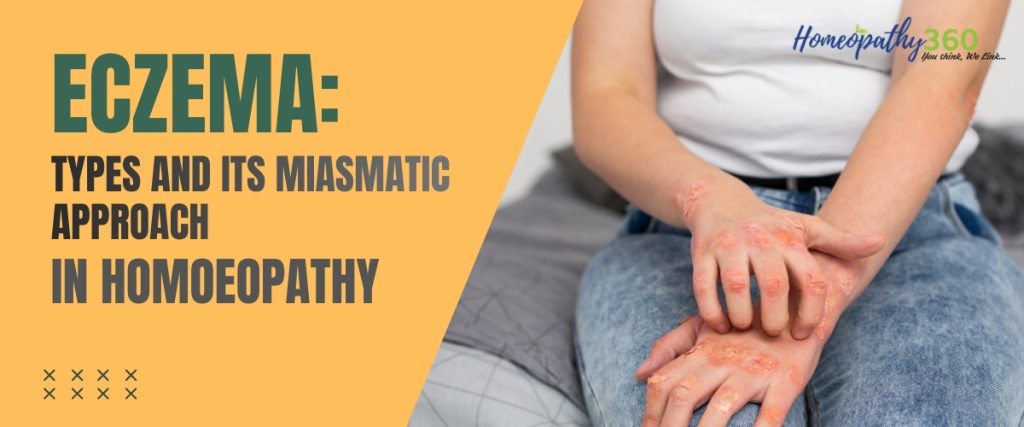
Eczema is a chronic inflammatory skin disorder characterized by pruritus, erythema, vesiculation, oozing, crusting, and lichenification. Conventional management primarily focuses on symptomatic relief, often resulting in recurrence. Homoeopathy considers eczema as a manifestation of internal constitutional and miasmatic imbalance. This article reviews the common types of eczema and analyzes their miasmatic background, highlighting the importance of miasmatic evaluation for accurate constitutional prescribing and long-term cure.
Keywords
Eczema; Dermatitis; Miasm; Psora; Sycosis; Syphilis; Homoeopathy
Introduction
Eczema, also known as dermatitis, is a common chronic skin condition affecting individuals of all age groups. It presents with periods of exacerbation and remission, significantly affecting quality of life. In Homoeopathy, skin diseases are viewed as outward expressions of internal derangement. Hahnemann emphasized that chronic skin eruptions are closely related to underlying chronic miasms, making miasmatic evaluation essential in understanding and managing eczema effectively.
Concept of Eczema in Homoeopathy
From a homoeopathic perspective, eczema is not merely a local skin disorder but a constitutional disease influenced by hereditary predisposition, environmental factors, emotional stress, and chronic miasmatic load. Suppression of skin eruptions may drive the disease inward, resulting in deeper pathology. Hence, treatment aims at correcting the internal imbalance rather than local palliation.
Types of Eczema
1. Atopic Eczema
Atopic eczema commonly begins in childhood and is associated with a personal or family history of allergy, asthma, or allergic rhinitis. It presents with intense itching, dry skin, and recurrent exacerbations, often aggravated by emotional stress.
2. Contact Eczema
This type occurs due to exposure to allergens or irritants such as chemicals, metals, cosmetics, or plants. Lesions are usually localized to the area of contact and present with erythema, vesiculation, and itching.
3. Seborrhoeic Eczema
Seborrhoeic eczema affects areas rich in sebaceous glands such as the scalp, face, and upper trunk. It presents with greasy scales, mild erythema, and itching.
4. Nummular Eczema
Nummular eczema is characterized by coin-shaped lesions that are itchy, oozing, and recurrent. It is commonly seen in adults and tends to worsen in cold and dry climates.
5. Varicose Eczema
Varicose eczema occurs in the lower limbs, particularly in individuals with chronic venous insufficiency. It presents with pigmentation, itching, scaling, and sometimes ulceration.
Miasmatic Approach to Eczema
1. Psoric Miasm: Psora is considered the fundamental miasm underlying most cases of eczema. Psoric eczema is characterized by:
- Intense itching
- Dryness of skin
- Redness and scaling
- Periodic aggravations
- Atopic and early-stage eczema are predominantly psoric in nature.
2. Sycotic Miasm: Sycosis contributes to chronicity and recurrence. Sycotic eczema shows:
- Thickened skin
- Oozing and crust formation
- Moist eruptions
- Tendency for hypertrophy and infiltration
- Seborrhoeic and chronic oozing eczemas often reflect sycotic dominance.
3. Syphilitic Miasm: Syphilis is associated with destructive and ulcerative changes. Syphilitic eczema presents with:
- Cracks and fissures
- Ulceration
- Bleeding
- Severe chronicity
- Varicose eczema with ulceration and long-standing neglected cases often show syphilitic traits.
Mixed Miasmatic States
Most chronic eczema cases are psoro-sycotic or psoro-syphilitic, requiring careful evaluation to identify the dominant miasm for accurate remedy selection.
Importance of Miasmatic Evaluation
Miasmatic analysis helps in:
- Understanding disease evolution
- Selecting deep-acting constitutional remedies
- Preventing recurrence
- Avoiding suppression
- Miasmatic prescribing strengthens the homoeopathic approach by addressing the root cause rather than surface manifestations.
Discussion
Eczema demonstrates how skin acts as an outlet for internal imbalance. Mere topical treatment may suppress symptoms but fails to address the underlying cause. A miasmatic approach integrates constitutional assessment with symptom totality, enabling long-lasting cure and restoration of health.
Conclusion
Eczema is a chronic constitutional disorder deeply rooted in miasmatic influences. Understanding the types of eczema along with their miasmatic background is essential for successful homoeopathic management. Miasmatic prescribing, combined with individualization, offers a holistic and curative approach in chronic eczematous conditions.
References
- Hahnemann S. Organon of Medicine. 6th ed. New Delhi: B. Jain Publishers. Hahnemann S. The Chronic Diseases. New Delhi: B. Jain Publishers.
- Kent JT. Lectures on Homoeopathic Philosophy. New Delhi: B. Jain Publishers.
- Boericke W. Pocket Manual of Homoeopathic Materia Medica. New Delhi: B. Jain Publishers.
- Close S. The Genius of Homoeopathy. New Delhi: B. Jain Publishers.