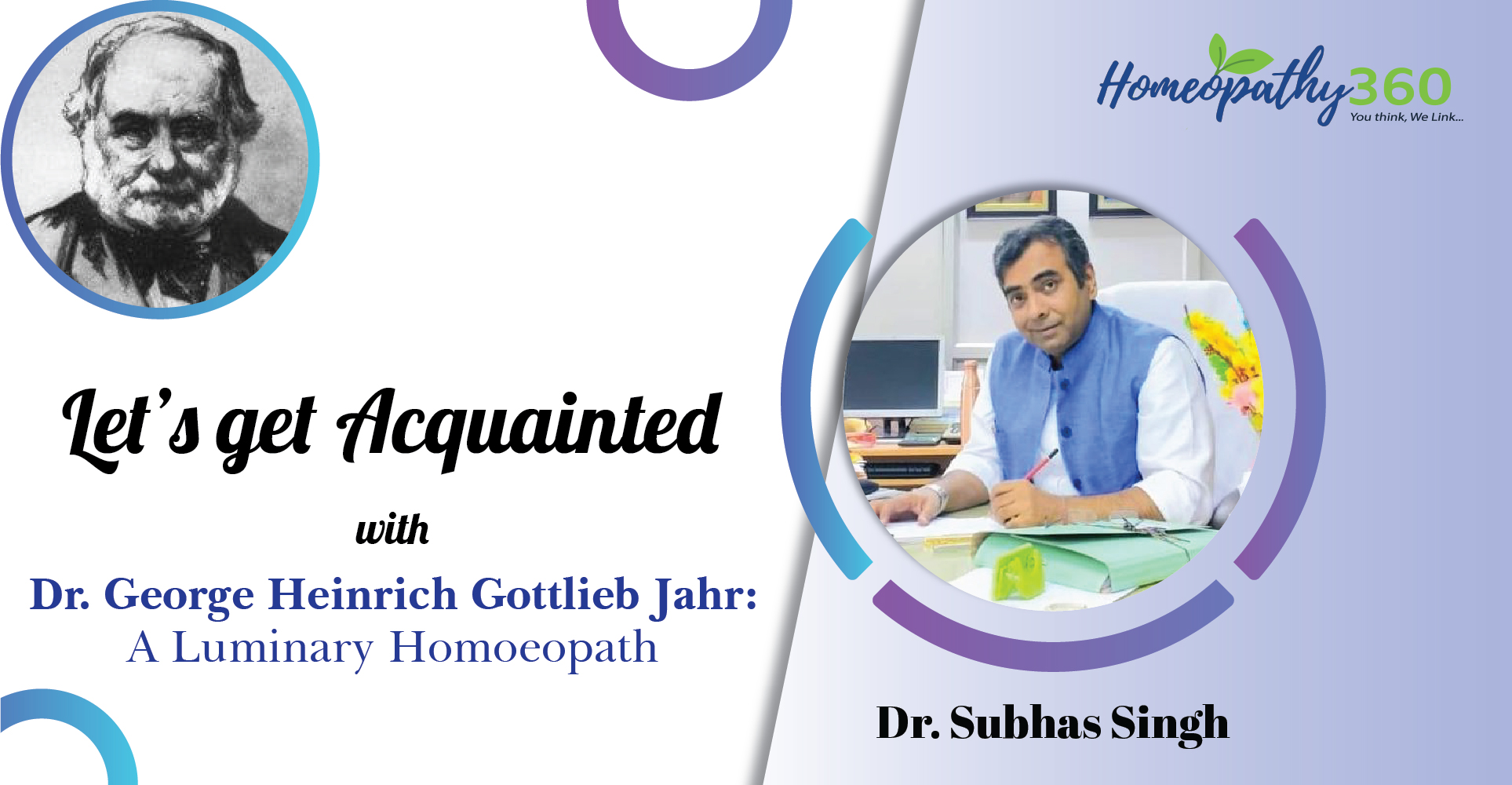
Dr. George Heinrich Gottlieb Jahr, a notable Homoeopathic stalwart and one of the early followers of Master Hahnemann, was exposed to Homoeopathy through Dr. Carl Julius Aegidi, another follower and prominent Homoeopath. He worked closely with Master Hahnemann and published numerous books in this field.
Early Life and Education
Dr. G. H. G. Jahr was born on 30th January, 1800, in Neudietendorf, a small town in Saxony (Saxe-Gotha), Germany. His early education took place in the institutions of the Moravian Brethren, renowned for their emphasis on both religious and academic excellence. Specifically, Dr. Jahr attended the Moravian schools in Niesky, Silesia, where his aptitude for scholarly pursuits became apparent. His success was so notable that, upon completing his classical education, he was immediately appointed to the position of Professor at the Moravian College, beginning his academic career at the age of twenty-five.
However, despite his success in academia, Dr. Jahr faced health challenges that led him to seek alternative treatment. It was during his struggle with a serious illness that he first encountered Homoeopathy, which would change the course of his life and career.
Introduction to Homoeopathy
Dr. Jahr’s introduction to Homoeopathy came through his treatment by Dr. Aegidi, who successfully cured him using Homoeopathic remedies. This experience deeply impressed Dr. Jahr and sparked his interest in the principles of Homoeopathy. Encouraged by Dr. Aegidi’s support, Dr. Jahr left his professorial position at Moravian College and decided to pursue a medical career, despite his initial academic inclinations.
Medical Studies and Relationship with Dr. Hahnemann
He trained in Homoeopathic medicine under Dr. Aegidi, who later recommended him to Dr. Samuel Hahnemann. Dr. Jahr’s meeting with Master Hahnemann marked the beginning of a lifelong intellectual partnership that significantly shaped his medical career. He was eager to pursue a practical career in Homoeopathy. Master Hahnemann recognized Dr. Jahr’s potential and invited him to collaborate on the compilation of 2nd edition of his landmark work, “The Chronic Diseases”. This collaboration was pivotal in Dr. Jahr’s development as a Homoeopathic physician and it solidified his commitment to Dr. Hahnemann’s principles.
Dr. Hahnemann also encouraged Dr. Jahr to pursue formal recognition as a medical doctor. So, he eventually enrolled and completed his medical degree from the University of Bonn. Dr. Jahr’s years at this University were marked by significant academic achievement. This period marked the beginning of Dr. Jahr’s deep involvement in the Homoeopathic movement.
Paris and Work with Master Hahnemann
In 1830, Dr. Jahr relocated to Paris, following Dr. Hahnemann’s move to the city. This was a critical period in the development of Homoeopathy and Dr. Jahr’s contributions were substantial. He lived and worked in Paris for over thirty years, becoming one of the foremost practitioners and scholars of Homoeopathy during this time. Dr. Jahr’s work in Paris was marked by a constant stream of publications and contributions to the growing body of Homoeopathic literature.
Dr. Jahr’s commitment to Dr. Hahnemann’s methods was unwavering and his belief in dynamization of remedies as the cornerstone of Homoeopathic treatment was central to his practice. He also became an advocate for the scientific validation of Homoeopathy, helping to lay the groundwork for the future development of the discipline.
Contributions to Homoeopathic Literature
Dr. Jahr’s most important work was the “Symptomen Codex” (Code of Symptoms), which was first published in 1849, consisted of 3 volumes. This comprehensive work included detailed descriptions of 143 remedies that had been proven up to that time and it quickly became a cornerstone of Homoeopathic literature. Dr. Jahr’s Symptomen Codex was a significant contribution because it expanded upon the work of Dr. Von Boenninghausen, who had primarily focused on antipsoric remedies. Unlike Dr. Von Boenninghausen’s work, Dr. Jahr’s Codex was comprehensive, covering a wide range of remedies and offering precise, accurate descriptions of their symptoms and therapeutic uses.
Major Works by Dr. Jahr
He was a prolific writer, producing a range of influential works that covered various aspects of Homoeopathy. His output included both comprehensive textbooks and smaller works for everyday use by Homoeopathic practitioners. Some of his notable works include:
- Dr. Jahr’s Repertory: published in 1834. This repertory was scheduled to be published under the supervision of Dr. Hahnemann but unfortunately that did not happen.
- G. H. G. Jahr’s Manual of Homoeopathic Medicine (1836), translated by Constantine Hering
- Jahr’s New Manual of Homoeopathic Practice (Vol 1, 1841), (Vol 2, 1842), 2nd American Edition, from the 3rd Paris Edition.
- Short Elementary Treatise upon Homoeopathia (1845)
- Manual of Homoeopathic Medicine (1847), Volume 1: Materia Medica; Volume 2: Therapeutical & Symptomatological Repertory, translated and edited by Paul Francis Curie
- Jahr’s New Manual (1848), Volumes 1-2, translated and edited by Charles Julius Hempel
- New Homœopathic Pharmacopæia & Posology (1850), by Charles Julius Hempel, Buchner, Gruner and Jahr
- Jahr’s Clinical Guide or Pocket Repertory: Therapeutics, Published in 1850
- Alphabetical Repertory of The Skin Symptoms: 1850
- Jahr’s New Manual (1853), Volume 3, translated and edited by Charles Julius Hempel
- Diseases of Females and Infants at the Breast: 1856 (Therapeutics)
In addition to these works, Dr. Jahr co-authored a French-language Homoeopathic Pharmacopoeia with the Catellan brothers, a significant contribution to the standardization of Homoeopathic treatments.
Editorial Work and Influence
Dr. Jahr also contributed to the development of Homoeopathy through his editorial work. From 1842 to 1845, he co-edited the Annales de la Médecine Homoeopathique with Dr. Simon, which became one of the foremost journals in the field of the time. He was also the editor of the Bulletin de l’Art de Guérir from 1861 to 1865, further cementing his role as a central figure in the promotion and development of Homoeopathic literature.
Philosophy and Medical Beliefs
Dr. Jahr’s Medical Philosophy was grounded in his strong belief in the principles of dynamization—the process by which Homoeopathic remedies are diluted and succussed to enhance their healing properties. He saw this as the true essence of Homoeopathy, which set it apart from other medical systems of the time. Dr. Jahr was in direct opposition to Mueller, Kafka, and Hirschel, who downplayed the significance of small doses in Homoeopathic practice. Dr. Jahr defended Dr. Hahnemann’s teachings against critiques and became one of the most dedicated followers of his mentor.
Dr. Jahr’s work often placed him in opposition to other Homoeopathic schools of thought. For example, Griesselich, a proponent of specific Homoeopathy, came into conflict with Dr. Jahr over the latter’s adherence to Hahnemann’s methods. Dr. Jahr argued for the broader application of Homoeopathy, while Griesselich and others focused more on specific remedies and their application in treating particular diseases.
Challenges in Belgium and Later Years
He left Paris for Belgium at the outbreak of the Franco-Prussian War in 1870. Despite his success in Paris and his continuing contributions to Homoeopathy, Dr. Jahr faced significant challenges in his later years. In the wake of political unrest, Dr. Jahr was prohibited from practicing medicine in Belgium because he did not possess a local Medical Diploma. This professional setback severely impacted his ability to support himself and led to significant emotional strain. His colleagues in Belgium tried to help by organizing a subscription to alleviate his financial difficulties, but the prohibition had a lasting effect on his health.
Demise
Dr. Jahr’s health began to decline and, in the summer of 1875, he was struck with a carbuncle that caused further weakening. Despite medical treatment, Dr. Jahr’s health deteriorated and he died on 11th July, 1875, in Brussels, Belgium, at the age of 75 years. In spite of facing significant challenges—both professional and personal—Dr. Jahr remained steadfast in his commitment to the study and practice of Homoeopathy until his death.