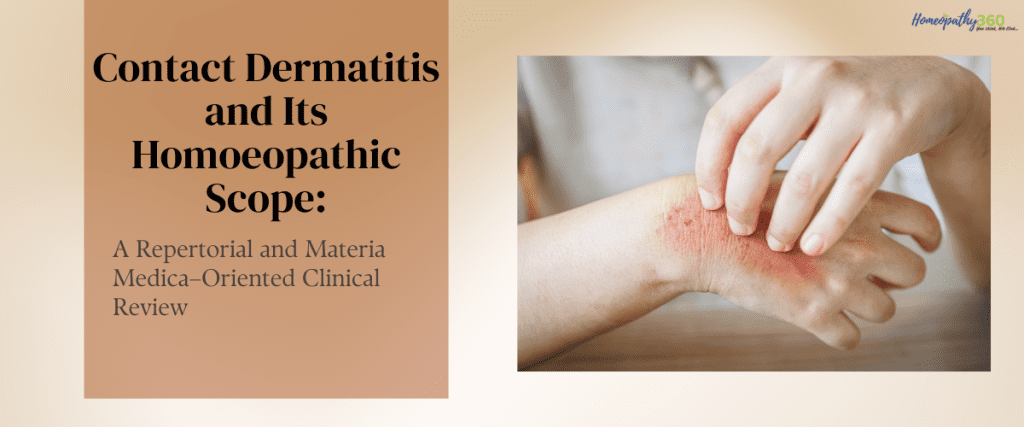
Contact Dermatitis and Its Homoeopathic Scope: A Repertorial and Materia Medica–Oriented Clinical Review
Abstract
Background: Contact dermatitis is a common inflammatory dermatosis caused by exposure to irritants or allergens. Conventional therapy focuses on avoidance and suppression, whereas homoeopathy emphasises individualisation and constitutional correction.
Objective: To evaluate the therapeutic scope of homoeopathy in contact dermatitis with special emphasis on Repertorial Analysis and Materia Medica differentiation, including lesser-known remedies.
Methods: Conceptual clinical review based on classical homoeopathic literature, dermatological texts, and repertorial methodology.
Results: Repertorial analysis systematically narrows remedy selection, while Materia Medica comparison enables precise differentiation. Inclusion of rare remedies enhances clinical accuracy in atypical cases.
Conclusion: Integration of repertory and Materia Medica provides a rational, reproducible framework for individualized homoeopathic management of contact dermatitis.
Keywords: Contact dermatitis, homoeopathy, repertory, dermatitis remedies, individualized medicine.
Introduction
Contact dermatitis is an inflammatory reaction of the skin resulting from exposure to external agents. It is among the most frequent dermatological complaints and significantly impacts quality of life due to itching, burning, and recurrent eruptions.
Homoeopathic philosophy, formulated by Samuel Hahnemann, views skin diseases as outward expressions of internal imbalance. According to this concept, treatment should address the patient as a whole rather than suppress local pathology.
Classification and Etiopathogenesis
Contact dermatitis is classified into:
- Irritant Contact Dermatitis – caused by chemical or physical injury
- Allergic Contact Dermatitis – delayed hypersensitivity reaction
- Photocontact Dermatitis – triggered by light–chemical interaction
- Occupational Dermatitis – due to workplace exposure
Pathogenesis involves epidermal barrier damage, immune sensitization, cytokine release, and inflammatory cascades.
Clinical Features
Typical signs and symptoms include:
- Erythema and edema
- Vesicles or bullae
- Oozing or crusting
- Scaling and fissures
- Severe itching or burning
Distribution often corresponds to exposure site, assisting etiological identification.
Homoeopathic Conceptual Approach
Homoeopathic prescribing is based on totality of symptoms, including:
- Mental state
- Physical generals
- Modalities
- Sensations
- Causative factors
- Constitutional traits
Cutaneous symptoms are especially valuable because they are objective and characteristic.
Role of Repertory in Dermatological Prescribing
The repertory is an indexed guide correlating symptoms with remedies. The systematic repertorial method refined by James Tyler Kent transformed homoeopathic prescribing into an analytical process.
Functions
- Standardizes symptom interpretation
- Compares remedy groups
- Identifies characteristic indications
- Guides rare remedy selection
- Ensures reproducibility
Etiological rubrics are particularly important in contact dermatitis:
- Skin eruptions after chemicals
- Dermatitis from cosmetics
- Eruptions after plants
- Eruptions from metals
These often lead directly to a small group of indicated remedies.
Materia Medica Perspective
Materia Medica provides qualitative portraits of remedies. Authors such as William Boericke and Henry Clay Allen emphasized that skin eruptions frequently serve as keynote indications.
Commonly Indicated Remedies
Rhus toxicodendron – vesicular eruptions, intense itching, better warmth, worse damp weather.
Graphites – cracked skin with sticky discharge, flexural dermatitis.
Sulphur – burning itching worse heat of bed, relapsing eruptions.
Arsenicum album – burning pains relieved by heat, anxiety, dry rough skin.
Natrum muriaticum – eruptions after grief or stress, greasy skin tendency.
Petroleum – deep fissures, winter aggravation.
Croton tiglium – rapidly spreading vesicles with intense itching.
Mezereum – crusty eruptions with pus beneath.
Rare Remedies and Their Clinical Indications
In resistant or atypical cases, lesser-known medicines may be required. These remedies often appear in lower repertory grades but become decisive when peculiar symptoms are present.
Important Rare Remedies
Anacardium orientale
Dermatitis with vesicles and intense itching accompanied by marked mental irritability or dual-will sensation.
Primula obconica
Plant-induced dermatitis affecting hands and face; common in gardeners or florists.
Kalmia latifolia
Eruptions similar to Rhus Tox, with neuralgic pains and numbness; symptoms migrate rapidly.
Juglans cinerea
Eruption resembling eczema simplex on upper chest, with itching pricking when heated by over-extortion.
Oleander
Moist eruptions behind ears or scalp margins; skin bleeds on scratching.
Anagallis arvensis
Occupational dermatitis of hands with fissures from detergents or solvents.
Ranunculus bulbosus
Burning vesicular eruptions aggravated by touch or motion.
Viola tricolor
Crusty exudative dermatitis with offensive discharge, often in children.
Remedy Differentiation
- Rhus tox vs Arsenicum: both burn; Rhus tox restless physically, Arsenicum anxious mentally.
- Graphites vs Petroleum: both fissured; Graphites sticky discharge, Petroleum deep bleeding cracks.
- Croton tig vs Ranunculus: both vesicular; Croton spreads rapidly, Ranunculus burns intensely on touch.
Such differentiation illustrates why repertory results must always be verified through Materia Medica.
Discussion
Contact dermatitis exemplifies the importance of individualized therapeutics. Suppressive approaches may remove eruptions temporarily but do not modify susceptibility. Homoeopathy aims at constitutional correction, reducing recurrence frequency and intensity.
Repertorial analysis provides methodological structure, while Materia Medica ensures remedy individuality. Inclusion of rare remedies expands therapeutic scope and prevents routine prescribing.
Clinical Significance
Integration of repertory and Materia Medica:
- Improves precision
- Enhances reproducibility
- Reduces empirical prescribing
- Encourages scientific documentation
- Expands remedy applicability
Conclusion
Contact dermatitis is particularly suitable for homoeopathic management due to its clear etiological factors and characteristic symptomatology. The repertory serves as an analytical guide, while Materia Medica confirms remedy individuality. Together they form the most reliable method for selecting the similimum, especially when rare remedies are required. Mastery of both tools is essential for accurate, scientific, and successful homoeopathic practice.
References
- Hahnemann S. Organon of Medicine. 6th ed.
- Kent JT. Repertory of the Homoeopathic Materia Medica.
- Kent JT. Lectures on Homoeopathic Materia Medica.
- Boericke W. Pocket Manual of Homoeopathic Materia Medica.
- Allen HC. Keynotes and Characteristics.
- Bolognia JL, Schaffer JV, Cerroni L. Dermatology. 4th ed.
- Fitzpatrick TB. Color Atlas and Synopsis of Clinical Dermatology.
- Murphy R. Lotus Materia Medica.
- Schroyens F. Synthesis Repertory.
Co-Authors:
Dr. S K. Mishra (Guide)
Principal & CEO,
Government Homoeopathic Medical College & Hospital, Bhopal (MP)
Dr. Sarita Verma
Professor & HOD,
Dept of Homoeopathic Repertory & Case Taking
Government Homoeopathic Medical College & Hospital, Bhopal (MP)