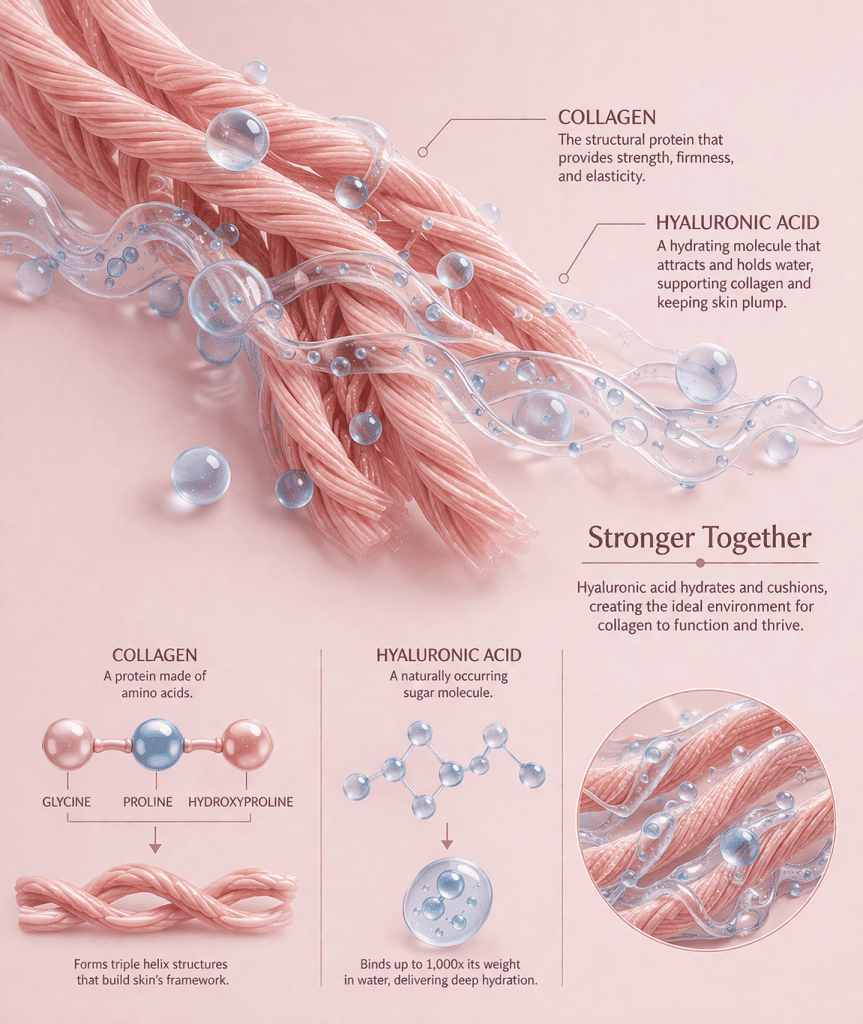
Collagen and hyaluronic acid are two of the most discussed ingredients in modern wellness, but they are often presented in overly simple ways. In reality, both play distinct and complementary roles in human physiology. Collagen contributes to the structural integrity of connective tissues, while hyaluronic acid supports hydration within the extracellular environment where those tissues exist. When considered together, they offer a more complete picture of how the body maintains skin quality, tissue resilience, and overall structural support over time.
Much of the conversation around collagen begins with beauty, especially skin appearance. That is understandable, since collagen is a major component of the dermis and is closely associated with firmness and elasticity. Yet collagen is not only relevant to the skin. It is also a foundational protein in joints, ligaments, tendons, cartilage, and other connective tissues. Hyaluronic acid, similarly, is not only a “skin hydration” ingredient. It is present throughout the body and contributes to lubrication, moisture retention, and extracellular matrix stability.
This broader physiological context is what makes the pairing so meaningful. Rather than viewing them as separate trends, it is more useful to understand how collagen and hyaluronic acid work within the same biological system.
Understanding Collagen as a Structural Protein
Collagen is the most abundant protein in the body. It serves as part of the framework that supports tissues and helps maintain structural integrity. In the skin, collagen fibers form a large part of the supportive architecture of the dermis. In joints and connective tissues, collagen contributes to flexibility, resilience, and mechanical strength.
Because collagen is so widely distributed, it is often associated with a range of wellness goals, from healthy aging routines to joint support and beauty-from-within approaches. Over time, however, natural collagen production declines. This is a normal age-related process that may affect the quality and appearance of tissues. In the skin, this may be reflected in reduced firmness and elasticity. In connective tissues more broadly, it may relate to changes in resilience and comfort.
This is why hydrolyzed collagen has become such a prominent category in nutrition and wellness. By breaking collagen down into smaller peptides, the ingredient becomes easier to digest and more convenient to incorporate into daily supplementation.
Why Hyaluronic Acid Is More Than a Moisture Ingredient
Hyaluronic acid is a naturally occurring glycosaminoglycan found in the skin, joints, connective tissues, and eyes. It is widely known for its remarkable ability to bind water, which is one of the reasons it is so often linked to hydration. But its role is deeper than simple moisture retention.
Within the extracellular matrix, hyaluronic acid helps create the hydrated environment that supports tissue quality and flexibility. In the skin, it contributes to moisture balance and softness. In joints and connective tissues, it is associated with lubrication and cushioning. Its presence helps maintain the physical environment in which structural molecules, including collagen, function.
Like collagen, hyaluronic acid levels also change with age. This is significant because hydration is not just cosmetic. Moisture balance plays an important role in how tissues maintain suppleness, smoothness, and comfort. A decline in hyaluronic acid can affect the skin’s ability to retain water efficiently and may contribute to visible changes over time.
Why the Combination Is Biologically Meaningful
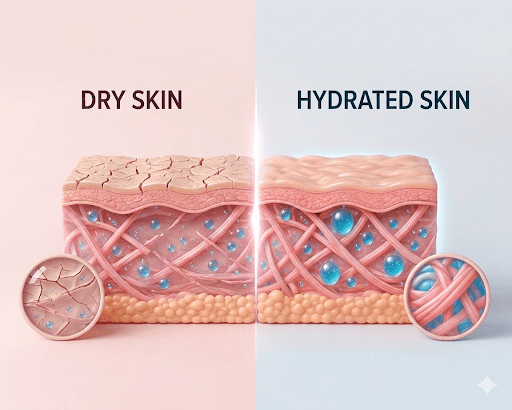
To understand why this combination matters, it helps to think of the body in terms of structure and environment. Collagen provides part of the structural framework, while hyaluronic acid supports the moisture-rich matrix surrounding that framework. One contributes to tissue architecture; the other helps preserve the hydrated conditions that support that architecture.
This is why Collagen Peptides and hyaluronic acid are often considered a more thoughtful pairing than collagen alone. Structure without hydration can lose flexibility. Hydration without structure cannot maintain the same level of tissue support. Together, they reflect a more complete view of how connective tissue is maintained.
This is particularly relevant in skin physiology. Skin quality depends on more than collagen density alone. It also depends on hydration balance, extracellular matrix organization, and the integrity of the environment surrounding collagen and elastin fibers. A formula that includes both collagen peptides and hyaluronic acid therefore aligns more closely with how skin health functions biologically.
The Relevance for Skin, Hair, Nails, and Joints
Although skin is often the primary focus in conversations about collagen, it is only one part of the picture. Connective tissue support affects several visible and structural areas of the body. Hair, nails, joints, and skin are all linked, directly or indirectly, to protein nutrition and connective tissue integrity.
This is why the concept of Collagen for Skin hair and nails resonates with so many people. It reflects the understanding that these tissues are connected through broader biological systems rather than isolated concerns. Hair and nails may be thought of as beauty markers, but they are also part of the body’s larger structural landscape. Joints represent another domain in which connective tissue quality matters deeply.
Still, skin remains a particularly important focus because it is where the intersection of collagen and hyaluronic acid is most visible. Collagen contributes to the supportive structure of the skin, while hyaluronic acid supports hydration and softness within the extracellular matrix. This makes the pairing especially compelling for those interested in beauty support from within.
Why Collagen Peptides Matter in Formulation
Not all collagen ingredients are the same. The term “collagen peptides” generally refers to collagen that has been hydrolyzed into smaller peptide chains. This process improves practicality and supports easier digestion, making collagen more suitable for daily use.
From a formulation perspective, this matters because consistency is one of the most important aspects of any wellness routine. A well-designed ingredient is not only about the headline name on the label, but also about how realistically it can be used every day. Hydrolyzed collagen peptides fit into this model well, which is why they have become so common in high-quality beauty and wellness products.
When paired with hyaluronic acid, the formula becomes more complete. Instead of only offering a structural protein, it also reflects the body’s need for a hydrated extracellular environment. This is what gives the combination a stronger scientific rationale and makes it more aligned with current educational discussions in wellness.
A More Advanced View of Beauty From Within
Beauty-from-within concepts have become increasingly popular, but the most credible approaches are those rooted in physiology rather than trend language. Skin, hair, and nails are not independent features operating in isolation. They are influenced by hydration, protein intake, tissue quality, and overall nutritional support.
That is why collagen and hyaluronic acid together can be understood as part of a more advanced beauty-support framework. They do not promise instant transformation, nor should they be reduced to exaggerated claims. Instead, they represent an evidence-aligned, biologically coherent approach to supporting connective tissue and hydration together.
For women in particular, this matters because wellness priorities often span more than one area at once. Many women are not only interested in skin support, but also in maintaining hair and nail quality, supporting healthy aging, and preserving daily comfort in connective tissues. A formula that reflects multiple dimensions of tissue health is therefore more relevant than one narrowly focused on only a single beauty outcome.
Formulation Quality and Ingredient Integrity
As consumer awareness grows, formulation quality has become more important. A product’s value is no longer judged only by whether it contains collagen, but by how well the formula is designed. The source, form, complementary ingredients, and overall simplicity all matter.
A thoughtful formula recognizes that ingredient synergy is not just a marketing concept. It is a reflection of biological logic. Pairing collagen peptides with hyaluronic acid makes sense because it mirrors the relationship between structure and hydration in the body. This is especially true when the formula is clean, straightforward, and designed with long-term usability in mind.
Consumers today are increasingly drawn to products that feel scientifically grounded and responsibly formulated. In that environment, combinations like collagen peptides and hyaluronic acid stand out not because they are flashy, but because they are coherent.
Final Thoughts
Collagen and hyaluronic acid each serve different but deeply connected roles within the body. Collagen supports the structure of skin and connective tissues, while hyaluronic acid helps maintain the hydrated environment in which those tissues function. When understood together, they represent a more complete approach to connective tissue support, skin wellness, and healthy aging.
This is why the pairing continues to attract interest in both wellness and beauty spaces. It reflects a more intelligent understanding of how the body works. Rather than focusing on one ingredient alone, it considers the broader environment that supports tissue quality over time.
For readers interested in a more thoughtful approach to daily wellness, the combination of collagen peptides and hyaluronic acid offers a valuable framework for understanding how structure and hydration work together, especially in the skin, but also across the broader connective tissue system.
FAQ
What is the difference between collagen and hyaluronic acid?
Collagen is a structural protein that helps support the framework of skin and connective tissues. Hyaluronic acid is a moisture-binding molecule that helps maintain hydration within the extracellular matrix. They have different roles, but they complement each other.
Why are collagen peptides often paired with hyaluronic acid?
They are paired because connective tissue depends on both structure and hydration. Collagen peptides support the body’s structural framework, while hyaluronic acid supports the hydrated environment surrounding that framework.
Is this combination only relevant for skin?
No. Skin is one of the most visible examples, but collagen and hyaluronic acid are also relevant to joints, connective tissues, and broader structural wellness.
Why are collagen peptides used instead of plain collagen?
Collagen peptides are hydrolyzed into smaller fragments, which makes them easier to digest and incorporate into daily wellness routines.
Does hyaluronic acid matter for more than hydration?
Yes. In addition to hydration, hyaluronic acid contributes to extracellular matrix quality, tissue suppleness, and lubrication in connective tissues.
Why do people look for collagen for skin hair and nails?
Because these tissues are all influenced by structural proteins and overall connective tissue support. The phrase reflects a broader wellness perspective rather than a single beauty goal.
Is the combination especially relevant as people age?
Yes. Both collagen and hyaluronic acid naturally decline with age, which is one reason the pairing becomes more relevant in healthy aging and beauty-support discussions.