

Abstract :-
Contact dermatitis is an inflammatory skin condition arising from exposure to physical, chemical, or even emotional irritants. From an allopathic standpoint, it is primarily viewed as a localized disorder resulting from dysfunction of the stratum corneum barrier, cytokine mediated inflammation, and chronicity due to TNF-α regulation. Management focuses on avoidance of triggers and symptomatic relief through topical steroids and emollients. Homoeopathy, in contrast, does not regard skin disease as purely local but as an external manifestation of deeper systemic and emotional imbalances. Homoeopathic management involves mainly individualized constitutional treatment aimed at addressing underlying susceptibility. Emotional factors—such as separation conflicts—are integral in case analysis, with rash location often reflecting symbolic psychosomatic expressions. A comparative analysis highlights that while allopathy ensures rapid relief and effective inflammation control, homoeopathy seeks a holistic, long-term cure by addressing both acute symptoms and constitutional predispositions. An integrative approach, combining the strengths of both systems, may offer a more comprehensive strategy for managing contact dermatitis and improving patient outcomes.
Keywords:- Contact Dermatitis, Allopathy, Homoeopathy, Comparative Study, Psychosomatic Factors, Skin Inflammation
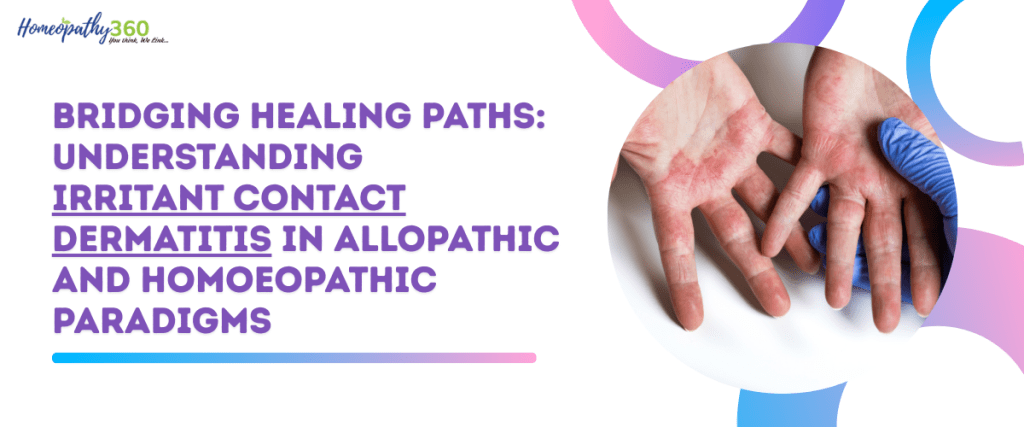
Introduction :- Contact dermatitis arises when the skin comes in contact with physical, chemical, or even emotional irritants. In such situations, the immune system perceives the substance as harmful and activates a defensive response. This often manifests as redness, swelling, itching, or rash formation. In irritant reactions, the rash may develop within minutes of exposure, whereas in allergic forms it may take several hours or even days to appear. (1)
Irritant contact dermatitis is frequently associated with environmental exposure and is observed more commonly in women than men. This gender variation is thought to be related to repeated exposure to household or occupational irritants. Individuals with atopic tendencies are also more susceptible due to impaired skin barrier function and heightened sensitivity to irritants. (2)
Allopathic Perspective :- Irritant contact dermatitis develops primarily due to disruption of the protective barrier function of the stratum corneum. Continuous or repeated contact with physical or chemical irritants in significant concentration can penetrate this outer layer and injure the underlying keratinocytes. In response, the keratinocytes release several inflammatory mediators, including IL-1, IL-6, IL-8, and TNF-α. Among these, TNF-α plays a central role in driving the inflammatory cascade and, through its self-regulating (autocrine) activity, contributes to the chronic nature of the condition. (2)
Management in allopathy usually begins with topical corticosteroids, which help control inflammation and reduce symptoms. The choice of steroid preparation depends on the severity of the eczema, the anatomical site involved, and the patient’s occupational or lifestyle needs. Effective treatment also requires careful identification of the suspected irritants and assessment of individual susceptibility factors that may predispose the patient to recurrent episodes. (2)
Homoeopathic Perspective :-
Local disease are a kind of one-sided diseases in which the changes and ailments appear locally on external parts of the body (sec. 185) (3)
On the local part of the body, irritant contact dermatitis has come under this local disease. According to Master Hahnemann there cannot be, strictly speaking, any local disease of the human organism. All the parts of the organism are intimately connected together to form an indivisible whole in sensations and functions.
(An external lesion which is too trivial to evoke response from the organism as a whole may appear at first sight as local disease. But if the injuries are of severe character, the whole organism sympathizes and there occurs fever etc. The treatment of such cases is relegated to surgery alone with internal homoeopathic medicinal aid.) (3)
When local disease with internal cause arising from internal malady having no external injury, the treatment is the formation of a complete picture of disease by noting the exact character of local affection, all changes, suffering symptoms observable in patient’s health. Symptoms which may have been previously noted when no medicine had been used. By that all symptoms make a totality of symptoms and choose similar medicine according to it.
In case of acute local disease, internal homoeopathic medicines use aconite, rhus tox, bell, mercury, etc….
Acute state of irritant contact dermatitis is to be treated at first , after the acute state has well subsided, anti psoric treatment should be given on the basis of present symptoms and previous morbid state (3)
Skin rashes are often seen as purely physical conditions, but emotional factors can also play a significant role—especially when they are related to separation conflicts. Understanding the Emotional Roots of Skin Rashes: The Link Between Separation Conflicts and Skin Reactions. When someone experiences unwanted separation—such as being unable to hug or hold a loved one or a pet—the skin rash often appears on the inner side of the arms, hands, fingers, or legs. This is where we naturally make contact with others through touch. On the other hand, if a person has the feeling of wanting to separate from someone— emotionally pushing them away—rashes tend to show up on the outer sides of the arms, hands, elbows, legs, knees, shins, or ankles, which symbolically represent pushing or kicking someone away.
The location of the rash can tell us a lot about the emotional context of the conflict. For example:
– Inner arms, hands, legs, fingers: Linked to longing for contact or painful separation.
– Outer arms, elbows, shins, knees, ankles: Reflect desire to push someone away.
– Scalp/face: Identity or recognition conflicts.
– Lips (cold sores): Separation from someone associated with intimacy.
– Chest, belly, genitals, back: Varying conflicts tied to relationships or belonging.
For example, if someone developed a rash during a time of separation while wearing a particular perfume or eating a certain fruit, their body might react with a new rash whenever they smell that perfume or eat that fruit again. This is often diagnosed as contact eczema/dermatitis.
Common triggers (tracks) include:
• Certain foods (like a specific fruit or vegetable)
• Jewelry (such as rings or necklaces)
• Body care products or perfumes
• Animal hair (especially if linked to a pet the person was once separated from) By recognizing these emotional and sensory connections, we can better understand the deeper causes of recurring skin issues—and work toward lasting healing, both emotionally and physically.(4)
Comparative Analysis :-
| ASPECT | Allopathy | Homoeopathy |
| View of Disease | Primarily local, due to barrier dysfunction and cytokine mediated inflammation. | Never purely local; skin disease reflects deeper systemic imbalance (constitutional + emotional). |
| Causation | Physical/chemical irritants damaging stratum corneum. | Internal dyscrasia triggered by external irritants; may also include emotional/psychosomatic conflicts. |
| Pathophysiology | Cytokine release (IL-1, IL-6, IL 8, TNF-α) → inflammation, chronicity. | Dynamic disturbance in the vital force, manifested through skin as external outlet. |
| Treatment Goal | Suppress inflammation, repair barrier, prevent recurrence by avoidance. | Address acute symptoms, then treat underlying constitutional state for long-term cure. |
| Remedies Used | Topical steroids, emollients, barrier creams. | Individualized constitutional remedies. Aconite, Rhus tox, Belladonna, Mercury (acute); |
| Approach to Emotional Factors | Not routinely considered in diagnosis/management. | Integral part of case analysis— location, type of rash may reflect unresolved emotional conflicts. |
| Duration of Relief | Rapid relief but possible recurrence if exposure continues. | Relief may be gradual but aims for deeper, lasting cure by treating root susceptibility. |
Conclusion :-
While Allopathy addresses contact dermatitis primarily as a barrier dysfunction and inflammatory process, offering rapid symptomatic relief through steroids and avoidance strategies, Homoeopathy considers it an expression of a systemic imbalance, treating both acute manifestations and the underlying constitutional tendency.
The comparative analysis highlights the strengths of both systems:
• Allopathy ensures immediate relief and effective inflammation control.
• Homoeopathy seeks a holistic, long-term resolution, including emotional and constitutional factors.
An integrative understanding of both perspectives can contribute to more comprehensive patient care and broaden therapeutic choices.
Thus, integrating the rapid symptomatic relief of allopathy with the holistic, constitutional approach of homoeopathy may create a synergistic model for effective and comprehensive management of irritant contact dermatitis.
References :-
1. Cleveland Clinic. Contact Dermatitis [Internet]. Available from: https://my.clevelandclinic.org/health/diseases/6173-contact-dermatitis 2. Sacchidanand S, editor. IADVL Textbook of Dermatology. 4th ed. Vol 1. Bhalani Publishing House; 2015.
3. Das AK. A Treatise on Organon of Medicine. Vol 2. New Delhi: B Jain Publishers; Year.
4. Principles of Holistic Medicine, German New Medicine