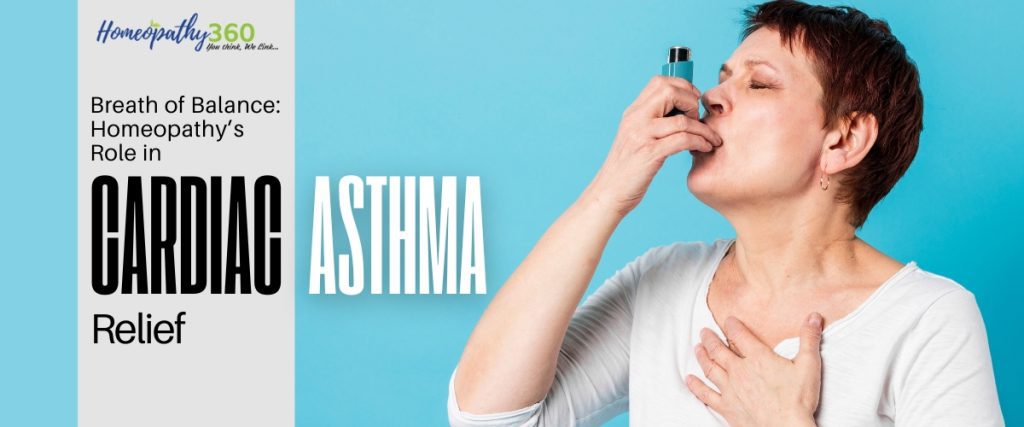
Cardiac asthma is a manifestation of left-sided heart failure that mimics bronchial asthma. Early recognition and differentiation are crucial, as misdiagnosis can lead to inappropriate treatment. A multidisciplinary approach focused on heart failure management is key to symptom relief and improved outcomes.
Homeopathy approaches disease based on individualized treatment, aiming to stimulate the body’s natural healing response. In cardiac asthma, homeopathy doesn’t treat the structural heart condition directly, but may be used as a supportive therapy to help manage symptoms and improve quality of life. Homeopathy may offer symptomatic support in cardiac asthma. use homeopathy only as an adjunct therapy OR as a complementary therapy, not as a replacement.
Key Words- cardiac asthma, wheezing, interstitial, Orthopnea, nocturnal, Cardiomyopathies, hypoxia
Introduction
Cardiac asthma is not a form of true bronchial asthma but rather a clinical condition characterized by wheezing, coughing, and shortness of breath due to congestive heart failure (CHF), particularly left-sided heart failure. The term “asthma” in this context refers to symptoms resembling bronchial asthma, though the underlying cause is cardiac, not pulmonary.
Pathophysiology
Cardiac asthma occurs when left ventricular dysfunction leads to increased pulmonary venous pressure, causing pulmonary congestion and interstitial edema. This fluid accumulation in the lung interstitial and alveoli stimulates pulmonary receptors, triggering bronchoconstriction, cough, and wheezing.
Key mechanisms include:
- Elevated left atrial pressure
- Pulmonary capillary fluid leakage
- Reflex bronchoconstriction via vagal stimulation
- Reduced lung compliance and airway narrowing
Etiology –
Left-sided heart failure, Acute decompensated heart failure (ADHF), Hypertensive heart disease, Mitral valve disease (especially mitral stenosis), Myocardial infarction, Cardiomyopathies.
| SR. NO. | Clinical Features | |
| Symptoms | Signs | |
| 1 | Paroxysmal nocturnal dyspnea (PND) | Inspiratory crackles (rales) |
| 2 | Orthopnea (shortness of breath when lying flat) | Wheezing (cardiac wheeze) |
| 3 | Wheezing | Elevated jugular venous pressure (JVP) |
| 4 | Persistent cough | Peripheral edema |
| 5 | Fatigue | S3 gallop |
| 6 | Chest tightness | Tachypnea and tachycardia |
Differential Diagnosis
Bronchial asthma, Chronic obstructive pulmonary disease (COPD), Pulmonary embolism, Pneumonia
Distinguishing Features:
| Feature | Cardiac Asthma | Bronchial Asthma |
| Age group | Older adults | All ages |
| Onset | Often nocturnal, sudden | Often triggered by allergens, exertion |
| Past history | Heart disease | Atopy, allergies |
| Wheezing | Expiratory + inspiratory | Predominantly expiratory |
| Response to bronchodilators | Poor or minimal | Good |
| Chest X-ray | Pulmonary congestion, cardiomegaly | Hyperinflation, clear lung fields |
Management
| SR.NO. | Acute Treatment | Chronic Management |
| 1 | Oxygen therapy to relieve hypoxia | Optimize heart failure therapy: |
| 2 | Diuretics (e.g., furosemide) to reduce pulmonary congestion | ACE inhibitors / ARBs / ARNi |
| 3 | Vasodilators (e.g., nitroglycerin) to reduce preload and afterload | Beta-blockers |
| 4 | Morphine sulfate (used cautiously): Helps relieve dyspnea and anxiety | Mineralocorticoid receptor antagonists |
| 5 | Positive pressure ventilation (e.g., CPAP/BiPAP) if respiratory distress is severe | SGLT2 inhibitors |
| 6 | Oxygen therapy to relieve hypoxia | Control of comorbidities (hypertension, diabetes) |
| 7 | Diuretics (e.g., furosemide) to reduce pulmonary congestion | Lifestyle modification (salt restriction, fluid management) |
| 8 | Vasodilators (e.g., nitroglycerin) to reduce preload and afterload | Cardiac rehabilitation |
Approach to Cardiac Asthma According to Organon
- Individualization
- No two cases of cardiac asthma are alike. Each patient presents a unique picture.
- Homeopathic remedy is chosen not for the disease, but for the patient as a whole.
- Case-Taking (Aphorisms 83–104)
- Thorough and detailed history is vital.
- Include emotional, mental, physical generals, and peculiar symptoms.
- Miasmatic Consideration
- Chronic miasmatic background must be explored.
- Past history of suppressed eruptions, gonorrhea (sycosis), or syphilitic affections may guide remedy choice.
- Vital Force (Aphorism 9)
- Disease arises when the vital force is disturbed.
- Cure is brought about by stimulating the vital force through the simillimum.
Different Homoeopathic medicines related to Cardiac Asthma
Aspidosperma (Quebracha)
- It’s called digitalis of the lungs
- It removes temporary obstruction to the oxidation of the blood by stimulating respiratory centers, increasing oxidation and excretion of carbonic acid.
- Want of breath during exertion is a guiding symptom
Strophanthus Hispidus-
- Dyspnoea especially on ascending
- Lungs congested
- Bronchial and cardiac asthma
Grindelia
- Difficulty of Respiration during sleep is due to its paretic action on the pneumogastric nerve, so the patient has to keep up in a sitting posture in the bed and sleep is entirely out of question due to interruption of breathing.
- Sense of suffocation and makes an effort to get his breath.
- Heart and lungs are equally weak, which relieves the condition of the two organs.
- In Cardiac asthma, the heart feels too weak to take care of the blood sent to it.
- Inhalation is easy, but expiration is difficult
- Its action on pulmonary circulation relieves asthma and lessens hypertension.
Kalium muriaticum
- Sensation as if the heart and lungs were constricted from vapours of sulphur.
- Expectoration of white mucus and hard to cough up
- < after taking food
- Gastric derangement are the exciting factor
- Congestion of chest with cold feet, emaciation and sunken eyes
Naja tripudians
- Beginning with coryza
- Hay fever with a flow of water from the nose, followed by intense sneezing after a few days, dryness of the lungs and great difficulty of breathing
- Nervous palpitation, can’t speak for choking
Lachesis
- The Heart feels as if turned over and ceased beating for a while, after which the pulsation increases
- He coughs up a quantity of water phlegm with great relief
- Feeling of constriction in throat and chest, as though a cord were tight around it.
- Chest stuffed, short cough with scanty, difficult expectoration.
Cactus Grandiflorus-
- There is a dullness of the lower part of each lung, gradually growing higher and higher from an effusion of serum into lower portion of the lung.
- This hypostatic congestion is due to cardiac weakness
- Could only breathe with the shoulder elevated and lying on back
- Periodical attacks of suffocation with fainting, cold sweat
- 11 o’clock in the morning or at night, symptoms are exaggerated
- Great constriction of chest and relieved as soon as expectorate
- Oppression and uneasiness as its chest was constricted with a hot iron band.
Digitalis Purpura
- Relieve the acute distress of asthma when it is secondary to heart affection
- Respiration slow, asthmatic paroxysms early in morning in cold weather
- Painful asthma worse when walking.
| Sr.no. | Origine or A/F | remedies |
| 01 | Gastric origine | Zingiber, nux vom, kali mur. |
| 02 | Paralysis of lung | Gels, Moschus |
| 03 | Convulsive asthma | Lobelia inflata, Lactuca cirosa |
| 04 | Suppression of rash | Aconite, Sulphur |
| 05 | Hay fever | Arum triphyllum, badiaga |
Time Modalities of Homeopathic Remedies in Cardiac Asthma
| Remedy | Time Modalities |
| Arsenicum album | Worse midnight to 3 AM |
| Grindelia robusta | Worse after midnight, while falling asleep |
| Lobelia inflata | Worse morning, better by evening |
| Digitalis | Worse at night, especially after lying down |
| Cactus grandiflorus | Worse during siesta or at night |
| Spongia tosta | Worse before midnight |
| Carbo vegetabilis | Worse evening and night, better with fan |
| Antimonium tartaricum | Worse at night, around 3–4 AM |
| Kali carbonicum | Worse 2–4 AM |
| Sambucus nigra | Worse after midnight, sudden onset in sleep |
| Rumex | Worse 2 AM |
| Naja | Worse Evening |
| Cactus grandifloras | Worse 11o o’clock in morning and night |
| Ferrum | Worse 12 PM |
| Chininum Arsenicosum | Worse 9 AM |
| Kali bichromicum | Worse 2 AM |
| Kali nitricum | Worse 3 AM |
| Lauroceraus | Worse 6 PM |
| Natrum Sulph, Stannum | Worse 4-5 AM |
| Syphilinum | Worse 1-4 AM |
Different Rubrics Related to Cardiac Asthma
| Category | Rubric | Source |
| Chest – Respiration | RESPIRATION – DIFFICULT – Heart, from affections of | Kent’s Repertory |
| RESPIRATION – ASTHMATIC – Heart, from affections of | Synthesis | |
| RESPIRATION – DIFFICULT – Lying – Aggravates | Kent | |
| RESPIRATION – DIFFICULT – Sitting – Ameliorates | Kent | |
| RESPIRATION – OPPRESSED – Heart, from affections of | Kent | |
| Chest – Cough | COUGH – Heart disease, with | Boericke |
| Chest – Constriction | CHEST – CONSTRICTION – Heart region – Angina, asthma from | Synthesis |
| Heart – General | HEART – ASTHMA – With | Boericke |
| HEART – PALPITATION – With dyspnea | Kent | |
| Sleep | SLEEP – WAKING – Dyspnea, from | Kent |
| Modalities | GENERALITIES – LYING – Aggravates | Kent |
| GENERALITIES – NIGHT – Aggravates | Kent | |
| GENERALITIES – SITTING – Ameliorates | Kent | |
| Mind | MIND – FEAR – Death, of – During asthma | Kent |