
The Homoeopathic Therapeutics of Diarrhoea
The homoeopathic therapeutics of diarrhoea, dysentery, cholera, cholera morbus, and cholera infantum are deeply rooted in the principles of individualization and symptom totality. Repertory plays a central role in translating these principles into clinical practice by systematically organizing symptoms into rubrics and guiding the selection of the most appropriate remedy.
In cases of diarrhoea, the repertory helps differentiate between various presentations such as painless, profuse stools; offensive, watery discharges; or stools associated with colic and tenesmus. Modalities like aggravation after eating, during night, or from cold drinks, and concomitants such as weakness, thirst, or vomiting are crucial. Remedies like Arsenicum album, Podophyllum, Aloe socotrina, and China officinalis are frequently indicated based on repertorial analysis. The repertory allows the physician to move beyond the diagnosis of “diarrhoea” and focus on characteristic symptoms such as gushing stools, involuntary evacuation, or relief after stool.
Dysentery, characterized by frequent, scanty stools with blood and mucus along with tenesmus, is another condition where repertory use becomes indispensable. Rubrics under “Rectum,” “Stool,” and “Abdomen” help capture key features such as straining before, during, or after stool. Remedies like Mercurius solubilis, Nux vomica, Colocynthis, and Ipecacuanha are differentiated through finer symptom details. The repertory aids in identifying whether tenesmus is constant, relieved by stool, or associated with cutting pains, thereby narrowing down the remedy selection.
In cholera and cholera morbus, which present with sudden onset of profuse vomiting and purging, collapse, and dehydration, repertorial evaluation becomes critical due to the rapid progression of symptoms. Rubrics such as “Vomiting and diarrhoea simultaneously,” “Coldness of body,” “Collapse,” and “Cramps in calves” are frequently used. Remedies like Veratrum album, Camphora, and Cuprum metallicum are classic choices. The repertory helps distinguish between these remedies based on subtle differences—such as the presence of intense thirst, profuse cold sweat, or violent cramps.
Cholera infantum, commonly seen in infants during hot weather, requires special attention to factors like dentition, feeding, and seasonal aggravation. Repertory rubrics include “Children,” “Summer complaints,” “Dentition,” and “Stool—offensive, watery, greenish.” Remedies like Podophyllum, Chamomilla, Calcarea phosphorica, and Arsenicum album are selected based on individual symptomatology. The repertory assists in correlating general symptoms like irritability, restlessness, or prostration with local gastrointestinal manifestations.
Overall, the repertory serves as an indispensable clinical tool in managing gastrointestinal disorders. It transforms scattered clinical observations into structured rubrics, enabling logical analysis and remedy selection. However, its effectiveness depends on accurate case-taking and proper understanding of rubric hierarchy and cross-references. While repertory guides remedy selection, it must always be complemented by Materia Medica verification to ensure the final prescription aligns with the patient’s totality.
In conclusion, the repertory not only enhances precision in homoeopathic prescribing for diarrhoeal diseases but also strengthens the scientific basis of remedy selection. Its judicious use leads to effective, individualized, and rapid therapeutic outcomes, especially in acute conditions like cholera and dysentery.
Plan and construction of bells diarrhea
(PUBLISHED IN 1869 BY JAMES B BELL)
Macro construction
Preface
Introduction
Plan and construction
homeopathic therapeutics (MM)
repertory partList of authors Additional work and index in general part 1 and part 2 in alphabetical order
Micro construction
Preface (1, 2 , 3, 4)
Introduction
Character and object of the work
The selection of the remedy
The administration of the remedy
Plan and construction
The book has been divided into two parts
Part 1 –The remedies and their indications (MM OR THERAPEUTIC PART)
Part 2 –Repertory Proper
In part 1: Remedies with their indications: acetic acid – zingier Under each remedy Type of stool Aggravation Amelioration Before stool During stool After stool Accompaniments | Materia Medica part arrangement CHAPTER IS GIVEN IN CAPITAL BOLD In ordinary – common symptoms. |
In Part 2 – Repertory proper:
CHAPTERS – CAPITAL BOLD
RUBRICS CAPITAL BOLD
SUB RUBRICS ———- bold ROMAN
REMEDIES 4 GRADES
bold- first grade- 4 marks
Italics- second grade -3 Marks.
Ordinary roman-third grade -2 Marks.
( Roman ) – Fourth grade -1 Mark.
CROSS REFERENCE – SEE, IN BOLD ROMAN
ARRANGEMENT OF RUBRICS:
Under all chapters and sub chapters the rubrics are arranged alphabetically.
Chapter 1: Pathological names.
This chapter gives direct pathological rubrics like (4 main rubric)
CHOLERA- asphyctic, infantum, morbus.
DIARRHOEA-
DIARRHOEA- chronic, infantile.
DYSENTERY- periodical in the early part of summer, every year on the same month and day: kali bich.
Rubrics are in bold capital letters.
Sub rubric in bold roman
Chapter 2: Character of the Stools. This Chapter deals with different types of Stool. For example: Aluminous, Bilious, Bloody, Coffee ground like, Copious, Frothy…
Some rubrics are having single remedy
Bilious, in albuminuria: terebinth.
Coffee grounds, like: dig
Chapter 3: Conditions of Stools and of the accompanying symptoms. Under the heading aggravations not only aggravating modalities are given but also many causative modalities are placed.
a)Aggravation • Acid after • Aged person in
B) Amelioration • Air, in open • Drinks cold • Ice cream
Chapter 4: Accompaniments of the evacuations this chapter is divided into three sub chapters. a. Before stool b. During stool c. After stool In this Chapter all the symptoms that accompany diarrhea before, during and after are included.
Here also many single remedy rubrics
a) Before stool • Abdomen, aching, sore, in upper part of • Fainting • Nausea
b)During stool abdomen, bearing down in, Exhaustion, Palpitation
c)After stool abdomen, burning in Calves, cramps in, Drowsiness, Fainting
Chapter 5: General accompaniments there are 23 sub chapters are given which are arranged according to Hahnemannian schema. Under each heading a peculiar concomitant state of patient suffering from diarrhea is given. For example: Mind and Mood – anxiety, Crying, Depression, Irritability.
Includes all the symptoms that occur during the attack.
23 SUB SECTIONS (chapter in capital bold and rubric in bold roman)
MIND AND MOOD TO GENERAL SYMPTOMS IN ALPHABETICAL ORDER
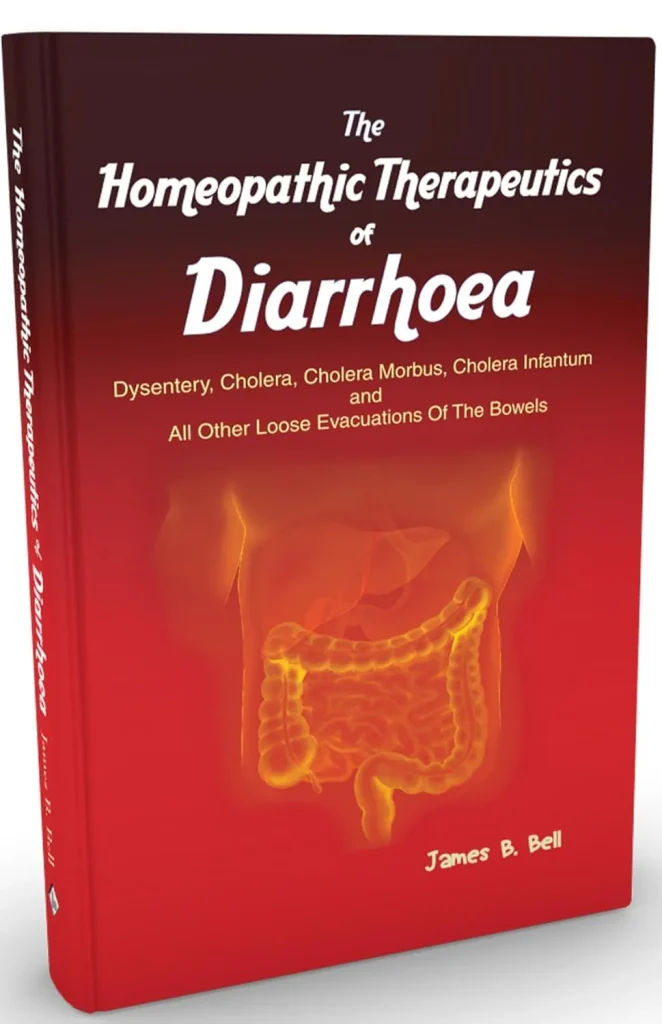
Title – The Homoeopathic Therapeutics of Diarrhoea
Author: Dr James Bachelder Bell
ISBN: 9788131901557
Imprint: BJain Regular
Pages: 320
Format: Paperback
Language: English
Dr Ganapati MD(Homp)
Associate Professor
Department Of Repertory
Shree Bhagwan Homp. Medical College
Chh. Sambhajinagar