How to Succeed in Homoeopathic Practice?
I strongly feel that before I write about this book, I must tell you about the author Dr R Prakash, who is no longer with us now in this world. “As a Homeopathy student, Dr R Prakash was a hardworking student, who used to note down every point told by the teachers. He had a good reading habit too, especially books related to Organon and Homeopathic philosophy. He used to share his ideas with his classmates”, says Dr Jayalalitha, one of his classmates at Dr Padiyar Memorial HMC, Ernakulam, Kerala. Dr R Prakash started his practice immediately after completing his education, and became a well-known practitioner who successfully managed many incurable cases without drifting from his Organon based practice. Later, when he joined the same college as a teacher, his OPD was always crowded with patients, mainly complicated and so-called incurable cases. He had the quality to share his knowledge with everyone. Even when he became sick and unable to travel and write, he used to share knowledge through his voice messages. Let’s offer tribute to that great legend who dedicated his entire life to Homeopathy.
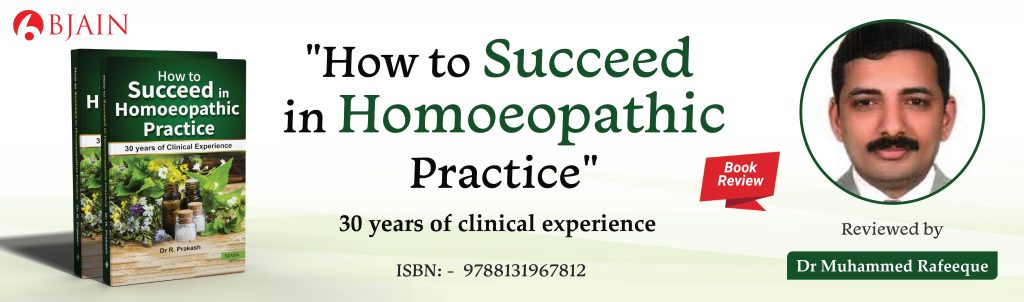
Now, let me go through the book entitled ‘How to Succeed in Homeopathic Practice – 30 years of Clinical Experience’, written by Dr R Prakash, and published by B Jain Publishers, New Delhi. In this book he has shared his thirty years clinical experience. Normally, Organon teachers do not talk much on clinical tips due to fear of students going away from the principles and the holistic approach of homeopathy. But, in this book, we can say his last words, he has given many valuable tips that are verified in his practice. He has not given any clinical tips blindly, but on the basis of some indications that are valid for a successful prescription.
Let’s go part by part. The book is divided into two sections. Section ‘A’ and section ‘B’. The section ‘A’ deals with Applied Organon of medicine, dealing with the fundamentals of Homeopathic philosophy and practice. Here the significance of Organon in practice is dealt with. He has explained everything in simple language that can be understood by even a beginner. There are many hidden points in Organon having a therapeutic utility, which we do not read much due to a wrong notion that too much study of philosophy can make practice difficult. He has explained the basic things on health, disease causing factors, types of diseases and approach to cure on the basis of Organon. The origin of diseases and progress and the homeopathic management in terms of remedy selection and potency and dosage explained in simple language. Then comes Kent’s 12 observations along with the approaches to be followed under each observation. He has also mentioned the classification of symptoms and its significance, followed by prescribing in each type of disease. The book also throws light on the origin and progress of diseases, indications of miasms, obstructions to cure, then the Homeopathic management including potency selection and dosage.
The section ‘B’ deals with clinical materia medica and therapeutics. He starts with lifestyle diseases and therapeutics. Homeopathic remedies with key indications are given here. He has covered obesity, diabetes, dyslipidemia, hypertension, etc. He has included many rare remedies too, with key indications. Then comes some points on cancer, the origin and the diagnostic features. Here the cancer remedies include many secret remedies too, which we do not get to read in many books. He has covered stroke, chronic liver disease, chronic heart disease, chronic kidney disease, acid peptic disease and osteoporosis. We get many useful remedies for practice under each topic. Most of the remedies are repeatedly verified by him in his busy practice.
Then comes the key indications of some polycrest remedies, followed by some aetiological prescriptions, and the key indications of some rare remedies. This chapter is followed by some clinical tips, arranged under the headings as per the repertory chapters such as mind, head, vertigo, etc., up to generalities, followed by injury remedies, ‘trios’ remedies, finally remedies for the irritable children. The next chapter deals with general conditions and remedies, which provide the thermal reactions + miasms + side affinity, making the remedies to be understood easily and remembered easily in front of a patient. He has also included the indications for tissue remedies, organ remedies, and diathesis related remedies.
The next chapter deals with frequently used homeopathic remedies with characteristic indications, which ranges from Aconite to Zincum met. Then comes the ‘Spot the remedy chart, in which Acetic acid to Tuberculinum are presented in a chart-like format showing the physical, chemical and medicinal causes and nervous types of each remedy. The next chapter is the Art and science of homeopathic pediatrics. It also gives the qualities needed for a homeopathic pediatrician for a successful case taking, history taking and general management. The next chapter deals with Homeopathic remedies for common pediatric conditions ranging from adenoid hypertrophy to tonsillitis. On an average 10 remedies are given with indications under each disease condition. This is followed by a chapter on key indications of homeopathic remedies in pediatrics, ranging from Ammonium carb to Zincum met.
There is an exclusive chapter for Monsoon GIT diseases, dealing with an integrated approach. There are a number of GIT troubles with indications of useful remedies. Another unique feature of this book is, he has provided an exclusive chapter for Covid-19 complications, discussed under different systems affected by Covid, along with remedies. The next chapter deals with the scope of Homeopathy in rheumatology, types of rheumatic diseases and the clinical indications. He has given constitutional remedies in rheumatology ranging from Aconite to Valeriana. The next one is the largest chapter in this book, ‘Dealing with Boericke’s Materia Medica at a glance’. Here the valuable indications that are verified by practice are given, which ranges from Abies can to Zingiber (from page 283 to 442). The last chapter is exclusively for five cases he had treated, which starts with a case of SLE and ends with a case of Tinea capitis.
His family members, Homeopathic colleagues, editors and the publisher took tremendous efforts to bring this work in the form of a book. Surely this book will satisfy all categories of readers as this book was based on his personal experience. A book from a person whose entire life was dedicated to the promotion of homeopathy has its own importance. Definitely this book can be kept on the table of all busy practitioners who wish to experience the wonderful therapeutic utility of Homeopathy.
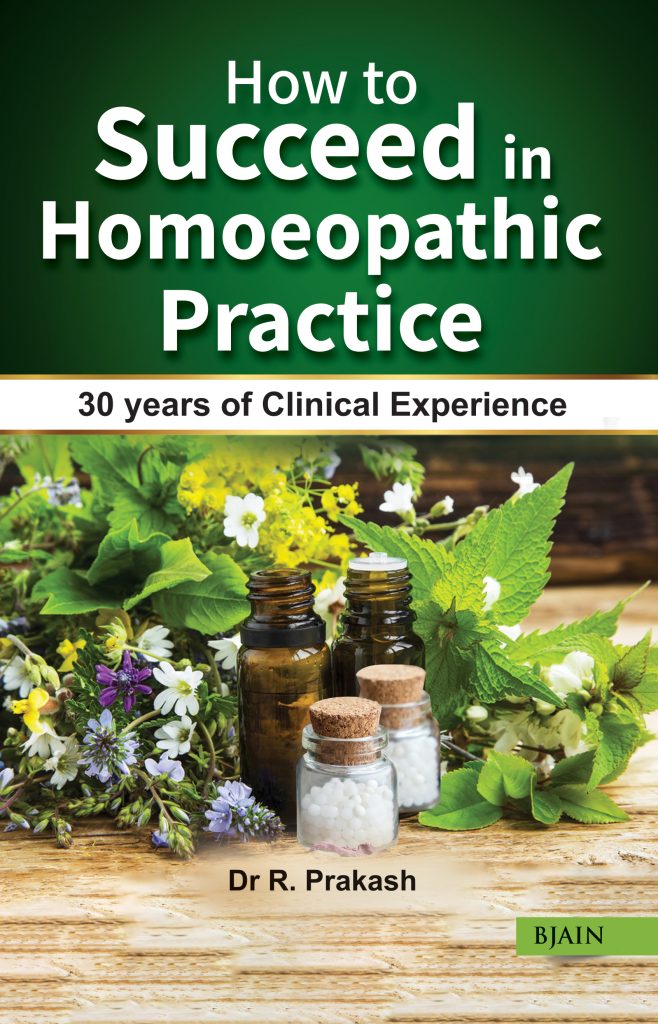
Title: How to Succeed in Homoeopathic Practice?
Author: Dr R Prakash
ISBN: 9788131967812
Imprint: B Jain Regular
Pages: 450
Format: Paperback
Language: English