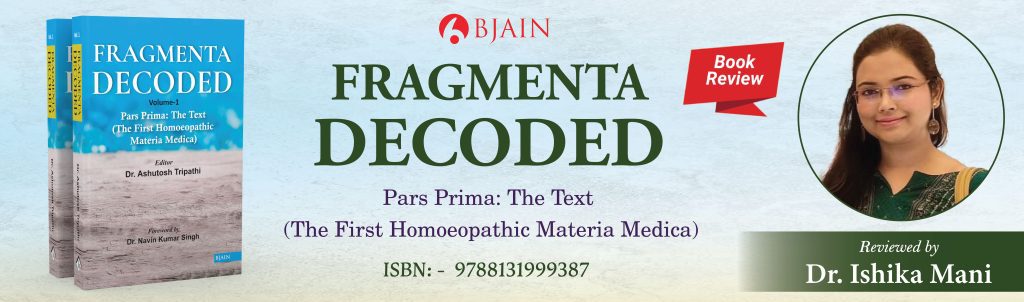
EDITOR’S CREDENTIALS:
Dr. Ashutosh Tripathi, the editor of Fragmenta Decoded, is a Medical Officer (Homoeopathy) at the All India Institute of Medical Sciences (AIIMS), Raipur. He is a graduate of the Oldest Homoeopathic Institution in Asia, The Calcutta Homoeopathic Medical College and Hospital and has completed his Post Graduation from the most premier institute of Homoeopathy, National Institute of Homoeopathy, Kolkata. Dr. Tripathi is currently pursuing PhD at Parul University. He has contributed extensively to homoeopathic literature and possesses over a decade of clinical, academic and research experience. Fragmenta Decoded reflects his scholarly commitment for preserving and revitalizing foundational Homoeopathic works towards contemporary readers.
OVERVIEW OF THE CONTENT:
“Fragmenta de Viribus Medicamentorum Positivis” is the earliest systematic compilation of Homoeopathic Drug provings by Dr. Samuel Hahnemann published in 1805, written in Latin language. Being a foundational work for the development of Homoeopathic Materia Medica, it has remained largely inaccessible to many Homoeopathic students as well as practitioners by the paucity of translation in English. “Fragmenta Decoded” has played a pivotal role not only as a translation, but as an earnest attempt at understanding the work by Master Hahnemann. The book goes far beyond a literal translation, enriches the original text through cross-references to Hahnemann’s later works, Materia Medica Pura and The Chronic Diseases, repertorial correlations between Pars Secunda and Pars Prima medicines, and comparisons with subsequent Latin editions of Fragmenta de viribus.
- The opening comprising a Foreword by Dr. Navin Kumar Singh, a Preface by the editor, Dr. Ashutosh Tripathi, and a Publisher’s Note by Manish Jain. This section offers valuable insights into the genesis, scholarly significance and also emphasize its value as an accessible resource for students, practitioners, and researchers of Homoeopathy.
- Following the Publisher’s Note, the book presents Hahnemann’s original Preface, supplemented with explanatory footnotes clarifying the core of the context.
- This book contains 27 medicines as separate chapters with an editor’s introduction for each, containing some precise information about the medicine.
- The annexures represent a treasure trove of valuable information, bring together several rare and insightful compilations including a list of residual symptoms, a comparative synopsis of Digitalis, a comparative table of the 1805 Leipzig edition and the 1824 Naples edition of Fragmenta, an evaluation of the gradation of symptoms from Fragmenta de Viribus Medicamentorum Positivis to Materia Medica Pura and Chronic Diseases and many more.
CRITICAL EVALUATION:
A critical appraisal of Fragmenta Decoded reveals it to be a thoughtfully conceived and meticulously executed work that contributes significantly to the study of classical Homoeopathic literature. A critical assessment of the work brings forth the following noteworthy observations:
- FIRST ENGLISH TRANSLATION OF HAHNEMANN’S FRAGMENTA:
“Fragmenta Decoded” is the first ever English translation of “FRAGMENTA DE VIRIBUS MEDICAMENTORUM POSITIVIS SIVE IN SANO CORPORE HUMANO OBSERVATIS” published in 1805 in Latin language. It contains two volumes-
- Pars Prima Textus, which forms the First Homoeopathic Materia Medica.
- Pars Secunda Index, which is recognized as First Homoeopathic Repertory.
- Description of every medicine in Pars Prima contains method of preparation, so also the First Homoeopathic Pharmacy as well.
So, basically it was a pilot study on human drug proving by Master Hahnemann and also the foundational pillar of all Homoeopathic literature. Such a historic treatise was outreached for last 200 years to readers unfamiliar with Latin. To know about original Fragmenta one has to depend on articles on Fragmenta which claiming no need to study the original book. “Fragmenta decoded” overcomes this longstanding linguistic barrier, enabling a wider audience to explore Hahnemann’s original observations and provings without relying on secondary exposition.
- NOT MERELY A TRANSLATION BUT AN INTERPRETATION:
This book is not only the literal translation from various available AI tools like ChatGPT, Google Translate, Meta AI, Grok but also
- corresponding the symptoms of Pars Prima with Hahnemann’s later work Materia Medica pura and The Chronic Diseases.
- Repertorial correspondence of Pars Secunda with medicines of Pars Prima.
- Correspondence with later Latin editions of Fragmenta, like Naples edition (1824) and Quin’s edition (1834) wherever required.
- CONCEPT OF ABSOLUTE SYMPTOM AND RELATIVE POWERS:
In editor’s preface, the concept of Absolute symptoms and Relative powers is explained in a comprehensible way. Absolute symptoms refer to those symptoms which appears on healthy human being during drug proving and the symptoms which appear on sick persons get mixed and complicated with natural disease is termed as Relative powers by Hahnemann.
- GRADATION OF SYMPTOMS:
There are technically 4 grades of symptoms in Fragmenta-
- BOLD
- Italics
- Roman
- (Roman)
But the BOLD is only 2 in number, belongs to Aconite and treated same as italics in Materia Medica Pura. So, practically there are 3 grades in Fragmenta, i.e. Italics, Roman and (Roman).
- CONCEPT OF RESIDUAL SYMPTOM:
The understanding of ‘Residual symptom’ becomes more easier by this book. In Hahnemannian drug proving, a residual symptom refers to a symptom that occurs due to enormous dose and persists after the main action of the medicine has ceased and remains observable in the prover for a longer period than the majority of proving symptoms. They may reveal the characteristic and long-acting effects of a medicine. It may be primary or secondary symptom. List of residual symptoms of different medicines are given separately in Annexure V.
- CONCISE EXPLANATORY FOOTNOTES:
The inclusion of explanatory footnotes in Hahnemann’s preface is one of the commendable features of the book. These significantly enhance the reader’s understanding of the text by elucidating historical references, clarifying archaic terminology and highlighting key concepts. These annotations elucidate Hahnemann’s ideas, makes it more accessible to contemporary readers without compromising the authenticity of the original work.
- EDITOR’S INTRODUCTION:
The Editor’s Introduction preceding each medicine serve as an intellectual appetizer, containing-
- Chronological order of the medicine in Hahnemann’s Fragmenta.
- Number of pages containing description of the drug.
- Total number of symptom (given by Hahnemann and other observers)
- Gradations of symptoms belongs to the medicine.
- Whether enlisted in Materia Medica Pura and The Chronic Diseases.
- CORRESPONDENCE WITH MATERIA MEDICA PURA & THE CHRONIC DISEASES:
An appealing advantage of the book is that it enables readers to cross-reference the medicines and symptoms recorded in Fragmenta with their subsequent representation in Materia Medica Pura and The Chronic Diseases. This facilitates to understand the journey of individual remedies from Fragmenta to Hahnemann’s later works and helps readers to appreciate the evolution of symptomatology and remedy profiles within the Hahnemannian corpus.
- SYMPTOMS OBSERVED BY HAHNEMANN AND OTHER PERSON:
By going through this book, one gets the opportunity to differentiate the symptoms of a medicine observed by Hahnemann and other observers. Even in Annexure I, II & III 3 symptoms chart are given by Dr. Richard Hughes, Dr. Richard Haehl and corrected symptom chart by Editor Dr. Ashutosh Tripathi regarding this.
- PROCESS OF PREPERATION AND DURATION OF ACTION OF MEDICINE:
As detail description of each drug containing method of preparation and duration of action as mentioned in Hahnemann’s Fragmenta, this feature bridge the gap between historical drug provings and their practical application, making the information relevant to both scholars and clinicians.
- APOTHECARIES’ WEIGHT SYSTEM:
The Apothecaries’ Weight System was a traditional system of weights and measures employed by physicians and pharmacists for preparing, compounding and dispensing medicines during late 18th and early 19th century, prior the adoption of the metric system. Hahnemann also used this system of measurement in his provings and pharmaceutical preparations. The inclusion of this historical measurement system along with their modern metric conversions in annexure assists researchers in comparing Hahnemann’s methods with modern pharmaceutical standards.
- ERRORS IN FRAGMENTA:
Fragmenta Errata section in annexure demonstrates the editor’s commitment to textual accuracy and scholarly rigor. Identifying and correcting errors present in the original editions or subsequent reproductions. Such editorial transparency enhances the credibility and academic value of the volume. This section is particularly valuable for researchers and historians, as even minor inaccuracies in proving records, remedy names, or symptom descriptions can influence interpretation and comparative study.
REVIEWER’S NOTE:
By unlocking the linguistic barriers Fragmenta Decoded transforms a historically important but largely inaccessible text into an accessible academic resource. Through thoughtful editorial guidance, explanatory notes, and extensive comparative studies the book renders a multidimensional understanding of the evolution of Homoeopathic Materia Medica. However,
a minor typographical oversight has been noted in some instances.
The book is highly recommended for students, postgraduate scholars, academicians, and practitioners seeking a deeper understanding of Hahnemann’s earliest proving records and their subsequent evolution.
CONCLUSION:
More than a translation, Fragmenta Decoded is a scholarly reconstruction of Hahnemann’s first Materia Medica. Its meticulous editorial work, extensive cross-referencing, and valuable annexures make it an important contribution to homoeopathic literature and a worthy guide for anyone seeking to explore the origins of Homoeopathic Drug proving. It deserves a place in every academic and professional Homoeopathic library.
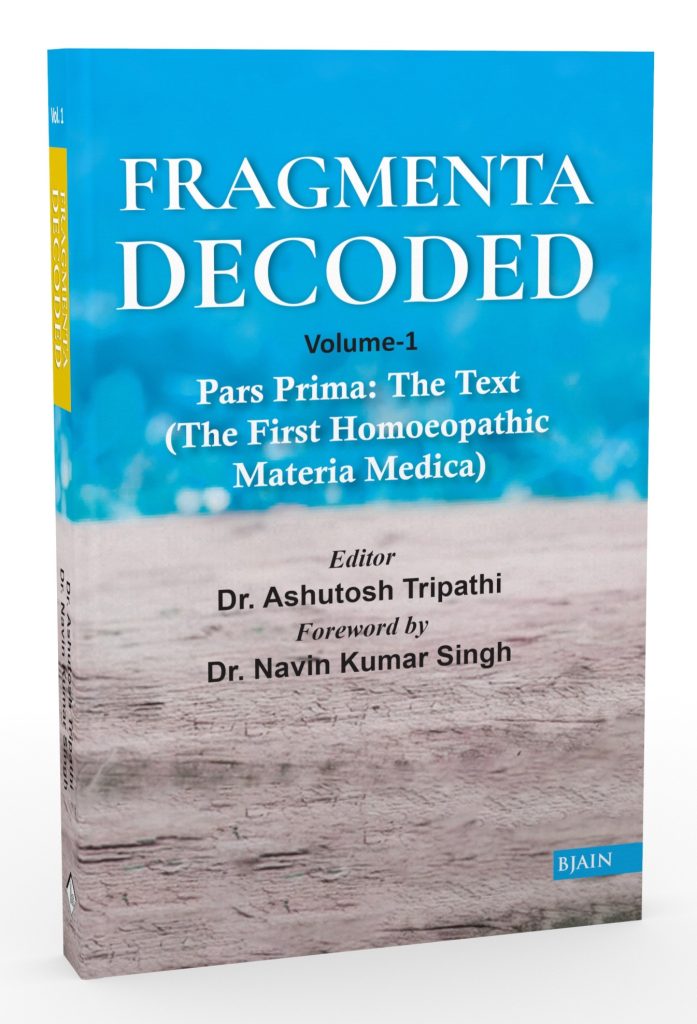
Title: Fragmenta Decoded
Author: Dr. Ashutosh Tripathi
ISBN: 9788131999387
Imprint: BJain Regular
Pages: 357
Format: Paperback
Language: English
Dr. Ishika Mani
B.H.M.S (WBUHS); Post Graduate Trainee, Department of Materia Medica, The Calcutta Homoeopathic Medical College and Hospital, 265, 266, A.P.C Road, Kolkata- 700009, West Bengal, India.