Dick Moskowitz is one of our brighter homeopathic stars renowned as an able practitioner and as a writer. His latest book, Conscientious Objector: Why I Became a Homeopath, written since his retirement from active practice, is part biography, part polemic.
The first few chapters detail his zigzag journey to becoming a medical doctor followed by doctoring in Boulder, Colorado, Santa Fe, New Mexico, and lastly, Boston. From the outset, he endeavored to practice a kinder, gentler medicine. In Boulder, he wrote that he was “giving out ample helpings of education and advice, and doing as little as possible of a drastic or aggressive nature. I saw my role as essentially guiding people through the complicated and tortuous labyrinth of the medical system and protecting them from being hurt too badly.” This attitude earned him the gratitude and trust of his patients while managing to alienate and sometimes even infuriate his allopathic colleagues.
What strikes one throughout the book is Moskowitz’s penchant for total honesty even at the expense of occasional self- disparagement. Very evenly, he praises those doctors whom he felt truly cared for their patients while not refraining from pointing out medical arrogance and hubris which he frequently encountered. The book brims with fascinating medical escapades (and I use the term advisedly). I have no doubt as to the veracity of his vignettes but be forewarned: Moskowitz is a first-rate storyteller who knows how to spin a yarn making the book, especially the first part, hard to put down.
Conscientious Objector is a kind of medical Pilgrim’s Progress whereby the hero, in this case Moskowitz, sees his life as a quasi- spiritual pursuit as he faces various trials (read here moral dilemmas and medical emergencies) and encounters a motley group of characters (doctors, midwives, and patients) representing an assortment of virtues and vices.
A moral dilemma: In the summer after his Junior year at Harvard he worked as a trainee in the Jackson Laboratory in Bar Harbor, Maine where one of his duties was to sacrifice experimental mice. He referred to this task as “little murders [which] disgusted and appalled me” and, with his wry sense of black humor, went on to liken his work and similar work in other labs to “a vast decentralized Auschwitz for mice and other animals.” He wondered (one presumes tongue in cheek) if he might be “a future Dr. Mengele in the making.” His solution: hole up in a corner of the library where he avidly read the works of Sigmund Freud whose writings enchanted him.
A medical emergency: At one point in New Mexico he delivered a healthy baby but the placenta would not expel. After waiting an hour, he pulled on the umbilical cord and extracted the placenta but it was still attached to the uterus. In fact, the uterus turned inside out and the woman was hemorrhaging badly with extremely low blood pressure. Unable to stop the bleeding and realizing he was in over his head, Moskowitz drove the woman “as fast I dared” to the hospital 20 miles away. On arriving, the woman was barely conscious and with an undetectable blood pressure. Fortunately, a young obstetrician happened by and knew exactly what to do. “Putting on a rubber glove, he rammed his fist into the woman’s vagina as hard and as far up as he could; and she awoke and sat up in a matter of seconds as if nothing had happened, with a blood pressure of 130/70, a sight I’ll never forget and would not have thought possible.” That incident left Moskowitz, a staunch critic of conventional medicine “with gratitude and admiration for so much that it [allopathic medicine] has achieved.”
When at Harvard, he had no predetermined interest in medicine; in fact, he had not even sent in an application to medical school by late spring (classes set to start in the fall). At that point his father swung into action, made a tactical call and “The next thing I knew I was going to NYU in the fall, well aware the class was already full and I had no business being in it.” In the spring of his last year (the time when medical students apply for internships and residencies) he had no idea what to do. “I felt completely up in the air…without any clear direction or purpose…” At this point, his brother proposed he study philosophy “which felt totally right.”
Believing he was leaving medicine “once and for all” he boycotted his own graduation ceremony much to the chagrin of his father. After 3 years at the University of Colorado in Boulder studying philosophy, he did an internship, got a Colorado license and began specializing in home births, quite unheard of for a medical doctor in that era. Over a thirteen-year period he attended around 600 home births. In Santa Fe, after studying some acupuncture, he ended up embracing homeopathy because, he writes, “it [acupuncture] felt too alien culturally…”
Moskowitz, like me, got his first formal introduction into homeopathy at “The Millersville Course,” a two- week summer course in Millersville, Pennsylvania, taught by the few dedicated (and aging) homeopaths left in America. Little did we know at the time that a few years hence we younger homeopaths would be bearing the torch for classical homeopathy in America. By the third chapter of Conscientious Objector Moskowitz is in full swing with homeopathy as he details a series of fascinating cures. One case in Chapter 5 entailed the use of Lapis albus (Silico- fluoride of Calcium.) A 15-year-old girl had such severe menstrual cramps that she sometimes fainted. Moskowitz, using Kent’s Repertory, found the rubric, “Faintness, before menses, from pain” where Lapus albus was listed in italics. Admitting he knew nothing about the remedy and that he had never even heard of it, he prescribed it with brilliant success thus illustrating the beauty of allowing an unusual symptom to govern the selection of the medicine.
How unlike allopathic medicine wherein all uncommon symptoms are dismissed and every diagnosis mandates a set prescription. We homeopaths refer to our approach as the inductive method and we proceed very much like a careful detective who scrupulously gathers this and that bit of evidence and allows the evidence to lead to the conclusion. If the conclusion is surprising or novel, so be it. It is the assembled clues that are all important.
Espousing this approach, Moskowitz relates a number of cases in which lesser known homeopathic medicines such as Cistus canadensis, Chimaphila and Agaricus were successfully prescribed. On page 130 of Chapter Five, “Medicines and Cases,” under the heading, “Homeopathic Research” the book veers away from the anecdotal. Moskowitz begins summarizing six studies proving the efficacy of homeopathic medicines and then writes: …if treatment with homeopathy yields results equal to or better than drugs, then logic, science, and common sense would all argue for using the cheaper, gentler, and safer method first, and saving the heavy artillery (read allopathic interventions) for when it fails.
In case Moskowitz’s proposal sounds naïve, I can attest that a similar system already existed in Castro’s Cuba when I taught homeopathy there in the early 2000s. The first level of care included diet and nutrition, plants and medicinal herbs, acupuncture and homeopathy. If the problem could not be resolved at that level the patient was referred up the medical ladder. The final rung was a fully-equipped hospital, usually in a large city, that emphasized pharmaceuticals and surgery. All medical treatment in Cuba was, and I assume still is, free. That such a system might come to pass in the United States is, of course, unlikely; but let it be known, Cuba has proved it feasible. Just doesn’t jibe well with capitalismo.
Chapters 6 through 10 have an entirely different flavor from the earlier chapters. Absent is Moskowitz the raconteur who tells anecdotes in a skillful and amusing manner. No longer the homespun philosopher, he is, in the latter chapters, the hard-hitting critic of modern or so-called ‘scientific’ medicine. These chapters require more attention as Moskowitz sometimes employs technical terms not familiar to the average reader.
Chapters 8, 9, and 10 are a brilliant analysis of the shortcomings (read dangers) of allopathic medicine and especially vaccines. Moskowitz has been a critic of vaccines for a good fifty years and probably knows as much or more about the subject as anyone. Every criticism is carefully referenced in the scientific literature making his arguments virtually impossible to refute though I realize I am being naïve when I write that as the hugely powerful medical establishment believes quite the contrary. Moskowitz sums it up when he writes that vaccines “…enjoy an almost religious veneration in our country.” Conscientious Objector: Why I Became a Homeopath is – with apologies to Charles Dickens – a kind of Tale of Two Cities with a charming folksy first part and a second part that is a withering (but fair) and very precise critique of allopathic medicine. It is a major opus.
Disclosure : Though Dick went to Harvard, and I to Yale, I venture to say that our allegiance to homeopathy outweighs our allegiance to our Alma Maters.
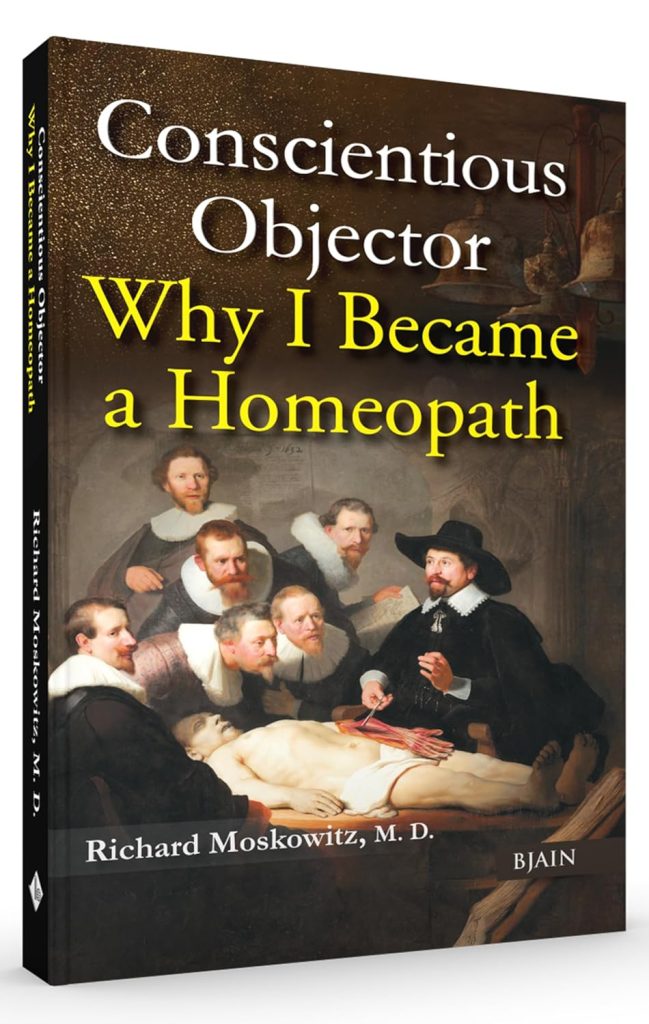
Title: Conscientious Objector – Why I Became A Homeopath
Author: MOSKOWITZ RICHARD
ISBN: 9788131967997
Imprint: B Jain Regular
Pages: 294
Format: Paperback
Language: English