Introduction
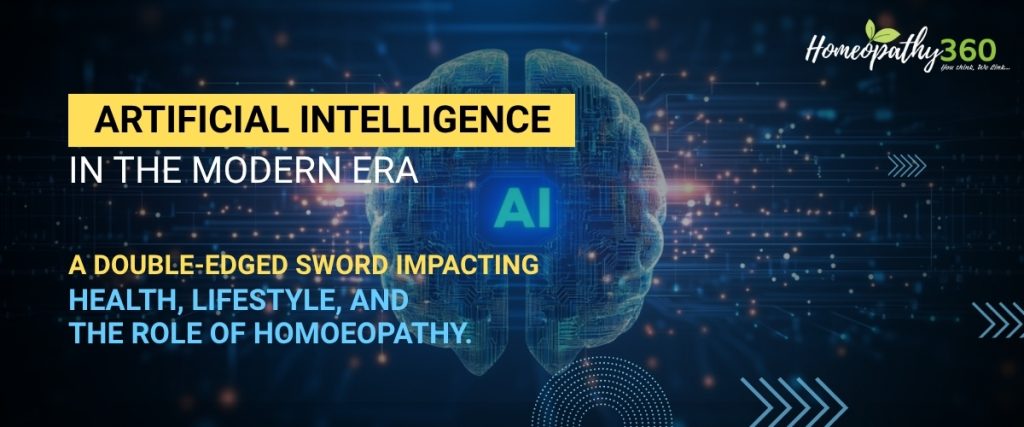
Artificial Intelligence (AI), once a subject of futuristic science fiction, has now become a defining force in nearly every aspect of human life. From virtual assistants and automated diagnostics to smart homes and personalized advertisements, AI’s presence is ubiquitous. While it has undeniably brought progress, convenience, and efficiency, its widespread integration has also raised concerns regarding health, emotional well-being, dependency, and erosion of natural lifestyle rhythms. As healthcare embraces AI-driven tools, it becomes critical to examine its influence holistically—particularly from the perspective of holistic systems like Homoeopathy, which emphasise individualized care, mind-body balance, and the natural healing process.
Benefits of AI in Modern Life and Healthcare
AI has transformed many sectors, including medicine. In diagnostics, machine learning algorithms can analyze imaging and lab data faster and sometimes more accurately than humans. Chatbots, virtual nurses, and wearable AI-powered health monitors offer 24/7 assistance, track vitals, and prompt lifestyle corrections. In Homoeopathy, AI is being developed to support repertorization, remedy selection, and even study of materia medica.
Furthermore, AI helps streamline administrative tasks, allows data-driven research analysis, and improves patient outreach. For practitioners, especially in rural or resource-poor settings, AI can be a bridge to better care through telemedicine and knowledge-sharing platforms.
Disadvantages and Health Implications of AI Overuse
Despite its advantages, excessive reliance on AI has led to sedentary lifestyles, mental health concerns, and emotional detachment. Constant screen exposure contributes to digital fatigue, disrupted circadian rhythms, and eye strain. Algorithm-driven social media promotes unrealistic expectations and reduces self-worth, often causing anxiety and depression.
AI tools that simplify daily chores may reduce physical activity, indirectly contributing to obesity, metabolic disorders, and postural problems. Increased automation can desensitize humans to natural cues of hunger, rest, and emotional connection.
Moreover, AI-driven decisions lack the nuanced, human touch necessary in healing professions like Homoeopathy, which deeply values subjective symptoms, emotional states, and individual responses.
Lifestyle Ruin: An Emerging Epidemic
The ease brought by AI often diminishes mindful living. Instead of walking to a store, people now shop online. Instead of engaging with nature, they scroll endlessly. Children prefer video games over outdoor play. These subtle but consistent shifts disrupt vitality, reduce physical resilience, and weaken mental willpower.
Sleep disorders due to screen addiction, early-onset myopia, disturbed digestion from erratic eating patterns—these are the new-age diseases. Many of these originate from a loss of discipline and routine caused by technological overdependence.
Homoeopathic Perspective: Balancing Tech with Vital Force
Homoeopathy views health as harmony between the vital force and external environment. Any factor—including technology—that disrupts this balance becomes a cause of disease.
Constitutional remedies like Nux Vomica may help address irritability and sleeplessness due to digital stress. Cocculus Indicus suits individuals suffering from jet lag or sleep deprivation from late-night screen time. Anacardium Orientale helps in cases of memory fatigue and split willpower due to information overload. Calcarea Carbonica is often indicated in cases of sluggishness and weight gain due to inactivity. Aurum Metallicum may help those facing existential burnout despite material success driven by technology.
Homoeopathy does not merely manage symptoms but encourages restoring rhythm, discipline, and sensitivity to one’s own vital needs.
Recommendations for Harmonizing AI with Natural Living
– Encourage tech-free hours daily and prioritise in-person human interaction.
– Promote physical activity alongside digital tasks.
– Use AI mindfully: as a tool, not a replacement for human effort.
– Incorporate holistic healing like Homoeopathy for emerging tech-driven lifestyle disorders.
– Educate patients about circadian health, balanced screen time, and the need for mental rest.
Conclusion
Artificial Intelligence is not inherently harmful—it is a tool shaped by how humans choose to use it. While its benefits are revolutionary, unchecked dependency has grave implications on health, mental peace, and lifestyle quality. Homoeopathy, with its holistic lens and individualized approach, provides a gentle, effective system of healing that can counteract many of AI’s unintended consequences. A balance must be struck between advancement and awareness—between convenience and conscious living.
References
1. Topol, E. (2019). Deep Medicine: How Artificial Intelligence Can Make Healthcare Human Again. Basic Books.
2. World Health Organization. (2021). Digital Health Guidelines.
3. Boericke, W. (1927). Pocket Manual of Homoeopathic Materia Medica.
4. Kent, J.T. (1900). Lectures on Homoeopathic Philosophy.
5. Ritchie, S., & Roser, M. (2023). Global Obesity and Physical Inactivity Statistics. Our World in Data.