Abstract
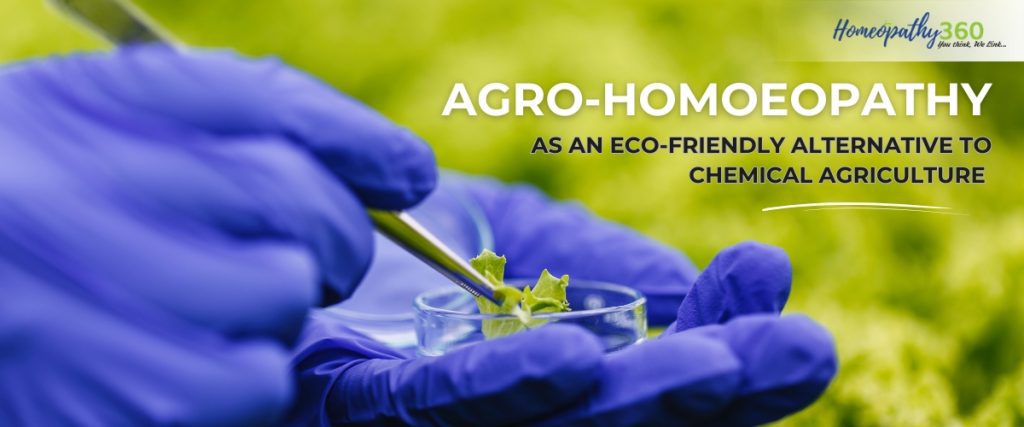
Contemporary agricultural practices have significantly increased food production; however, this achievement has been accompanied by considerable environmental and public health concerns. Intensive use of chemical fertilizers, pesticides, and herbicides has contributed to soil degradation, decline in biodiversity, development of pest resistance, contamination of water resources, and harmful effects on human and animal health. In response to these challenges, agro-homoeopathy has gained attention as an eco-friendly and sustainable approach to agriculture. By applying homoeopathic principles to plants, crops, soil, and irrigation systems, agro-homoeopathy seeks to enhance plant vitality, strengthen natural defense mechanisms, and restore ecological balance without leaving toxic residues. Grounded in the principles of similars, minimum dose, and holistic understanding of living systems, this approach offers a complementary alternative to chemical-based farming. The present article critically examines the concept, philosophy, principles, applications, advantages, challenges, and future prospects of agro-homoeopathy as a sustainable agricultural practice.
Keywords:
Agro-homoeopathy, sustainable agriculture, eco-friendly farming, plant vitality, organic agriculture, soil health
Introduction
Agriculture forms the foundation of human civilization by supplying food, raw materials, and livelihood to a substantial segment of the global population. The introduction of the Green Revolution and chemical-intensive farming techniques resulted in remarkable improvements in crop yield and food security. Nevertheless, prolonged reliance on synthetic fertilizers and pesticides has generated serious ecological consequences. Declining soil fertility, pest resistance, environmental pollution, and concerns related to food safety have raised questions regarding the long-term sustainability of chemical agriculture. In recent years, increasing awareness of climate change, environmental degradation, and human health risks has encouraged the adoption of sustainable agricultural systems.Practices such as organic farming, natural farming, biodynamic agriculture, and integrated pest management are increasingly promoted. Within this spectrum, agro-homoeopathy represents a distinct holistic approach that applies homoeopathic principles—traditionally utilized in human and veterinary medicine—to crop production. This system focuses on strengthening the innate vitality of plants and maintaining harmony between soil, plants, and the surrounding environment.
Concept and Philosophy of Agro-Homoeopathy
Agro-homoeopathy involves the use of homoeopathic remedies for plants, seeds, soil, and irrigation water with the aim of preventing diseases, promoting healthy growth, and improving crop productivity. The system is founded on the same philosophical and therapeutic principles that govern classical homoeopathy.
Plants as Living Systems
Plants are living organisms capable of responding to environmental stressors, pathogenic attacks, and nutritional imbalances. Although they lack a nervous system, plants exhibit sensitivity, adaptability, and regulatory responses essential for survival. Agro-homoeopathy acknowledges this living vitality and treats plants as dynamic biological systems rather than passive production units.
Holistic Perspective
In contrast to chemical agriculture, which often targets isolated symptoms such as pests or nutrient deficiencies, agro-homoeopathy adopts a comprehensive view of the agro-ecosystem. Soil condition, climatic factors, plant species, microbial activity, pest dynamics, and human interventions are all considered interconnected. Disease manifestation or reduced yield is interpreted as an expression of systemic imbalance rather than an independent problem.
Principles of Agro-Homoeopathy
Law of Similars
The principle of “similia similibus curentur” (like cures like) is applied to plant health. Substances capable of producing specific symptoms in healthy plants may, when administered in potentized form, stimulate recovery in diseased plants exhibiting similar symptoms. For instance, remedies derived from pathogenic organisms may be used to manage corresponding plant diseases.
Principle of Minimum Dose
Agro-homoeopathy employs highly diluted and potentized remedies administered in extremely small quantities. This approach eliminates the risk of toxicity, environmental contamination, and chemical residues, thereby ensuring ecological safety.
Individualization
Each agricultural situation is unique, influenced by crop type, soil characteristics, climatic conditions, and environmental stressors. Consequently, treatment must be individualized. Even identical diseases affecting different crops or fields may require different remedies based on symptom expression and local conditions.
Vital Force and Susceptibility
Plants possess an inherent regulatory energy responsible for growth, development, and resistance. Disease arises when this vital force becomes disturbed. Homoeopathic remedies act by stimulating and regulating this vitality, thereby reducing plant susceptibility to pests and diseases.
Applications of Agro-Homoeopathy
Plant Disease Management
Agro-homoeopathy has been utilized in the management of various plant diseases, including fungal, bacterial, and viral infections, as well as root and stem rots. Rather than directly eliminating pathogens, remedies enhance the plant’s intrinsic resistance and recovery potential.
Pest and Insect Management
Certain homoeopathic preparations help reduce pest infestation by modifying plant susceptibility. Treated plants may become less attractive to insects or more capable of resisting pest attacks, thereby decreasing dependence on chemical pesticides.
Improvement of Soil Health
Soil health is fundamental to sustainable agriculture. Agro-homoeopathic interventions have been reported to enhance microbial activity, improve nutrient assimilation, restore soil vitality after prolonged chemical exposure, and reduce soil-borne diseases.
Seed Treatment and Germination
Application of homoeopathic remedies to seeds has been associated with improved germination rates, enhanced seedling vigor, increased resistance to early infections, and more uniform crop establishment.
Agro-Homoeopathy versus Chemical Agriculture
Environmental Impact
Chemical agriculture contributes significantly to soil degradation, water pollution, and biodiversity loss. In contrast, agro-homoeopathy is non-toxic, biodegradable, and environmentally benign, posing minimal risk to soil microorganisms, pollinators, animals, and humans.
Residue-Free Produce
Chemical residues present in conventionally grown crops represent a major public health concern. Agro-homoeopathic practices do not leave harmful residues, thereby improving food safety.
Cost-Effectiveness
Homoeopathic remedies are economical and required in very small quantities. This reduces input costs, making agro-homoeopathy particularly beneficial for small and marginal farmers.
Role in Sustainable and Organic Farming
Agro-homoeopathy aligns well with the principles of organic and natural farming systems. It can be effectively integrated with composting, crop rotation, and biological pest control. Additionally, it supports farmers transitioning from chemical-based to organic agriculture by aiding in the restoration of soil balance and plant vitality.
Challenges and Limitations
Despite its potential benefits, agro-homoeopathy faces several limitations. These include limited awareness among farming communities, absence of standardized research methodologies, and skepticism within the scientific community. Accurate interpretation of plant symptoms and appropriate remedy selection require specialized training and experience. Addressing these challenges through education, systematic research, and institutional support is crucial for broader acceptance.
Future Scope
In the context of climate change, soil degradation, and increasing food safety concerns, agro-homoeopathy holds considerable future promise. Large-scale field trials, interdisciplinary research collaborations, and inclusion in agricultural extension programs may strengthen its scientific credibility and practical application. Integration of agro-homoeopathy within the One Health framework can further contribute to sustainable agriculture and environmental conservation.
Conclusion
Agro-homoeopathy presents a holistic, eco-friendly, and sustainable alternative to chemical agriculture. By enhancing plant vitality, improving soil health, and preserving ecological balance, it addresses underlying agricultural imbalances rather than merely controlling surface symptoms. Although further scientific validation is necessary, agro-homoeopathy shows potential as a complementary and valuable component of sustainable agricultural systems.
References
Altieri, M.A. Agroecology: The Science of Sustainable Agriculture. CRC Press.
Chaboussou, F. Healthy Crops: A New Agricultural Revolution. Jon Carpenter Publishing.
Khanna, K.K. Principles and Practice of Homoeopathy. B. Jain Publishers.
Bellavite, P., et al. Immunology and Homoeopathy. Springer.
Peer-reviewed research articles on agro-homoeopathy and sustainable agriculture.
Co-Author
Dr. Hemlata R. Laddad, MD (Hom.)
Professor & Head
Department of Gynaecology & Obstetrics,
HMC, Akola