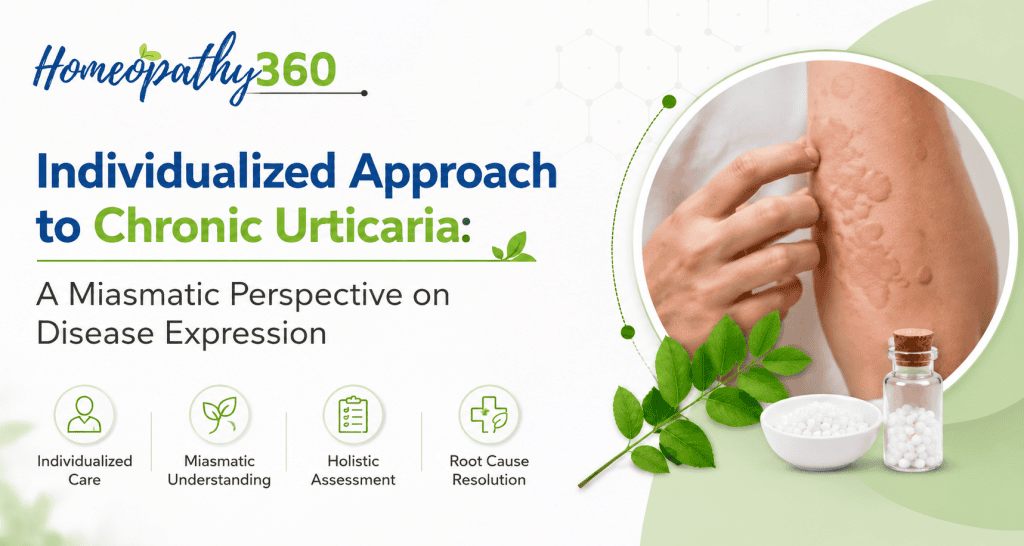
Individualized Approach to Urticaria: A miasmatic Perspective on Disease Expression
Abstract
Chronic urticaria is a multifactorial dermatological disorder characterized by recurrent wheals, itching, and angioedema persisting for more than six weeks. It poses a therapeutic challenge due to its recurrent nature and often idiopathic origin. Homoeopathy provides a holistic approach by addressing the underlying dynamic disturbance and individual susceptibility. This article elaborates on aetiology, pathophysiology, clinical manifestations, miasmatic background and individualized homoeopathic management of chronic urticaria.
Keywords
Chronic urticaria; Homoeopathy; Miasm; Individualization; homoeopathic management
Introduction
Chronic urticaria is a common and debilitating mast cell driven skin disease presenting with itchy wheals, angioedema or both. Histamine is the substance responsible for producing the rash and itching. However, it’s important to understand that histamine is not the underlying cause of urticarial rash rather, it is a result of the allergic process, which is immunologically mediated. It is a common condition affecting with high prevalence in women from age group of 20 to 60 years, prevalence estimates of 3% globally.
The condition can significantly impact quality of life, affecting sleep, daily activities and work. Urticaria is diagnosed in people with a history of wheals that last less than 24 hours with or without angioedema. A through physical examination should be undertaken. Identify the triggers and should be eliminated if possible (e.g. Drug or food allergy).
According to homoeopathy no eruption is local, it is a manifestation of internally deranged vital force, hence medicine given should also act on dynamic level and should be given internally to assist vital force to cure. Dr Hahnemann said, “There are no diseases only sick people”. Homoeopathy has no specific medicine for all patients of same diagnosis; it treats the patient individually by knowing the miasmatic influence on them. As regards the cause of disease Dr Hahnemann has classified causes into 3 categories – Exciting cause (acute disease), maintaining cause (cause occasionalis which must be removed where it exists, for chronic disease) and fundamental cause (which is generally due to chronic miasm).
While conventional medicine focuses on symptomatic relief using antihistamines and immunomodulators, homoeopathy emphasizes treating the patient as a whole, considering both physical and mental aspects. The recurrence and chronicity of urticaria indicate a deeper disturbance of the vital force.
Definition
Urticaria is a common, transient, and usually recurrent skin disorder, showing the sudden appearance of pale oedematous plaques with erythematous borders. Urticaria involves only the outermost portion of the dermis, presenting as well-circumscribed raised serpiginous borders with blanched centres that may merge to became giant wheals.
Etiological Factors –
1. Food: Most cases of acute urticaria caused by allergic foods, e.g. egg, milk and milk products, wheat, nuts, sea food etc.
2. Medication: Antibiotics, penicillin injection, over the counter drugs etc.
3. Infections: Acute urticaria may be associated with respiratory tract infections.
4. Inhalations: Pollen, house dust, mites, animal saliva etc.
5. Insect stings: Honeybee, yellow jacket, horns, wasp, fire ants.
Others
Allergic: In acute form of urticaria, the substances that stimulate the immune system for the release of mediator receptor called histamines and other chemicals, for the cause of hives.
Non-allergic: Urticaria triggered by infections, physical elements, emotional stress and, physical exertion. These all can also stimulate the release of histamines resulting in wheals or hives.
Autoimmune conditions: Specifically chronic urticaria may be associated with autoimmune diseases.
Genetic Factors: The family history of urticaria can increase the risk of the causing urticaria.
Idiopathic: In various cases, the accurate cause of urticaria remains unknown.
This is particularly seen in chronic idiopathic urticaria, where no specific incite or underlying condition can be noted.
Pathogenesis Of Urticaria
Urticaria results from vasodilatation and increased vascular permeability associated with the extravasations of protein and fluids into the dermis. Angioedema results when a similar process occurs in the deep dermis and subcutis. Histamine has generally been regarded as the mediator of these changes although other mediators such as prostaglandin D2 and Interleukin-1 are possibly involved in some circumstances. Both immunological [Type 1 and Type 31] and non-immunological mechanisms can cause mast cells and basophils to degranulate, liberating histamine and other substances. Although immediate [Type 1] Ige mediated mast cell release is the classic underlying mechanism of urticarial reactions, there is evidence that delayed type hypersensitivity reactions are often involved as well.
The fact that histamine is a major contributory factor in the development of urticaria can be substantiated by the following evidence:
i. The cutaneous response to histamine is similar to urticaria
ii. Many forms of urticaria are markedly improved by anti-histamines
iii. The plasma histamine level and local histamine release are increased in urticaria
iv. The mast cells are apparently degranulated in urticaria. However, in many types of urticaria histamine release does not occur.
Clinical Classification Of The Urticaria
1. Physical urticaria: Triggered by external factors.
- Adrenergic Urticaria: A type of stress-induced urticaria with temporary red papules surrounded by halos of hypopigmented, vasoconstricted skin.
- Aquagenic Urticaria: Triggered by water contact, leading to papular, itchy wheals that last for 30-45 minutes.
- Cholinergic Urticaria: Caused by body overheating, resulting in papular, itchy wheals that last between 30 minutes to 1 hour.
- Cold Urticaria: Cold exposure causes pruritic wheals, which persist for 1-2 hours.
- Delayed Pressure Urticaria: Pressure induces diffuse, tender swelling that lasts for 8-24 hours.
- Dermographism: Skin stroking causes burning and deep swelling, lasting for less than 48 hours.
- Exercise-Induced Anaphylaxis: Exercise leads to pruritic wheals, lasting from minutes to hours.
- Localized Heat Urticaria: Heat exposure results in pruritic wheals that last for about 1 hour.
- Vibratory Angioedema: Vibration against the skin triggers angioedema, lasting for 1 hour.
2. Contact urticaria: Induced by stimulants.
3. Angioedema (angioneurotic oedema): The reaction involved lower dermis of the skin with more diffuse and painful swelling, without itching. The lips, palms, soles, limbs, trunk, and genitalia are affected.
- Hereditary angioedema: recurrent episodes without urticaria; gastrointestinal symptoms are commonly seen. Family history positive in 75% of the patients; prolonged attack last up to 72-96 hrs.
- Idiopathic angioedema: May be associated with urticaria; swelling lasts up to 48 hrs.
- Allergic angioedema: Usually followed by urticaria and sometimes anaphylaxis; last for 24-48 hrs.
DIAGNOSIS
Diagnosis of the Urticaria is predominantly symptomatic. Although Physical examination, Detailed history and investigations can also be done.
Physical Examination: – The physical examination should focus on conditions that might precipitate urticaria or could be potentially life threatening, such as the following:
- Angioedema of the lips, tongue, or larynx.
- Individual urticarial lesions that are painful, long lasting (longer than 36-48 h), or are ecchymotic; also, urticarial lesions that leave residual hyperpigmentation or ecchymosis upon resolution (suggesting urticarial vasculitis).
- The presence of systemic signs or symptoms, particularly fever, arthralgias, arthritis, weight changes, bone pain, or lymphadenopathy.
- Scleral icterus, hepatic enlargement, or tenderness that suggests hepatitis or cholestatic liver disease.
- Thyromegaly suggesting autoimmune thyroid disease; joint examination for any evidence of connective tissue disease, rheumatoid arthritis, or systemic lupus erythematosus (SLE).
- Lungs for pneumonia or bronchospasm (asthma).
- Skin for evidence of bacterial or fungal infection.
Investigations
Complete blood count (CBC), stool and urine examination, thyroid function tests, hepatitis screening, antinuclear antibodies (ANA), total Ige, skin prick test, serological ELISA test, autologous serum skin test and ultrasonography may be carried-out if any underlying illness is suspected.
Homoeopathic Approach
Dr. Samuel Hahnemann has noted his view regarding allergic disorders, urticaria in organon of medicine VI edition aphorism 117. In this part he emphasizes about idiosyncrasy. He says that it is a peculiar corporeal constitution which although otherwise healthy possess a disposition to be brought into more or less morbid state by certain things which seem to produce no impression and no change in many other individuals. But this inability to make an impression on everyone is only apparent. For as two things are required for the production of these as well as all other morbid alterations in the health of man – to unit, the inherent power of the influencing substance and the capability of the vital force that animates the organism to be influenced by it. The obvious derangements of health in the so called idiosyncrasies cannot be laid to the account of these peculiar constitutions alone, but they must also be ascribed to things that produce them in which must lie the power of making the same impressions on all human bodies, yet in such a manner that a small number of healthy constitutions have a tendency to allow themselves to be brought into such on obvious morbid condition but they actually make this impression, when every healthy body is shown by this, that when employed as remedies they render effectual homoeopathic service to all sick persons for morbid symptoms similar to these. They seem to be only capable of producing in so called idiosyncratic individuals.
Miasmatic interpretation
Hypersensitivity reactions are the indications of psoric and pseudopsoric miasms. The skin manifestations like eruptions, itching which are clinical manifestations of primary psora, also hypersensitivity reaction at physical and mental level. Hypersensitive reaction to certain ingestants, inhalants etc come under psoric miasm. Hence this urticaria comes under psora, but when the system gets exhausted and weak and hyper reacts with recurrence it favours to tubercular miasm. Hence urticaria can come to both psora and tubercular miasm.
For treating the patient, Patient’s Personal history like age, mode of living, diet, occupation, domestic circumstances, social relations etc are very important. It only helps us to know to patient completely but also helps to know the cause of disease and many other factors which maintain the disease (exciting or maintaining cause) as well as for the selection of homoeopathic medicine (Aphorism 208)
Another study by Sreedevi showed that due to some exciting cause, eruptions might flare up in chronic urticaria. In this phase, our line of treatment is to treat that phase with an acute short-acting remedy followed by a constitutional remedy or an anti miasmatic remedy.
Common Remedies For Urticaria
Natrum muraticum, lycopodium, sulphur, dulcamara, rhus toxicodendron, apis mellifica, urtica urens, aconite napellus, antimonium crudum, Copaiva Officinalis, Calcarea Carbonica, arsenicum album.
Conclusion
Chronic urticaria is a multifactorial condition requiring a holistic approach to management. Homoeopathy provides an effective therapeutic management by focusing on the totality of symptoms and underlying miasmatic disturbances. Through individualized treatment and careful case-taking, long-term relief and improved quality of life can be achieved.
REFERENCE
- Maurer M, Metz M, Zuberbier T, Church MK. Chronic urticaria: unmet needs, emerging drugs, and new treatment approaches. Lancet. 2024;403(10333):1234–45.
- Kaplan AP. Chronic urticaria: pathogenesis and treatment. J Allergy Clin Immunol. 2004 Mar;114(3):465–74.
- Mehta H, Janaani P, Vinay K, Bishnoi A, Parsad D, Kumaran MS. Cold urticaria in tropics: A clinico-epidemiological study from North India. Indian J Dermatol Venereol Leprol. 2024;90(4):442-448.
- Grattan C, Powell S, Humphreys F; British Association of Dermatologists. Management and diagnostic guidelines for urticaria and angio-oedema. Br J Dermatol, 2001 Apr; 144(4):708-14.
- Barzilai A, Baum A, Ben-Shoshan M, Tzanani I, Hakroush R, Coster D, Solomon M, Greenberger S. Epidemiological and clinical characteristics of adult and pediatric patients with chronic spontaneous urticaria.J Clin med.2023;12(23):7482.
- Sharma A, Singh Kushwaha N. Urticaria and its Homoeopathic Approach. Int J Creative Res Thoughts. 2021 Sep;9(9)
- Hahnemann S. Organon of Medicine. 6th ed. Translated by William Boericke. New Delhi: B. Jain Publishers; 2002.
- BANERJEA S.K, Miasmatic diagnosis practical tips with clinical comparisons, B. Jain publishers (P) Ltd, New Delhi, p.82
- Kumar A, Agrahari D, Shukla P. Urticaria and its homeopathic management – literature review. Homoeopathy University, Jaipur; 2020 Jun 11.
- Saxena, R., Saxena, I. G., & Sharma, P. (n.d.). Urticaria with homoeopathic management.
Under the guidance –
Dr Ranjan C Britto, Professor, Department of Organon of Medicine and Homoeopathic Philosophy, Father Muller Homoeopathic Medical College and Hospital, Mangalore.