Evolving Beyond the Nodule: A Homoeopathic Approach to Managing Nodular Goitre and Associated Psychosomatic Distress
Abstract
Nodular goitre is a prevalent endocrine condition often causing physical symptoms and sometimes linked to underlying psychological stress. While standard allopathic treatments typically involve hormonal management or surgical removal, this case report explores the efficacy of individualized homoeopathic care in a 53-year-old female patient diagnosed with nodular goitre. The therapeutic plan centred on the patient’s unique psycho-emotional characteristics—including profound grief, anxiety, irritability, and heat sensitivity—leading to sequential prescribing of Natrum muriaticum (Nat Mur) followed by Calcarea iodatum (Calc Iod) and Nux vomica (Nux Vom). Over three years, this intervention resulted in a significant reduction in emotional distress, resolution of constitutional symptoms (such as generalized weakness, alopecia, and thermal intolerance), and the patient’s self-reported reduction in the size and associated discomfort of the neck swelling, demonstrating that homoeopathy offers a valuable supportive or primary treatment option in intricate endocrine presentations.
Keywords: Goitre, Individualized, Endocrine, Psycho-emotional.
Introduction
A goitre is clinically defined as an abnormal enlargement of the thyroid gland, which may be classified as either diffuse or nodular. Nodular goitre, characterized by the formation of one or multiple lumps, is highly common, with incidence increasing significantly with advancing age. Typical presenting symptoms include noticeable swelling in the cervical region, a feeling of local discomfort, and, in severe instances, difficulty swallowing or breathing. The aetiology of this condition is often complex and multifactorial, encompassing factors such as iodine deficiency, genetic predispositions, and the development of benign tumours. Regardless of the cause, nodular goitre frequently diminishes a patient’s overall quality of life.
Aetiology:
- Worldwide, the most frequent reason for this is inadequate iodine intake.
- Hormone production problems may also stem from inherited defects or the use of certain medications, such as lithium.
- In addition, thyroid inflammation—whether caused by autoimmune conditions like Hashimoto’s thyroiditis, infections, or postpartum changes—can lead to swelling. Hashimoto’s disease, in particular, involves the immune system attacking the thyroid and usually results in long-term hypothyroidism, while postpartum thyroiditis affects a small percentage of women within a year after childbirth and often resolves without treatment.
- Another major cause of thyroid enlargement is the presence of tumours or nodules. These growths may form as single lumps or cause a more general swelling of the gland. Most thyroid tumours are benign and do not pose a serious health risk, but some can be malignant. Regardless of whether they are cancerous or not, these growths can still contribute to noticeable changes in the gland’s size or structure.
Case History:
- History of Patient Illness: A 53-year-old housewife presented with a swelling in the lower anterior aspect of the neck persisting for 2 years, with a significant increase in size and discomfort which is aggravated by warm weather noted one week prior to the consultation. She also experienced generalized weakness and significant hair loss.
- Treatment History: Non-significant/not specified.
- Past History: Non-significant.
- Family History: Non-significant.
Physical Generals:
- Thermal Reaction: Hot; patient prefers fans, loose clothing, and rainy weather.
- Appetite: Good; 2 meals per day.
- Thirst: Good; 2 Liters per day.
- Desire: Nil.
- Aversion: Nil.
- Urine: 5 times/Day; 2 times/Night; straw coloured.
- Stool: 1 time/Day; normal in consistency.
- Sleep: Good; refreshed.
- Dreams: Unremembered.
- Perspiration: Generalized; odourless.
Mental Generals:
- Grief: Deep history of trauma following the death of her young daughter.
- Delusions: Persistent sensation of seeing her dead child.
- Temperament: Anxious; becomes angry over trifles.
- Social Profile: Historically social and a natural leader in her youth.
General Physical Examination: Patient is moderately built and nourished. Well oriented with time, place and person.
Vitals: Temperature- Afebrile at the time of examination; Pulse: 72 bpm, Weight: 63 kgs, Height:156 cms., Respiratory rate: 18 rpm, SPO2: 98%, B.P.: 120/80 mmHg.
Local examination: B/L Enlargement of thyroid lobe. Right lobe measures 63x24x18mm. Left lobe measures 38x18x17mm. Isthmus is 5 mm.
Diagnosis: Nodular Goiter (Uni-nodular).
Analysis and Evaluation of Symptoms:
| Category | Symptoms | Clinical Significance |
| Common Symptoms (Pathognomonic) | Swelling in the lower anterior neck.Bilateral enlargement of thyroid lobes.Local discomfort/pressure. | These symptoms confirm the Diagnosis of Nodular Goitre but do not help in selecting a specific remedy. |
| Uncommon Symptoms (Characteristic/Individual) | Delusion: Sees dead people (her daughter).Grief: Profound, long-standing trauma.Cravings: Intense desire for Fish (2+).Aversions: Cucumber and Cabbage (2+). | These are “Strange, Rare, and Peculiar” (S.R.P.) symptoms that point directly to the individual remedy (Natrum Mur). |
| Physical Generals and Modalities | Thermal: Hot patient (prefers winter/fan).Aggravation: Symptoms worse in warm weather.Concomitants: Alopecia (hair loss) and weakness. | These provide the Miasmatic direction and confirm the thermal state required for remedy selection. |
Constitutional totality:
- Pathological generals:
- Discomfort feeling
- Swelling in the neck
- Aggravated by warmth
- Weakness
| MENTAL GENERALS | PHYSICAL GENERALS | CHARACTERISTIC PARTICULARS |
| IMAGINES SEEING DEAD PEOPLE.ANGER EASILY.ANXIOUS | CRAVING: FISHAVERSION TO CUCUMBER AND CABBAGETHERMALLY HOT | SWELLING IN NECK3+DISCOMFORT FEELING3+AGGRAVATED BY WARMTH3+HAIRFALLWEAKNESS |
Repertorial Analysis
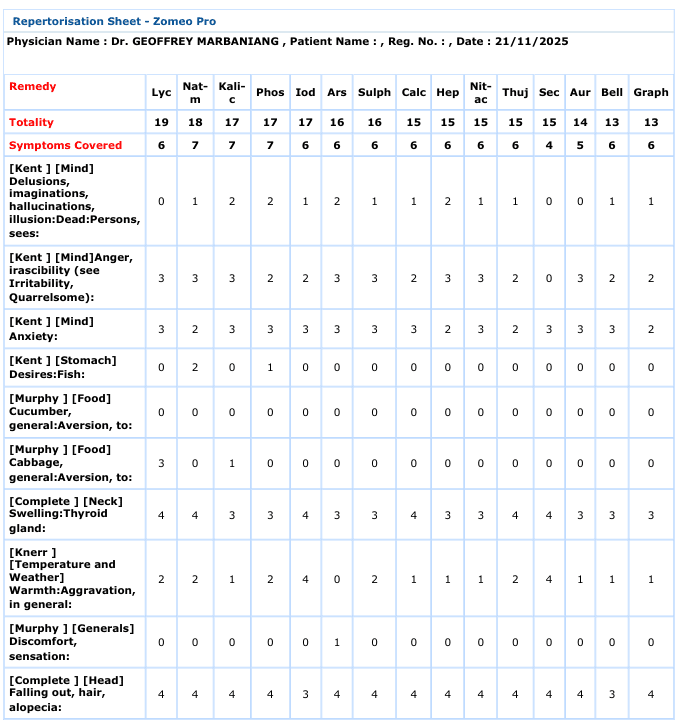
Figure 1: Repertorial result.
- Repertory/Software used: Hompath Software.
- Primary Remedy: Natrum muriaticum (Selected for deep grief, dwelling on the past, heat intolerance, and irritability).
- Secondary/Specific Remedy: Calcarea iodatum (Organ-affinity for glandular enlargements).
Prescription:
- On 19/10/2022
- Rx
- NATRUM MURIATICUM 0/1 (1 TEA-SPOON – 0 – 1 TEA-SPOON) X 1 WEEK.
- 2 GRAIN TAB. (2-0-2) X 1 WEEK.
- Advice: Increase Iodine, Selenium, and Zinc; moderate/cook cruciferous vegetables (goitrogens).
Follow ups:
| Date | Symptom Changes | Prescription |
| 19/10/22 | Delusion absent; Anger and Anxiety reduced. | Nat Mur 0/1 |
| 14/12/22 | Neck swelling same; general state improved. | Sac. Lac. (Placebo) |
| 01/02/23 | Neck swelling improved. | Nat Mur 0/2 |
| 07/02/24 | Neck swelling plateaued. | Calc Iod 30 |
| 01/01/25 | Continued improvement in swelling. | Calc Iod 200 |
| 01/11/25 | Swelling better. New C/O Heartburn. | Nux Vomica 200 |
Reports:
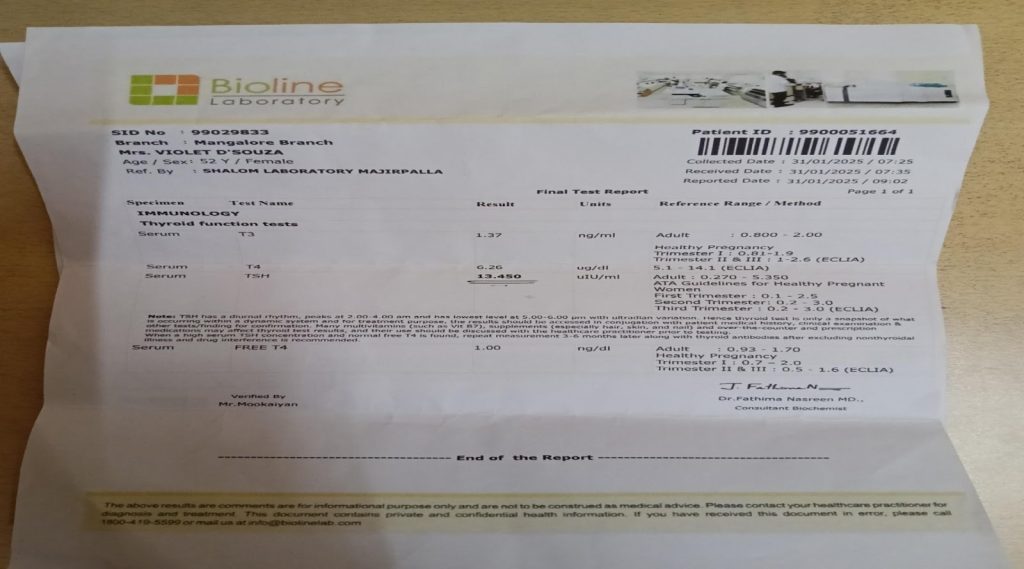
Figure 2: Before treatment
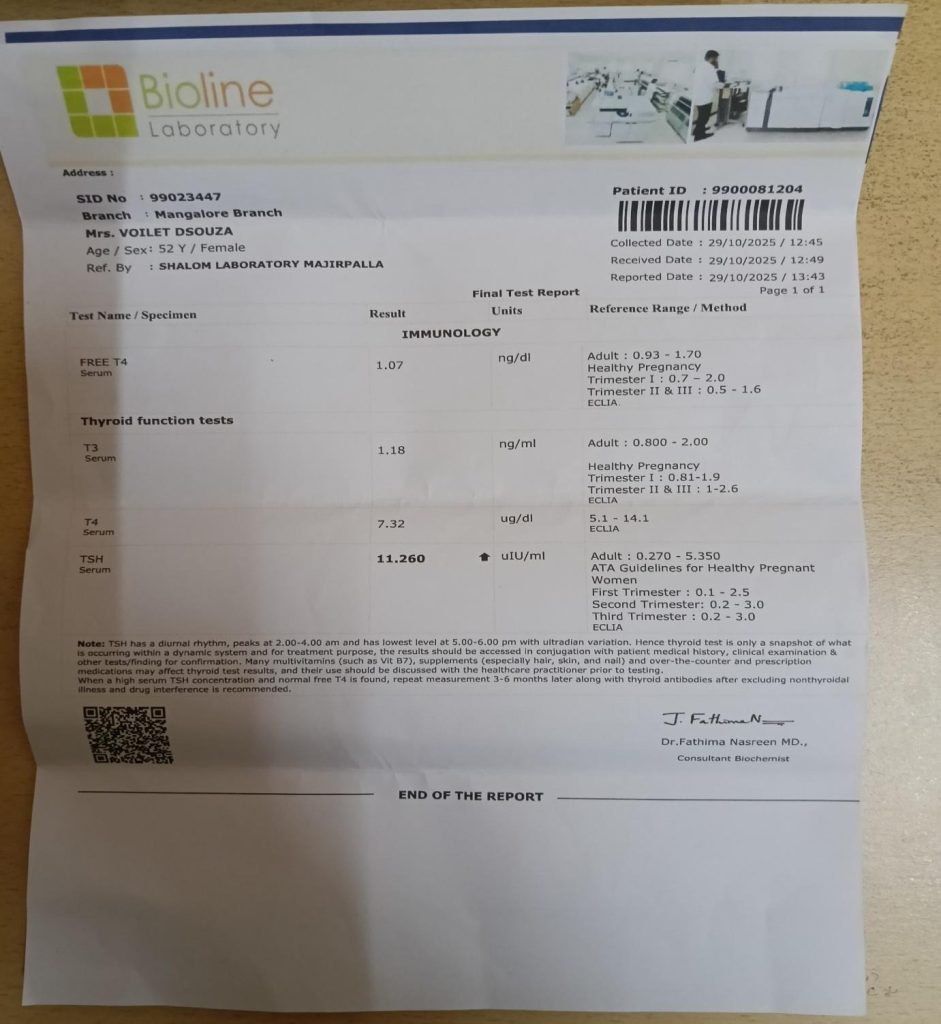
Figure 3: After treatment
Conclusion:
This case report documents the successful individualized homoeopathic management of a 53-year-old female patient with nodular goitre. The use of constitutional remedies, primarily Natrum muriaticum, was pivotal in resolving profound psychosomatic symptoms, which in turn supported the subsequent action of the organ-specific remedy, Calcarea iodatum, in reducing the neck swelling. This management approach advocates for the inclusion of individualized complementary therapies in the management protocol for complex endocrine disorders.
References:
- UCSF Health. Thyroid Nodules and Goiter [Internet]. San Francisco (CA): UCSF Health; [cited 2025 Nov 22].
- Mayo Clinic. Goiter – Symptoms & causes [Internet]. Rochester (MN): Mayo Foundation for Medical Education and Research; 2024 Oct 17 [cited 2025 Nov 22].
- Cleveland Clinic. Goiter: What It Is, Causes, Symptoms, Diagnosis & Treatment [Internet]. Cleveland (OH): Cleveland Clinic; 2022 Dec 15 [cited 2025 Nov 22].
- Khan M, Gaba WH, Khan LU. Goiter. In: StatPearls [Internet]. Treasure Island (FL): StatPearls Publishing; 2025 Jan 19 [cited 2025 Nov 22].
- Vithoulkas G. Materia Medica Viva. Volume 8. New Delhi (IN): B. Jain Publishers; 2008.
- Boericke W. Pocket Manual of Homoeopathic Materia Medica & Repertory. New Delhi (IN): B. Jain Publishers; 2004.
- Cooper DS. Multinodular Goiter. In: Feingold KR, Anawalt B, Boyce A, et al., editors. Endotext [Internet]. South Dartmouth (MA): MDText.com, Inc.; 2016 Sep 26 [cited 2025 Nov 22].
- Gnanakkumar T. A Study of Clinical Profile and Management of Nodular Goiter. Int J Sci Stud. 2020;8(3):28-34.
Under Guidance of Dr. Arun Varghese Of Department Of Homoeopathic Materia Medica Of Father Muller Homoeopathic Medical College.