
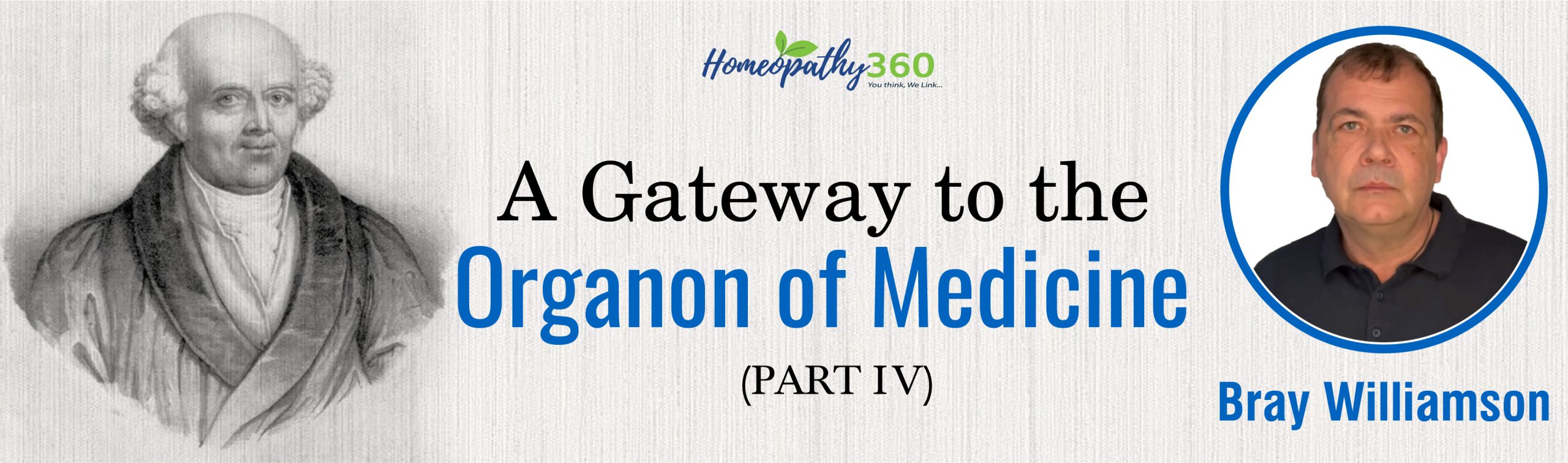
A Gateway to the Organon of Medicine (part 4) By Bray Williamson MA Lic.BS Hom
Edited by Sarah Burnett BA(Hons)
In this the fourth instalment of my Gateway to the Organon of Medicine series I shall be deconstructing and explaining the meaning behind the Sixth aphorism of the Organon, as well as Hahnemann’s footnote. For those of you wishing to explore deeper into how this aphorism affects the way in which a homoeopath should take a case, please watch the recording of my webinar from the 30th April 2025, which can be found on here on Homeopathy 360.
The Sixth Aphorism.
‘The unprejudiced observer – well aware of the futility of transcendental speculations which can receive no confirmation from experience – be his powers of penetration ever so great, takes note of nothing in every individual disease, except the changes in the health of the body and of the mind (morbid phenomena, accidents, symptoms) which can be perceived externally by means of the senses, that is to say, he notices only the deviations from the former healthy state of the now diseased individual, which are felt by the patient himself, remarked by those around him and observed by the physician. All these perceptible signs represent the disease in its whole extent, that is, together they form the true and only conceivable portrait of the disease.’
The first three words of this Aphorism, ‘The unprejudiced observer’ carry a weight and power that all homoeopaths must constantly strive to attain. It is a state of being that is necessary in order to gain a full and unpolluted picture of the information gleaned and given during a case taking. These words clearly show that Hahnemann realised how so many physicians struggle to observe without prejudice in it’s many forms. Rather than just considering the major prejudices such as race, religion, gender, sexuality, and social class, (in fact it is my opinion that anyone with these prejudices should not be taking cases, rather they need their own case taken), we must look further afield to other issues that can be prejudicial to the homoeopathic observation, such as triggers, assumption, and empathy.
Hahnemann follows those three most important words with ‘…well aware of the futility of transcendental speculations which can receive no confirmation from experience…’
Here Hahnemann is making it very clear that using systems for case taking along with assumptions from the homoeopath, coupled with speculation based on anything that is outside of homoeopathy has no place in homoeopathic case taking. This includes (but is not exclusive to) allopathic diagnosis. There appears to be a continuous misunderstanding by homoeopaths that an allopathic diagnosis is of relevance when describing a case, however rest assured it is not.
Hahnemann continues ‘…be his powers of penetration ever so great, takes note of nothing in every individual disease, except the changes in the health of the body and of the mind (morbid phenomena, accidents, symptoms) which can be perceived externally by means of the senses…’
In this section Hahnemann is telling us not to be distracted by anything that we have not perceived directly from the patient such as for example, an allopathic diagnosis. He is enforcing the importance that both the physical symptoms and the mental symptoms carry equal weight.
He explains that we should be aware of events or situations that have affected the patient (morbid phenomena), of any accidents they may have suffered, and of course the symptoms expressed by the patient. However he is also telling us to be aware of symptoms by using all of our senses, being aware of the smell of a patient, the body language that they use throughout the case taking, skin temperature in fevers, or texture in lesions, and so on.
The sixth aphorism continues with, ‘…that is to say, he notices only the deviations from the former healthy state of the now diseased individual, which are felt by the patient himself, remarked by those around him and observed by the physician.’
Here we see the accessible pool of information that is available to the homoeopath. Foremost are the symptoms which the patient is experiencing and expressing during the case taking, second to this are the changes which have been observed by those around the patient. This is particularly helpful in the treatment of children and adults with mental illness. Lastly in Hahnemann’s hierarchy, are the observations of the physician. These are not the unprejudiced observations of the case taking, rather they are the subjective observations of the senses. These subjective observations are useful, but not definitive in creating the totality of the case. Once again, at no point does Hahnemann mention allopathic diagnosis.
Hahnemann concludes this Sixth aphorism with ‘All these perceptible signs represent the disease in its whole extent, that is, together they form the true and only conceivable portrait of the disease.’
Here we now have the totality of the disease picture. The combination of information that when obtained without prejudice will show us the true ‘portrait’ of the energetic derangement of the Vital Force, and the remedy required to cure the patient.
In his footnotes to this aphorism, Hahnemann attacks the practices of allopathy, with the allopath’s arrogant habit of ignoring the totality of symptoms, and pretending to know what is to be cured by creating a diagnosis, and as a result using unknown medicines. He explains that the symptoms expressed by the patient show us the morbid affects upon the Vital Force. That we do not need to see the spiritual entity to see the effects it has upon the individual and to find a remedy in order to create a cure. It is also made clear in these footnotes that even then the attacks upon homoeopathy were coming from arrogance without perception.
In my next instalment of this series I will deconstruct and explain the seventh aphorism.
As previously mentioned, my homeopathy 360 webinar expands upon the concept of the unprejudiced observer. I look at and explain the issues that can affect a homoeopathic case taking, along with the issues that can prejudice the remedy selection and thus prevent cure. I also explore the infestation of allopathic diagnosis in homoeopathy, and the negative effect this can have on the homoeopaths capacity to be the unprejudiced observer.