ABSTRACT
In today’s time constraints era where patients are in hurry and want quick relief from acutes, phatak repertory is one of simplest and handy repertory book arranged in alphabetical order used for quick reference. It is ideal repertory for beginners as well as who tends to believe in artistic prescription.
KEYWORDS: Phatak repertory, Acute, Coryza, Impaired Hearing, Toothache, Earache, Cough
INTRODUCTION
Every homeopath who is attempting to use this Wonderful healing system has always faced difficulties with acute prescribing. When neighbours, friends, and family need your immediate assistance for a Coryza, cough, headache, Earache, Toothache etc…Where you can’t take whole case, here clinical repertories come to rescue us. Phatak repertory is concise, clinical and alphabetically arranged repertory which is published in 1963 by Dr S.R. PHATAK. Dr. Phatak has confirmed, tested and clinically proven each and every rubric and remedy before including it in his repertory. Each inclusion has either come from his own case experience and clinical observation, or has been strongly justified by master like Kent, Boger, or Clark .It is aimed at reducing the difficulties to physician in every sense of word. Though this book looks small but, it consists of massive content.
Dr. Hahnemann defined acute disease as – “The disease to which man is liable are either rapid, morbid processes of the abnormally deranged vital force, which have a tendency to finish their course more or less quickly but always in moderate time.” During the treatment of acute disease main aim of the physician is to accelerate the natural defence mechanism. Physician has to prescribe only on the present acute totality. Which is recently altered symptoms whether they are mental general, physical general, particulars should be considered.
ABOUT PHATAK’S REPERTORY:
Dr. Shankar Raghunath Phatak had an idea of preparing a repertory which he pursues with the help of his friend Mr. S. L. Kapadi, which he was not able to pursued because of his disturbed health. Mr. S.L.Kapadi came with skeletal copy of this repertory the author systematize it in a proper way and made many editions. Dr. Homai Merchant typed the hand written copy and this copy was present at author’s table for almost 10 years. During that time many useful editions were made with the help of Mr. Kapadi. Author’s son Dr. D.S.Phatak went through all the sections did the preliminary spade work and with the help of Mr. Datay first edition was printed.
DIFFERENT EDITIONS OF PHATAK REPERTORY
1 st edition – 1963
2 nd edition – 1977
3 rd edition – 2000
4 th edition – 2005
PLANNING AND CONSTRUCTION OF PHATAK REPERTORY
Book divided into 3 parts:
1) Preface
2) Abbreviation
3) Repertory proper
Uniqueness of this repertory is that it is printed in 2 columns. The repertory is arranged in alphabetical order and rubric wise there are no separate sections like in other repertories such as Kent and BTPB. All the present rubrics like mental, physical generals, physical particulars, pathological and physiological condition, clinical symptom and modalities are arranged in alphabetical manner. From A to Z- Abdomen to Zygomae.Sources of this repertory are Boericke, Kent, BTPB, Dr Clarke’s dictionary etc. Dr Phatak followed the concept of generalisation of Dr Boger. Essential cross references are given in the repertory; it contains 393 medicines and 1971 rubrics.
⮚ Arrangement and construction of rubric
● Location / sensation affection in general
● Sides,
● Alternating sides,
● Radiating to,
● Alternating with,
● Sub-location/sub-sensations, aggravation, amelioration, concomitants are intermingled as they are arranged in alphabetical manner.
Typography:
1 st grade – CAPITAL
2 nd grade – Italics
3 rd grade – Roman
Philosophical Background
Dr. Phatak is inspired by Bogers philosophy. So, philosophy is same as Boger
synoptic key.
SPECIAL FEATURE
- Extended version of Boger synoptic key, so many pathological generals are given, remedies for particular rubrics have been reduced.
- Under desire mind rubrics are given, like desire for beautiful things. Under aversion both mental and food aversions are given like aversion to bed, aversion to cheese.
- The direction of symptoms is given separately.
- There are many diagnostic rubrics are given like measles, pneumonia, malaria, bronchitis, and also drug abuse of in general as given as main rubric.
- Causation – Cause of disease given under aggravation. E.g., Operation, surgical after aggravation, laparotomy after aggravate, forceps delivery after aggravate.
- Rubrics are special to Phatak repertory are aero plane flying in aggravation, birth mark, blood pressure high.
- Clinically helpful rubrics are present in Phatak repertory like Milestones, Walking, Talking, Dentition delay, fontanelles delay given in particular rubric children, infant.
Symptom evaluation
Although it is derived from Boger synoptic key. In this book, he has given more and more importance to modalities especially to causative factors. Since when the complaints has started. Then, latter comes general modalities,
concomitants, desires, aversions and the mental rubrics come later.
When to use Phatak Repertory
1) Generals are available.
2) Cases with pathological Generals.
3) Cases were Causations marked.
4) Cases with clear modalities.
Limitations - Characteristic particulars are not well represented.
- Not for the cases rich in mental symptoms.
- Rubrics and remedies are minimized.
ILLUSTRATIVE ACUTE CASES:
Case: 1
A 30 years old female having complain of coryza. she feel too much weakness, exhaused. she was much thirsty for large quantity of water. she could not tolerate heat or sun heat, but she also said that, she could not tolerate air of
fan to her legs. I referred to phatak’s repertory: Prescription was NAT. MUR 200 – bd for 3 days. Followed by Sac.lac 30 BD.
Her entire symptomatology relived within three days.
Case: 2
A 34 years old female came for hearing diminished in one ear since 5 days. Which is started after taking bath in river. She said that water must have entered in her ear, so it will get better in some time. When it did not get better, I came to take medicines. After referred to Phatak repertory VERBASCUM only remedy getting. So, VERBASCUM 200 single dose prescribed and on 2 nd day itself her hearing was normal.
The availability of rubric “HEARING, BAD, WATER GETTING INTO EAR, FROM” was key for the case solution.
Case: 3
A 40 years old male came for toothache he was having a lot of pain in his left upper molar. even after taking painkillers not making any difference. Pain was so much that patient slaped his face in pain. patient said that I am unable to tolerate such a severe pain. On examination there is presence of abscess. I searched Phatak repertory: After that HEPAR SULPH 1M hs for 3 days prescribed, followed by Sac.lac 30 BD. Now no toothache patient is well.
Case: 4
A 18 year old male patient came for pain in ear since 1 week. pain occurs in morning when he used to go to pass stool. Pain occurs when he has to exert a lot of force to pass stool due to constipation. It feels as if the eardrum will burst due to the force. I repertorized using Phatak‘s repertory: On this basis NUX VOMICA 200- BD for three days , prescribed and patient is
better within 4 days, no ear pain as well as no constipation.
Case: 5
A 40 year old lady patient came to clinic and directly entered in cabin and asked medicine for cough. I said wait for your turn. Patients don’t believe and said that please give me medicine quickly. Than i asked: ok, tell me what your problem is? Patient said that I having coughing problem since 4 days when I am enter in room .As like here I entered and coughing started continuous. Repertorized using phatak’s repertory: VERETRUM 200 OD for two days was prescribed, followed by S.L.
within two days patient is came to say I’m alright yesterday night itself.
CONCLUSION
Homeopathic management is more effective by utilizing the Phatak repertory. The core principle of individualization, homeopathy demands a careful and accurate selection of the simillimum—an endeavour made more efficient
through the application of a reliable repertory. Among the various repertories available, the Phatak Repertory stands out for its concise, clinically oriented rubrics that align closely with practical case taking. Phatak repertory is simple, practical and it contain gem rubric in huge range. Its alphabetical structure not only boosts practitioner confidence but also enhances the accuracy and success of outcomes in acute cases. Truly, the Phatak Repertory is a valuable
asset—a boon to both practitioners and patients alike in the realm of modern homeopathy.
REFERENCES:
1) Harinadham K. Dr. – The principal and practice of repertorization (second reprint edition), New Delhi, Indian books and periodical publishers, April 2010
2) Khanaj R. V. – Reperire, (fifth revised and added edition), New Delhi, Indian books and periodical publishers, (P) L. td, 2002
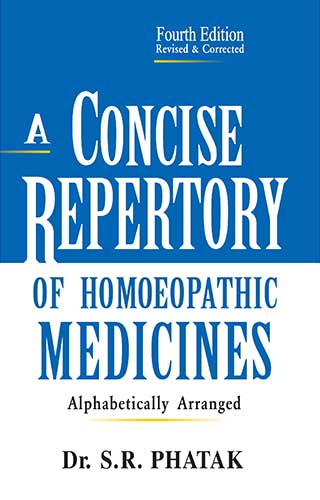
3) Phatak S. R. – A concise repertory of homoeopathic medicine alphabetically arranged (fourth edition), New Delhi, B. Jain publishers (P) L.td, 2005
4) SARKAR B. K. – Organon of medicine, (tenth reprinted edition), Delhi, Birla Publication (P) L.td, 2010
5) Tiwari S. K. – essentials of repertorization (fifth edition), New Delhi B. Jain publishers (P) L.td, 2012
6) Vitholkas G. – The science of homoeopathy, (reprint edition), New Delhi,
B. Jain publishers (P) L. td, 1993