A Clinical Case of Eosinophilic Fascitis Treated With Classical Hahnemannian Homeopathic Medicine
PURPOSE – The purpose of this presentation is to highlight the possibility of successfully applying classical Hahnemannian homeopathic medicine in pathologies that have been incompletely resolved with conventional treatment.
Eosinophilic fasciitis belongs to the large group of autoimmune rheumatic diseases, described under the generic term “connective tissue diseases.”
MATERIALS & METHODS
THE CLINICAL CASE
Introduction
72-year-old patient,, female, retired, married, no children.
January 20, 2021 – A patient who had previously been treated by a general practitioner came in for a visit. She was a heavy smoker who had undergone surgery for breast cancer at the age of 42.
Until a few weeks earlier, the woman, referred to here by the fictitious name Adele, had been in good health and able to carry out all her activities. A retired hairdresser, she has always been slim despite her good appetite and currently takes care of the house and also does farm work (she has a vegetable garden, fruit trees, olive trees, and a vineyard), helping her husband. All these activities keep her very busy, especially since her husband has a small business and does not have much time to devote to farming.
An excellent cook, with ample space both in the house and in a large porch, as well as excellent produce from her own land, she is ‘forced’ by her husband to cook (without any help from others!) for a large number of people, whom her husband invites almost every day.
It can therefore be said that she has always been a strong and active woman.
Reason for visit
She came in for a visit because she had been experiencing pain and noticed swelling in her forearms and legs for several weeks. She said she would prefer not to take conventional chemical medications but rather homeopathic therapy.
Materials and Methods
Her symptoms were recorded, a physical examination was performed, and the symptoms were selected and repertorized. The physical examination reveals obvious “pasta-like” consistency and hardness in the forearms and legs, which are markedly painful on palpation. Adele reports that she has great difficulty sitting down and that, on the contrary, she feels better when lying on her back.
The symptoms selected and repertorized are those that have recently appeared:
- Skin: swelling
- Extremities – dropsy
- Extremities – swelling – lower limbs – dropsy
- Extremities – shortened – muscles and tendons (the patient reports exactly this sensation)
- Extremities – swelling – forearms
- General – burning pain
- General – cold – applications improve
- General – sitting aggravates
- General – lying on back improves
- General – heat aggravates
- General – cold – bath, desire for a cold bath
- Stomach – no thirst
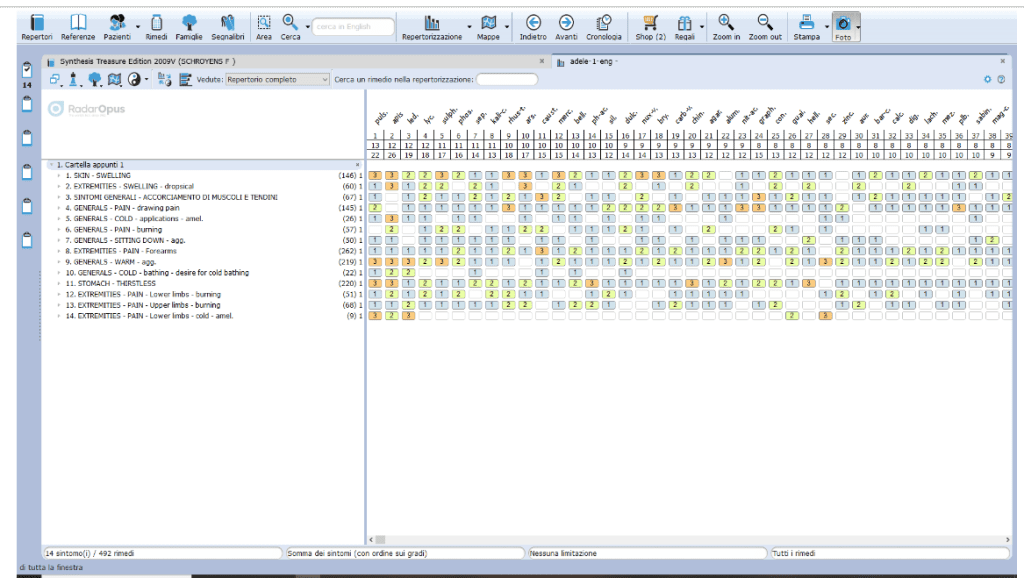
Based on the repertorization results, the remedy corresponding to the greatest number of symptoms is considered; furthermore, Adele’s appearance (a criterion that can often be misleading) seems to confirm the remedy, so Pulsatilla 1 MK one tube dose globules is prescribed. The patient is asked to provide feedback a few days after taking the remedy.
The patient calls after a few days to report that the burning pain and swelling seem to be gradually improving, but not as much as expected and hoped for: she is advised not to take anything else for the time being and to return for a visit after a week.
After a week—on January 29—the patient returns for a follow-up visit, without further improvement; physical examination also reveals persistent swelling and “pasta-like” consistency of the limbs.
The symptoms are reviewed and the following are added to the previous repertorization:
- EXTREMITIES – lower limbs – burning pain
- EXTREMITIES – upper limbs – burning pain
- EXTREMITIES – lower limbs – cold improves
- EXTREMITIES – upper limbs – cold improves
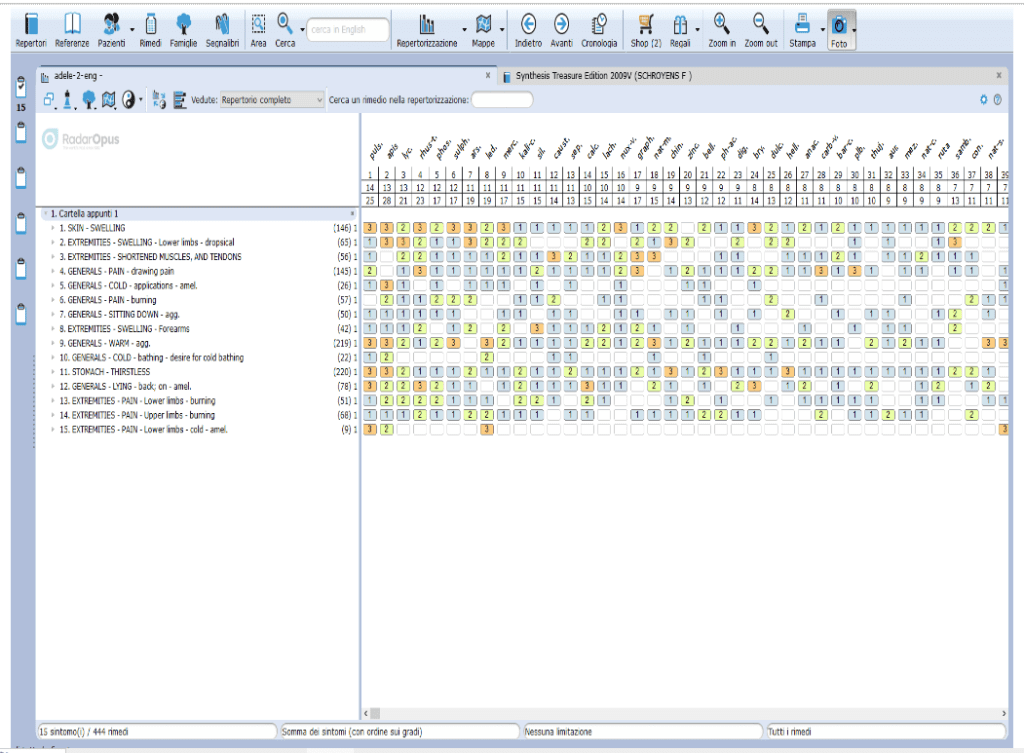
However, this repertorization is “excessive”: it certainly cannot be considered a “minimal syndrome of maximum value.” Nevertheless, it provides some suggestions that appear to be reliable. It is decided to select what should perhaps have been prescribed from the outset: APIS MELLIFICA. This time, the 50,000th potency is chosen: the aim is to avoid aggravation and go a little deeper. Prescription: APIS 3 LM, two drops in water, every day for a week and then every other day until a check-up after twenty days.
After 20 days, the patient is indeed improving, moving better, and the pasty swelling of the lower and upper limbs is improving.
A new appointment is scheduled for further evaluation after another 20 days (around February 19) of therapy with APIS 3 LM, two drops in water every other day. During this time, however, Adele is persuaded by her doctor and some friends to undergo an evaluation at the nearest university rheumatology center.
After undergoing numerous tests, Adele sends the reports documenting: MONOCYTOSIS and EOSINOPHILIA.
(I am not reporting the tests because it would take much longer than the twenty minutes allocated to present the case).
Diagnosis made at the rheumatology center: EOSINOPHILIC FASCITIS.
Eosinophilic fasciitis (or Shulman’s syndrome) is a rare rheumatic disease that causes inflammation and painful thickening of the muscle fascia and skin, especially in the limbs, giving them an “orange peel” appearance. It is characterized by an increase in eosinophils in the blood, but the exact cause is unknown, although environmental factors, medications, trauma, or physical exertion may trigger it, and it is associated with skin fibrosis, fatigue, and sometimes carpal tunnel syndrome.
Main symptoms
• Pain, swelling, and hardening: Symmetrical and progressive, mainly in the arms and legs.
• “Orange peel”: The skin becomes hard and lumpy.
• Limited movement: Due to thickening of the tissues.
• Other manifestations: Fatigue, arthritis, myositis, carpal tunnel syndrome.
Diagnosis
• Biopsy: Essential, must include the deep fascia, showing inflammation with eosinophils.
• Blood tests: Peripheral eosinophilia.
On May 5, 2021, the following therapy is prescribed:
PREDNISONE 25 mg per day, to be reduced to 12.5 mg.
CYCLOSPORINE 100 mg, 2 tablets per day.
CHOLECALCIFEROL drops: 6 drops per day.
OMEPRAZOLE 20 mg, 1 tablet in the morning.
The patient therefore stopped taking APIS and followed the rheumatology center’s prescription: she underwent periodic check-ups as established by her rheumatologists. The situation did not seem to improve and, after a few months, METHOTREXATE 7.5 mg was added to the existing therapy. 1 vial i.m. once a week (combined with 5 mg of folic acid on the day of administration) and the prednisone dosage is increased to 50 mg<7die.
Time passes (during which the patient occasionally calls to provide updates on her tests and therapy, stating that there are few therapeutic effects and many side effects); finally, in July 2023 (two and a half years after the first visit), Adele asks to be seen again to resume homeopathic treatment. She comes for a visit on July 10, 2023.
At that time, the drug therapy was the same as before, except for prednisone, which was reduced to 2.5 mg/day.
At first glance, when Adele enters the office, the effects of prolonged cortisone therapy are very evident: a “full moon” face, striae rubra, and widespread swelling. Upon physical examination, the swelling of the limbs and pain have decreased, but the feeling of “shortened limbs” persists. The swelling now present is probably also related to steroid therapy.
Adele says she can’t take it anymore: however, she is advised not to abandon her regular check-ups at the rheumatology center and her current therapy until she has seen an improvement with homeopathic treatment.
At this point, it is necessary to review the entire case according to homeopathic methodology: it can no longer be considered an “acute condition” (it was probably not even in January 2021); on the contrary, the patient has become “chronic” in her therapy and pathology, even if some symptoms have subsided.
Having already established a precise nosological diagnosis with the relative pathognomonic symptoms of the disease, it is necessary to detect, confirm, and evaluate the mental, general, and physical symptoms characteristic of the patient (not only of her disease), as specified in paragraph 153 of the Organon.
The picture obtained should be compared with the experimental pathogenesis of homeopathic medicines and an attempt made to select the simillimum, i.e., to arrive at an individualized medicinal diagnosis of the single homeopathic medicine. To achieve this essential goal, the computerized repertory is a surprisingly fast and fairly reliable aid; but, as in every case, it is the Materia Medica that must confirm the prescription choice that is about to be made.
In summary: this entire process corresponds to Hahnemann’s homeopathic method.
In the interview, Adele reveals herself to be a completely different woman from how she had been perceived in the past: she had always been considered a decisive woman, a little harsh, talkative, and even a little difficult to control, yet willing to “submit” to her husband’s ideas (dinners with friends, evening gatherings for group meetings, etc.). The Adele who appears now is a woman who is fed up with having people around, tired of being in company, who masks her introversion with a loquacity that appears “defensive”: this was probably the real patient, although it should not be forgotten that she is under the influence of very strong medication.
Now Adele is very thirsty and very hungry, and continues to suffer from the heat.
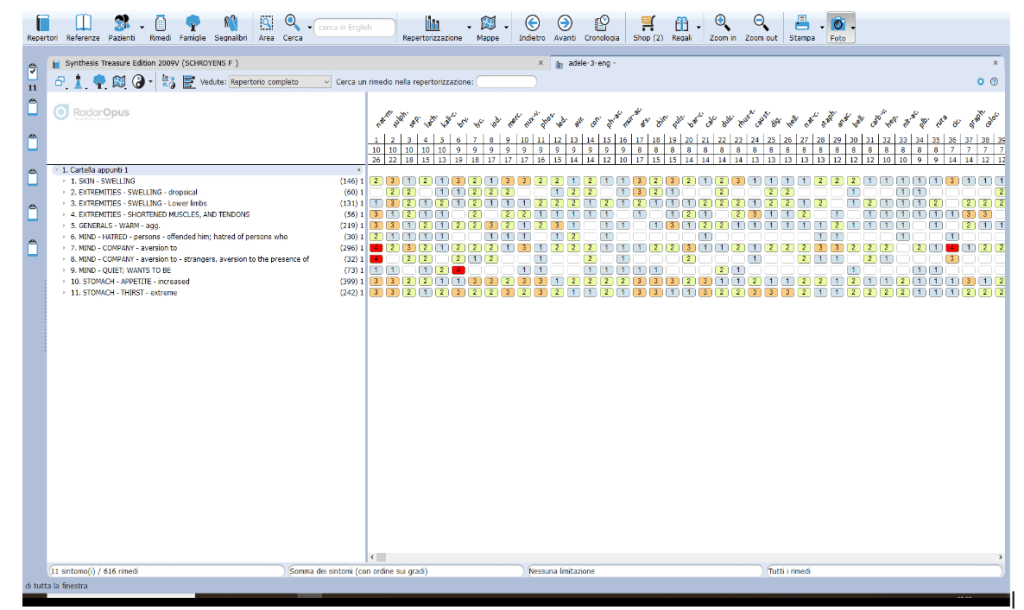
Symptoms (Rubrics) selected in this case review:
- Skin – swelling
- Extremities – swelling – lower limbs – dropsy
- Extremities – shortened muscles and tendons
- General – heat – aggravates
- Mind – hatred – hates people who have offended him
- Mind – company – aversion to company
- Mind – company – aversion to the presence of strangers
- Mind – quiet – desires to be quiet
- Stomach – appetite – increased
- Stomach – thirst – extreme
Repertorization of selected symptoms:
The Encyclopedia of Pure Materia Medica
Allen, Timothy Field
• Publisher: B Jain Publishers Pvt Ltd
• Publication date: January 1, 2011
EXTREMITIES
Complains of rheumatic pain in the arms and legs; the feet and ankles are particularly painful and stiff.
Painful tension here and there in the joints, as if the tendons were too short, or as if he had been beaten, has become very frequent.
Weakness, heaviness, and sagging of the arms.
Spasmodic contraction of the upper arms.
Muscle contractions in the forearm, noticeable to the touch.
Feeling of tension in the forearm.
Swelling of the lower limbs, from mid-leg down, with the feeling that the feet are filled with lead in the evening.
Difficulty crossing the legs.
Thighs are sore and tense when walking
Stabbing pain in the middle of the front of the left thigh, preventing walking
Feeling as if the tendons below the knees are too short
Heavy legs; feeling of bruising when climbing stairs
Painful stretching of the muscles at the back of the left thigh while sitting quietly
Leg cramps at night
Tension in the calves while walking, as if the muscles were too short
Tension in the lower limbs, in the calves, up to the knees, only while walking, not while sitting
Constricting pain similar to cramps in the calves while walking
Cramp in the left calf.
STOMACH.
INCREASED APPETITE
Thirst. Increased thirst
Constant thirst
Very thirsty
Very thirsty in the morning upon waking and throughout the day.
MIND
Sad and depressed
Depressed mood
Depression of spirit
Depressed mind, hungry
Depressed and full of pain
Sad mood
Hatred towards people who had insulted him
He got angry very easily
In a melancholic mood, she preferred to be alone for several days.
Perhaps this was the real Adele from the beginning! It is also considered that Apis is an acute form of Natrium Muriaticum!
Prescription: Natrium Muriaticum 4-6 LM FG treatment (thirty numbered capsules) (FG, as you know, stands for Federico-Galassi, as Pietro Federico and Renzo Galassi developed this formulation): one capsule per day, taking only the contents of the capsule, remembering to follow the numbering of the capsules from 1 to 30.
August 7, 2023 (= almost a month later)
The patient comes to the office for a check-up on her general condition and therapy.
The symptoms already described have begun to subside: she is able to move her arms better and can lift heavier weights than in the past. Objectively, the ‘pasta-like’ texture and edema of her forearms are reducing. Her lower limbs show only a slight improvement, and Adele still has difficulty walking down steps. She complains of night cramps in her lower limbs.
It can be noted that the patient is less “angry” and less willing to submit to constraints. She claims that she wants to be more “free” and no longer submit to her husband’s impositions, asking him directly not to invite too many people for dinners, lunches, and various gatherings because she does not want to always have to do everything herself. (Organon paragraph 253: “In all diseases, among the signs that show the beginning of improvement or aggravation, the most certain and reliable is the state of mind and the entire behavior of the patient…….)
It is recommended to continue with the current therapy and, once the Natrum muriaticum 4-6 LM package is finished, to move on to the next potency scale 7-9 LM: since the goal of avoiding aggravation, which has not occurred so far, remains, it is recommended to take the numbered capsules every other day (including the placebo capsules).
September 18, 2023:
The patient continues to improve. The burning sensation has also decreased, and her lower limbs are much better. She is able to descend stairs with reasonable agility, and the swelling and stiffness in her limbs are minimal.
During the period when we did not see each other, the patient decided to reduce her doses of cyclosporine and corticosteroids herself. In fact, she reports having completely stopped cyclosporine and left prednisone at 2.5 mg/day: “since there has been no worsening since reducing these drugs and the homeopathic therapy is clearly ‘working’ (it is likely that the ‘rebound’ did not occur thanks to the periodic administration of Natrum muriaticum), we prefer not to contest the patient’s choice, while pointing out that she should have at least consulted her homeopathic doctor first.”
Treatment with Natrum muriaticum 7-9 LM continues according to the previous prescription.
October 30, 2023:
The patient continues to improve: the cramps in her lower limbs have disappeared and she no longer feels “diffuse swelling.” She has finished the numbered capsules of Natrum muriaticum 7-9 LM, but it is considered useful to continue with this medication and it is decided to use Natrum muriaticum 12 LM, 5 drops in water once a week, for 10 weeks.
January 15, 2024:
She returns for a visit after a rheumatological check-up: her therapy with Methotrexate, cyclosporine, and steroids has been confirmed, but the patient has already suspended it some time ago (a few weeks earlier, she had asked by phone if she could also eliminate the remaining small dose of prednisone, and it was decided that it might be time to try to eliminate this last remnant of conventional therapy as well).
She is in good general condition, moves well, and the stiffness in her limbs has disappeared.
She continues with Natrum muriaticum 12 LM 5 drops in water once a week for another 10 weeks.
April 8, 2024:
A major emotional trauma occurred that shook her deeply. While doing some farm work, her husband set fire to some brush, which resulted in a fire that reached the edge of a major road.
Gelsemium MK, one tube dose of globules, is prescribed (intercurrent remedy – as per Hahnemann’s Indications in Chronic Diseases, par. 217 of the Italian edition) and therapy with Natrum muriaticum is temporarily suspended, to be resumed at the next check-up on
April 28, 2024:
Despite what happened, there has been no worsening or recurrence of symptoms of the disease.
July 8, 2024:
The patient is continuing with homeopathic therapy alone: in a recent rheumatology check-up, the specialist who examined her confirmed the allopathic therapy, stating that it was clear that the conventional therapy was working (sic, !!!!) and should be continued.
Given this direct confirmation of the effectiveness of the treatment with Natrum muriaticum, which was also confirmed by blood tests (the patient reports that her latest blood tests showed normal values, including inflammatory markers),
It was decided to go a little deeper with the remedy and continue with Natrum muriaticum 200 CH globule dose tube, to be taken not in its entirety but only the amount contained in the cap of the tube.
The decision to switch from 50,000ths potency to Hahnemannian centesimal potency was motivated by the consideration that the patient had recovered excellent vital energy and that there was no risk of aggravation by administering a potency of the remedy that would have a much greater “impact” on the depth of Adele’s suffering.
September 30, 2024:
At the check-up, the patient reports that she has been feeling very well but that she has noticed a slight stiffness in her limbs for a few days, but nothing else: it is decided to administer a few globules of Natrum muriaticum 200 CH diluted in water and dynamized at least 10 times.
On a couple of occasions, she reports feeling well over the phone: she will return for a check-up in a few months if there are no further developments.
January 20, 2025:
Check-up – The patient is in good health, climbs and descends stairs without difficulty, lifts weights without difficulty, is in good spirits, is not angry at all, and speaks without haste or anger.
It is suggested that she manage any subsequent administrations of the medication on her own, without neglecting to return for a check-up at least every six months in case there is no longer a positive response to the repeated dose of Natrum muriaticum.
Natrum muriaticum 200 CH should only be repeated when symptoms reappear, in small quantities (10 globules) of water, dynamizing it a little more each time than the previous time, i.e., giving the solution a few more succussions than the previous administration.
July 22, 2025:
The patient is still in good health, moves very well, and her blood tests are good. At the last check-up, the rheumatologist decided to suspend Methotrexate and cyclosporine and to maintain only 2.5 mg of prednisone (sic, !!!). It was not necessary to repeat any administration of the homeopathic remedy.
December 19, 2025:
The situation remains unchanged. A few days earlier, Adele took a few globules of Natrum muriaticum 200 CH in water, more out of fear that her symptoms would reappear than because they had actually reappeared (according to her, the symptoms of fasciitis seem to be very minimal and subtle).
February 9, 2026
How is Adele doing?
She has not taken any more Natrum Muriaticum globules and is in good health. She will contact me if any symptoms reappear, but I will see her again at the end of May anyway.
RESULT
To date, the case is progressing positively. Adele has resumed a normal life and is able to do everything without any particular problems or limitations.
This is, of course, a complex condition that will need to be monitored over time, assessing any changes, aggravations, and the need to review any symptoms that may appear.
We would like to remind you that the goal of homeopathic treatment is not simply to make this or that symptom disappear (a result that can certainly be achieved with conventional therapy without, however, improving the patient’s overall mental and physical condition and susceptibility to illness), but to address the true cause of the disease which, as Hahnemann indicates in paragraph 5 of the Organon, confirmed by many of the most illustrious homeopaths over two centuries) is the MIASMATIC CONDITION OF THE PATIENT (it is useful to the physician, as it helps him to treat everything related to the exciting or occasional cause, more likely in acute disease, as well as the most salient points in the history of chronic disease, which enables him to discover the fundamental cause, which is generally due to a chronic miasm) .
Homeopathic therapy prescribed according to Hahnemann’s criteria proved effective, at least until the patient’s last check-up. The symptoms reported by the patient, corresponding to the experimental symptoms of the remedy, were resolved by the administration of the homeopathic medicine. Organon paragraph 2: “The highest ideal of a cure is to restore health quickly, gently, and permanently; that is, to remove and destroy the entire disease by the shortest, safest, and least harmful means, based on principles that are easy to understand.”
CONCLUSIONS –
This clinical case confirms the dictates of the LMHI definition of homeopathy, which is based on the paragraphs of the Organon
The LMHI (Liga Medicorum Homoeopathica Internationalis) defines:
“Homeopathy is a method of medical practice that aims to improve the health of an organism through the administration of medicines that have been tested, potentized, and individually selected according to the Law of Similitude.”
LMHI-ECH: Training standards for member schools – 2012, p. 5
The approach is holistic, considering the patient as a whole (physical, mental, and emotional) to stimulate self-healing mechanisms and reduce inherited and/or acquired miasmatic burdens.