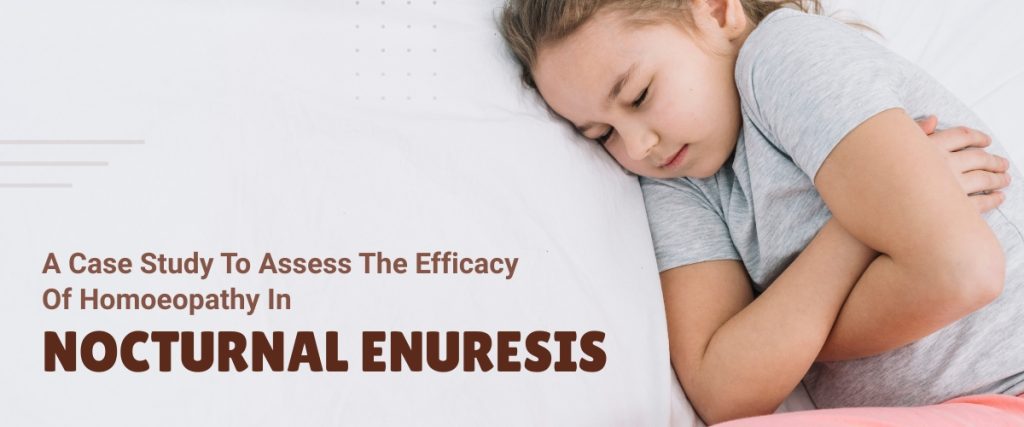
A Case Study To Assess The Efficacy Of Homoeopathy In Nocturnal Enuresis
Abstract
Nocturnal enuresis, commonly known as bedwetting, is a prevalent pediatric condition characterized by involuntary urination during sleep beyond the age at which bladder control is expected. It affects children worldwide and may persist into adolescence if not appropriately addressed. The condition can be classified into primary and secondary types and is influenced by multifactorial etiologies including genetic predisposition, delayed bladder maturation, nocturnal polyuria, sleep arousal dysfunction, and psychological factors.
Although nocturnal enuresis is often self-limiting, it can significantly impact a child’s emotional well-being, self-esteem, and family dynamics. Early identification and comprehensive evaluation are essential to rule out underlying medical conditions and to guide appropriate management. Treatment approaches range from behavioral and lifestyle interventions to pharmacological therapy, depending on severity and underlying cause.
Keywords- Nocturnal enuresis, homoeopathy ,Lachesis, pediatric
Introduction
Nocturnal enuresis is defined as intermittent involuntary voiding during sleep in children aged five years or older, occurring at least twice per week for a minimum of three months, in the absence of congenital or acquired defects of the nervous system or urinary tract. According to the International Children’s Continence Society, this condition represents one of the most common developmental disorders encountered in pediatric practice.
Bedwetting is a common concern for parents and caregivers, with prevalence rates estimated at approximately 15–20% at five years of age, decreasing progressively with age as bladder control matures. Despite its high prevalence, nocturnal enuresis remains underreported due to social stigma, misconceptions, and the belief that children will simply outgrow the condition.
The etiology of nocturnal enuresis is multifactorial, involving delayed maturation of bladder function, reduced nocturnal secretion of antidiuretic hormone, increased nighttime urine production, reduced functional bladder capacity, deep sleep patterns, and psychological stressors. Genetic factors also play a significant role, with higher incidence observed in children with a positive family history.
Homoeopathy as holistic system provide benefits with its constitution based remedy treatment.
According to Hahnemannian classification of disease nocturnal enuresis comes under local disease with internal cause and is usually considered a chronic miasmatic manifestation , predominantly psoric In nature .
Case study
- Pt name- abc
- Age /sex-12 yrs male
- Address-sachin
- Qualification -4th std
- Religion -hindu
- Opd no-25070485
- Dept-pedia
- Date-24/7/25
Chief c/o-
C/o nocturnal enuresis since childhood
| Location | Sensation | Concomitant | Modality |
| Urinary bladder (since 12 yrs) | Involuntary urination | – | – |
Personal history –
- Appetite- not adequate
- Desire-spicy cold drink
- Aversion- brinjal
- Thirst-adequate
- Urine- nocturnal enuresis
- Stool-once /day
- Sleep-sound (kapde nikalke sota he
- Dreams-snakes
- Perspiration -more on face
- Thermal-hot
Past history of–
- Pneumonia -after birth
- Typhoid -at the age of 2.5 yrs
- Family history of
- Mother-healthy
- Father-hearing problem in lt and rt ear
- Grand mother/father-healthy
Physical examination
- Built thin
- Teeth decayed
- Nails rt nail injury
- Eyes -sclera white
- Conjuctiva pink
- Tongue moist
- Gums pink
Systemic examination
- Rs- aebe clear
- Git-p/a soft
- Cns conscious
Analysis and evaluation
Mental general
- Competitive-1
- Jealousy-1
- Fear of snake ,ghost,dark-1
- Dreams- snakes horrifying-1
- Sympathetic towards death of birds animal-1
Physical general
- Desire for spicy, cold drink-2
- Aversion brinjal-2
- Perspiration more on face-2
- Thermal hot-3
Particular
Urine involuntary nocturnal -1
Abdomen -sensitive to clothing wants to uncover-2
Totality of symptoms
- Competitive
- Jealousy
- Fear of snake, ghost, dark
- Dreams- snakes horrifying
- Sympathetic towards death of birds animal
- Desire for spicy, cold drink
- Aversion brinjal
- Perspiration more on face
- Thermal hot
- Urine involuntary nocturnal
- Abdomen -sensitive to clothing wants to uncover
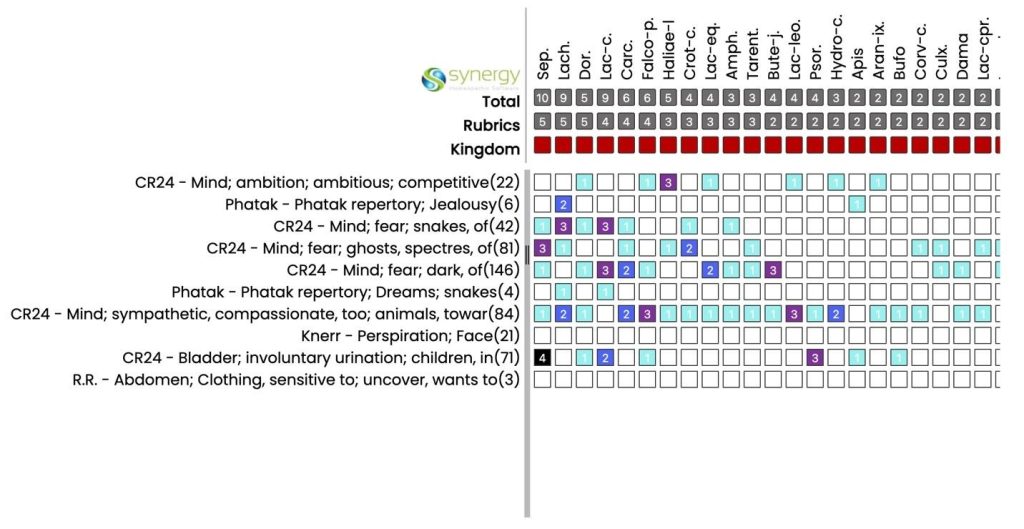
Repertorial totality (using synergy software)
- -cr mind ambition ambitious competitive
- -phatak repertory jealous
- Cr mind fear snakes of
- Cr-mind fear dark of
- Phatak repertory-dreams snakes
- Cr -mind sympathetic compassionate too towards animal
- Knerr-perspiration face
- Cr-bladder involuntary urination children in
- Rr-abdomen clothing sensitive to uncover wants to
Provisional Diagnosis -Nocturnal Enuresis
Differential Diagnosis–
1. Obstructive sleep apnea-disrupted sleep patterns due to sleep apnea can sometimes trigger bedwetting
2. Bladder dysfunction- overactive bladder or neurogenic bladder can cause involuntary urination
3. Behavioral or developmental disorders – anxiety adhd or other behaioral disorder can cause nocturnal enuresis
4. Primary nocturnal enuresis- is when a child has never been consisitently dry at night
5. Secondary nocturnal enuresis-is when a child has demonstrated the ability to sta dry at night for at least 6 months but then starts to bed wetting
Final Diagnosis-Primary Nocturnal Enuresis
Miasm –Psora
Differential Medicines-Lachesis ,Nux Vom ,Calc Sulph
Lachesis– suited most as pt ‘s mind is likely to be animal mind – competitiveness jealousy ,dreams of snakes also and charasteristic of uncovering the abdomen
Nux Vom-as pt is intelligent competitive but nux is belong to plant kingdom and pt’s mental symptoms are more towards
Calc Sulph– as pt is hot fearful and nocturnal enuresis but this is mineral remedy and mind doesn’t matches perfectly
Prescription
RX
LACHESIS 200 X OD X 3 DOSE X 3 DAY
SL 200 X BD X 7 DAYS
(SELECTION OF POTENCY ON THE BASIS OF SUSCEPTIBILITY AND INTENSITY OF SYMPTOMS )
FOLLOW UP
| DATE | CHANGE IN SYMPTOMATOLOGY | PRESCRIPTION |
| 31/7/2025 | RELIEF IN BEDWETTING FOR 2 DAYS | LACHESIS 200 X OD X STATSL 200 X BD X 15 DAYS |
| 14/8/25 | FREQUENCY OF URINATION REDUCED | LACHESIS 200 X OD X STATSL 200 X BD X 15 DAYS |
| 28/8/25 | ONLY OCCASSIONAL BEDWETTING | SL 200 X BD X 15 DAYS |
| 4/9/25 | IMPROVEMENT IN OVERALL CONDITION | SL 200 X BD X 30 DAYS |
CONCLUSION
Studies have shown that homoeopathic treatment for nocturnal enuresis is very effective in children with significant noticeable results in above case it is observed that nocturnal enuresis can be successfully managed with constituition based homoeopathic remedy with effective results
REFERENCES
1 .Hahnemann S. Organon of Medicine. 6th ed. New Delhi: B Jain Publishers; 2002.
2. Close S. The Genius of Homoeopathy. New Delhi: B Jain Publishers.
3. Kent JT. Lectures on Homoeopathic Philosophy. New Delhi: B Jain Publishers.
4. Allen JH. The Chronic Miasms. New Delhi: B Jain Publishers.
5. Roberts HA. The Principles and Art of Cure by Homoeopathy. New Delhi: B Jain Publishers.
6. Kliegman RM, St. Geme JW, Blum NJ, Shah SS, Tasker RC, Wilson KM. Nelson Textbook of Pediatrics. 21st ed. Philadelphia: Elsevier.