A case study-Scope of Homoeopathy in Abnormal Uterine Bleeding
Abstract- )Abnormal Uterine Bleeding (AUB) is any vaginal bleeding, spotting, or heavy flow occurring between periods, after sex, or outside a regular cycle (24–38 days). Often caused by hormone imbalances, structural issues (fibroids/polyps), or ovulatory dysfunction, it affects many women, particularly at the beginning or end of reproductive years. Treatments range from medication to surgery. A case report-A young woman, 28 yrs of age, with long- standing menstrual irregularities, severe dysmenorrhea, facial hair growth and mood changes sought individualized homeopathic care after limited relief from past treatments. With continued follow ups, her cycles became regular, flow normalized and pain improved enough to reduce.
Keywords: Abnormal uterine bleeding, uterine haemorrhage,Dysmenorrhea, Homoeopathy.
Introduction
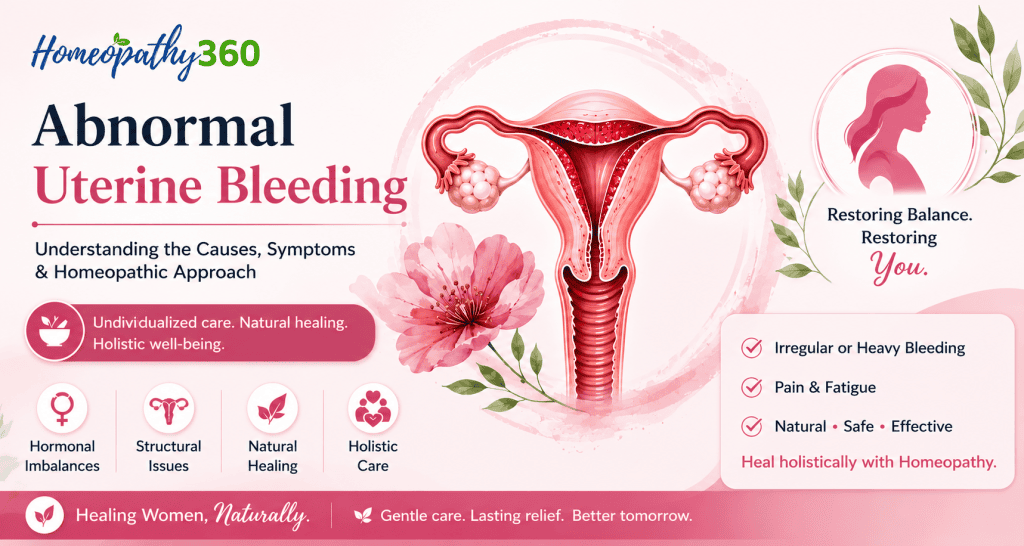
Abnormal uterine bleeding (AUB) is a broad term that describes irregularities in the menstrual cycle involving the parameters of frequency, regularity, duration, and volume of flow outside of pregnancy in reproductive-aged women.(1)
Up to one-third of women will experience AUB in their life, with irregularities most commonly occurring at menarche and perimenopause. A normal menstrual cycle has a frequency of 24 to 38 days and lasts 2 to 7 days, with 5 to 80 mL of blood loss.
Symptoms and Signs
• Heavy bleeding (Menorrhagia): Soaking through pads/tampons every hour for several hours, or needing to double up.
• Irregular bleeding: Bleeding between periods or unpredictable cycles. • Extended periods: Bleeding lasting longer than 7 days.
• Postcoital bleeding: Bleeding after sexual intercourse.
• Pain/Fatigue: Accompanied by pelvic pain, weakness, or anemia.
Common Causes
• Ovulatory Dysfunction: Often due to hormonal imbalances, such as PCOS or thyroid issues, where the egg is not released’
• Structural Issues: Fibroids, polyps, or adenomyosis.
• Medications: Certain hormonal contraceptives or blood thinners.
• Cancer/Precancer: Endometrial hyperplasia or cancer, particularly in older individuals.
Risk Factors
• Age (common in adolescents or perimenopause).
• Obesity (impacts hormone levels).
• Conditions like PCOS or hypothyroidism.
When to Seek Medical Attention
• Bleeding after menopause.
• Bleeding during pregnancy.
• Soaking through pads or tampons every hour.
• Bleeding that persists for months or is accompanied by severe pain.
Treatment:
• Medication: Hormonal contraceptives, GnRH agonists, tranexamic acid, or nonsteroidal anti-inflammatory drugs (NSAIDs).
• Procedures/Surgery: Endometrial ablation, uterine artery embolization, or hysterectomy
A Case report -A 28 years female consulted on 15/11/2025 for the treatment of menstrual irregularities since one and a half year ( last 3-4months menses not appeared), weight gain,pain in lower abdomen and constipation since 1years. She was on gynecologist treatment but did not found quit effective which leads to her in anxiety day by day .The patient was investigated with ultrasound (USG) of abdomen and pelvis, TFT and other necessary sex hormonal and blood investigations and were found to have an bilateral polycystic ovarian disease.
Personal History: Patient by occupation is a house wife belonging to middle class socio economic family.
Past History: Vaccinated in the childhood & No any history of premorbid illness.
Family History: Father: Diabetes mellitus Mother: GERD
On examination: NAD
Mental generals: She reported a persistent fear of darkness, often accompanied by dreams of ghost. The patient described herself as emotionally sensitive and prone to weeping, with mental fatigue and forgetfulness. She felt disinterested in household responsibilities, expressed a strong desire to work, and preferred outdoor activities. Sexual desire was markedly reduced.
Physical generals
• Appearance:- Lean, thin person
• Thermal – Hot
• Thirst – Thirstless
• Desire – Sweets
• Perspiration – More on face
• Menses – Irregular 3-4days/50-60 days/1pad/scanty flow
• Stool – constipated with hard stool
• Urine- normal
• Sleep – Acute Dreams – religious and ghosts
Investigations:
• Urine pregnancy test: Negative
• Thyroid Function Test: Normal
• Ultra Sonography of abdomen and pelvis: Abnormal uterine bleeding
• Diagnosis: Abnormal uterine bleeding
Totality of symptoms
Mental generals-
• Fear of darkness
• Emotionally sensitive
• Weeping tendency
• desire for work
• forgetfulness
Physical generals-
• Desire for sweets
• Thirstless
• Hot patient
Particulars-
• Irregular scanty menses
• Pain in lower abdomen
• Constipation
• Dreams of religion and ghosts
Repertorisation: The repertorisation was done by using Synthesis repertory and following rubrics were taken
• MIND – FEAR-alone,of being-darkness;in the
• MIND – FORGETFUL
• MIND – sensitive
• FEMALE GENITALIA/SEX-MENSES -irregular
• GENERALS – FOOD and DRINKS – sweets – desire
Remedy selection and prescription • Remedy: Pulsatilla nigricans 200C BID for 2 days and Placebo /TDS for 15 days
Homoeopathic View
As mentioned by Dr. Cowperthwaite, Abnormal uterine functioning is but a symptom of various existing pathological states of the generative organs. It has been always arises from grave constitutional diseases. It is evident, therefore, that the condition itself can have no established pathology, nor is it probable that menstrual abnormality ever gives rise to pathological states, it being itself a result rather than a cause of the many constitutional diseases with which it is associated and the existence of which has been erroneously attributed to the failure of the menstrual function (6)
Dr. Kent says…Homoeopathy is women’s best friend. It respects her modesty, reserves her womanhood, relieves her of the many ailments peculiar to her sex & habits and does it all more pleasantly .(7)
Follow ups
| Date | Symptoms | Medicine | Dose |
| 15/11/2025 | Menstrual irregularity, weight gain, constipation, mild hair growth on chin and pain in right iliac fossa | Pulsatilla nigricans 200 Phytum | 2 doses BID/4pills For 15 days/4pills TDS |
| 15/12/2025 | General condition stable constipation reduce pain in abdomen reduced menses not appeared yet | SL 1dose Phytum | Stat For 15 days/4pills TDS |
| 02/01/2026 | Constipation reduced, Menses gradually appeared for 1 day | SL 1dose Phytum | Stat For 15 days/4pills TDS |
| 04/02/2026 | Constipation reduced up to 50%, General good condition Menses not appeared | Pulsatilla nigricans 200 Phytum | 2 doses BID/4pills For 15 days/4pills TDS |
| 07/02/2026 | General condition good Menses appeared with no fresh complaints No pain in abdomen Constipation reduced | SL 1dose Phytum | Stat For 15 days/4pills TDS |
| 05/03/2026 | Menses appeared with no fresh complaints Constipation reduced. | SL 1dose Phytum | Stat For 15 days/4pills TDS |
Discussion and Conclusion: Homoeopathic medicines are effective in the management of menstrual irregularities, as the menstruation of the patient become regular and she was better symptomatically without any conventional medicines. It shows that homoeopathic medicines are safe and can be used as an alternative line of treatment.
Conflict of Interest- Not available
Financial Support- Not available
References
1. Dutta DC, MBBS, DGO, MO. D C Dutta’s Textbook of Gynecology, Revised and reprint of Sixth edition 2013, 195.
2.Davis, Emily, and Paul B Sparzak. “Abnormal Uterine Bleeding (Dysfunctional Uterine Bleeding).” NIH.gov, StatPearls Publishing, 2023,
www.ncbi.nlm.nih.gov/books/NBK532913/.
3.Kliegman, Robert, et al. Nelson Textbook of Pediatrics. 21st ed., Philadelphia, PA, Elsevier Inc., 2020.
4.National Library of Medicine (U.S. National Library of Medicine Current Catalog. 1992.
5.Frederik Schroyens, and Jeremy Sherr. Synthesis: Repertorium Homeopathicum Syntheticum : The Source Repertory. India, B. Jain Publishers (P) Ltd, 2016.
6.Copperthwaite A. n.d. Disorders of Menstruation. New Delhi: B Jain Publishers. 7.Kent JT. What the doctor needs to know in order to make a successful prescription. Sett Dey 1957.
GUIDED BY — PROF. (DR.) BABITA SAXENA
M.D.(HOM.), DEPARTMENT OF GYNAECOLOGY AND OBSTETRICS
COLLEGE- GOVT.HOMOEOPATHIC MEDICAL COLLEGE AND HOSPITAL, BHOPAL,M.P., INDIA