Abstract:
This article presents a case study of a 15-year-old male patient diagnosed with Juvenile Plantar Dermatosis (JPD), a chronic dry-skin condition affecting the weight-bearing areas of the feet. The patient presented with deep fissures, coldness, and pain in both feet, which had persisted for seven months despite trying various ointments.
Key Features and Treatment Approach
JPD symptoms: shiny, red, dry skin with glazed appearance, painful fissures, and scaling on weight-bearing areas of the soles
Treatment: Petroleum 200 was selected based on repertorisation and materia medica consultation, considering the patient’s physical and mental symptoms
Outcome: The patient’s fissures healed completely, and he reported reduced self-consciousness in public places, enabling him to express himself more confidently
Conclusion:
This case study highlights the effectiveness of homoeopathic treatment in managing JPD symptoms and improving the patient’s quality of life. The selection of Petroleum 200 was based on the patient’s unique symptoms and characteristics, demonstrating the importance of individualized treatment approaches in homoeopathy
Keywords: Juvenile Plantar Dermatosis, Children, Homoeopathy, Petroleum, Individualisation, fissures, Sole, Timidity.
Juvenile Plantar Dermatosis:
Juvenile plantar dermatosis is a common and chronic, dry-skin condition of the feet that mainly affects pre-adolescent children.
Juvenile plantar dermatosis is also known as atopic winter feet and forefoot dermatitis.
Common age group:
Juvenile plantar dermatosis commonly affects children between the age of 3 and 14 years, with an average age of 8. It occurs slightly more frequently in boys than girls. Juvenile plantar dermatosis is rarely seen in adults.
Causes:
- Frictional movements, as the foot moves up and down in a shoe
- The occlusive effect of covered footwear, especially synthetic shoes (eg, nylon or vinyl)
- Excessive sweating (hyperhidrosis), which when followed by rapid drying leads to cracking and fissuring
- Genetic sensitivity of the skin
- Climatic changes: with worsening during the summer months due to heat and sweating, and in colder months due to the wearing of winter boots. Hence there is no consistent seasonal variation.
Clinical features:
Juvenile plantar dermatosis involves the weight-bearing areas of the soles of the feet presenting as itchy or sore, shiny, red skin with a glazed appearance and loss of the epidermal ridge pattern.
- It usually affects both feet symmetrically.
- Painful fissures, cracking, and scaling occur.
- The plantar aspect of the great toes (ball of the big toes) is the commonest site of involvement and is the usual initial site.
- Common involvement of the ball of the foot (forefoot) and in some cases the heel; toe-webs and instep are usually spared, helping to distinguish this from tinea pedis.
- It can rarely affect the palms and fingertips.
Treatment Approaches:
- Moisturizing:Apply thick, greasy moisturizers like petroleum jelly or barrier creams (containing dimethicone) after bathing and before bed.
- Footwear: Choose well-fitting, breathable shoes (preferably leather) and avoid synthetic materials.
- Socks: Opt for absorbent cotton or wool socks, and change them when damp.
- Powder: Sprinkle absorbent powder in shoes to manage moisture.
- Rest: Schedule quiet times for feet to rest and heal.
- Occlusive dressings: Cover fissures with adhesive bandages or liquid acrylate glue to protect and promote healing.
- Topical Corticosteroids: Short-term use of topical corticosteroids (like hydrocortisone) may be considered for inflammatory episodes, but long-term use should be avoided to prevent skin thinning.
- Barrier creams: Apply barrier creams to protect the skin, especially after bathing or showering.
- Foot hygiene: Gently cleanse the feet with mild soap and water.
Case:
A 15-year old male visited our OPD at Government Homoeopathic medical college and hospital, Bhopal(M.P.) on 04 Jan 2024 with his mother.
Presenting complaint
Deep cracks, fissures in sole of both feet since last 7 months
Coldness of feet
Fissures are painful to touch and sometimes bleeds as well
ODP:
A 15-year old male visited our OPD at Government Homoeopathic medical college and hospital, Bhopal(M.P.) on 04 Jan 2024 with his mother, having complained of deep fissures in the sole of both feet. Complaints started before 7 months in winter, initially there was dryness of feet with coldness for a few days later superficial cracks started developing within a week cracks kept becoming deeper painful along with bleeding sometimes, he tried various ointments but nothing improved condition.
Physical Generals
Appetite: Ravenous, hunger increase after stool feels empty
Thirst: 1-2 lit per day, nothing specific
Aversion: Meat
Desire: Nothing specific
Stool: Satisfactory
Perspiration: Offensive
Sleep: Sound
Thermally: Chilly
Dreams: Nothing prominent he could recall of
Urine: D5N1
Mental Generals
He was very timid during case taking, hesitant to speak, was thinking a lot before speaking, and when asked does always speak after thinking this much, he replied again after thinking a lot that it’s important to think before speaking as it prevents mistakes which might embarrass him later. His mother said that he is very shy, especially in crowded places, he fears going through an ordeal with many people, he becomes extra conscious of his behaviour in public places.
General Examination:
Anaemia: present
Cyanosis: not detected
Oedema: not present
Hair: brown
Neck glands: not palpate
Gum: reddish
Pupils: normal
Pulse: 74bpm
BP: 110/70 mm hg
Temperature: Afebrile
Diagnosis: Juvenile Plantar Dermatosis
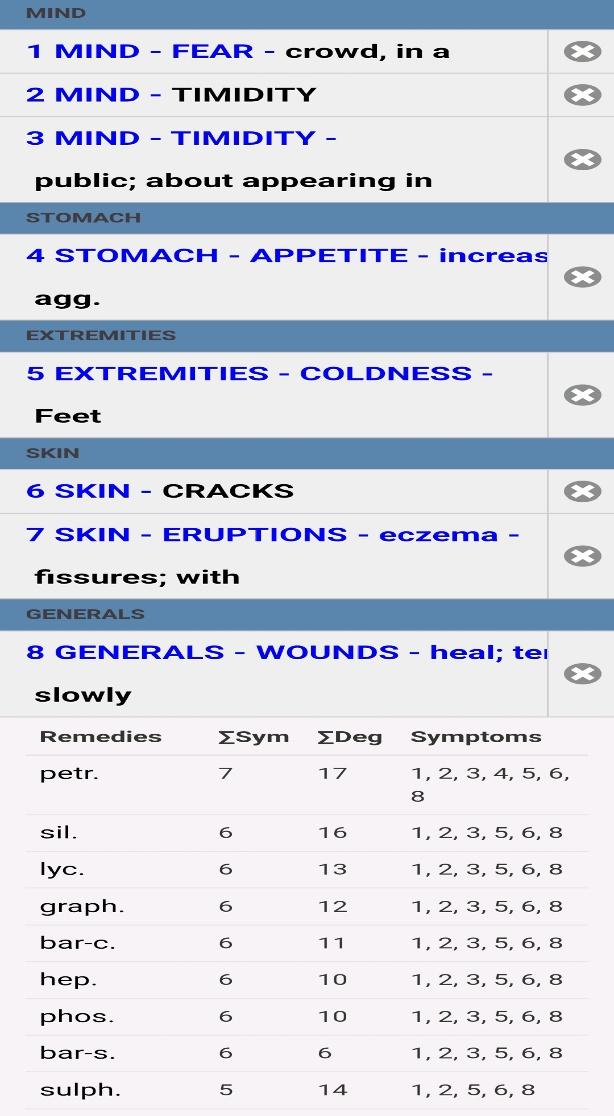
Repertorial Anaylysis
1)Mind- Fear- crowd in
2)Mind- Timidity
3)Mind- Timidity- public; about appearing in
4)Stomach- Appetite- Increased- Stool after
5)Extremities- Coldness- feet
6)Skin- Cracks
7)Skin- Eruptions- Eczema- fissure; with
8)Generals- Wound- heal; tendency to; slowly
Basis of Prescription:
The above mentioned rubrics were taken for repertorisation. After repertorisation and in consultation with materia medica petroleum was selected. Also petroleum belongs to carbon group, where there is theme of being dignified, they value themselves and timidity in public places comes from fear of doing something which might not suit there stature, this child at such young stage is concerned about not making mistake while speaking with someone or when he is in public places to avoid any embarrassment, this matches with the theme of carbons and physical generals and particulars are covered by petroleum.
Prescription
On 4/1/2025
Petroleum 200 BD×4 days
followed by placebo twice a day for 3 weeks
Follow up on 3/2/2025
Fissures healed completely. Along with this he said that he feels less conscious in public places and is able to express himself without much strain.


Conclusion
This case study demonstrates a successful homeopathic approach to treating Juvenile Plantar Dermatosis (JPD) in a 15-year-old boy. For seven months, he suffered from deep, painful, and bleeding fissures on the soles of his feet.
The chosen remedy, Petroleum 200C, was not just for the physical symptoms. It was selected after a thorough analysis of his unique presentation, including his timidity, fear of crowds, and anxiety about public appearances and reason behind this timidity which aligned well with the deeper themes associated with carbon-group remedies, including Petroleum . These mental and emotional aspects, often overlooked in conventional treatments, were crucial to the homeopathic prescription. This personalized approach, which considered the whole person, proved incredibly effective.
Within a short period, the fissures completely healed. What’s more, the patient reported a significant improvement in his mental state, feeling less self-conscious in public and more able to express himself. This outcome highlights the profound impact of individualized homeopathic care, addressing not just the skin condition but also the underlying emotional well-being. This case serves as a powerful example of how homeopathy can offer holistic relief for complex dermatological issues.
Citation:
- Oakley A, Eshraghi A. Juvenile plantar dermatosis [Internet]. DermNet NZ; 2018 [cited 29 Jun 2024]. Available from: https://dermnetnz.org/topics/juvenile-plantar-dermatosis
- Ashton RE, Griffiths WA. Juvenile plantar dermatosis—atopy or footwear? Clin Exp Dermatol. 1986;11(6):529-34. Doi: 10.1111/j.1365-2230.1986.tb00504.x.
- Ashton RE, Jones RR, Griffiths A. Juvenile plantar dermatosis. A clinicopathologic study. Arch Dermatol. 1985;121(2):225-8.
- Harding CR. The stratum corneum: structure and function in health and disease. Dermatol Ther. 2004;17 Suppl 1:6-15. Doi: 10.1111/j.1396-0296.2004.04s1001.x.
- Shipley DR, Kennedy CT. Juvenile plantar dermatosis responding to topical tacrolimus ointment. Clin Exp Dermatol. 2006;31(3):453-4. Doi: 10.1111/j.1365-2230.2006.02121.x.
- Elias PM, Choi EH. Interactions among stratum corneum defensive functions. Exp Dermatol. 2005;14(10):719-26. Doi: 10.1111/j.1600-0625.2005.00363.x.
- Ingram JR. Eczematous disorders. In: Griffiths C, Barker J, Bleiker T, Chalmers R, Creamer D, editors. Rook’s Textbook of Dermatology. 9th ed. Wiley Blackwell; 2016. P. 39.21-2.
- Boericke, W., & Boericke, O. E. (1990). Homoeopathic materia medica with repertory comprising the characteristic and guiding symptoms of the remedies (R. B. Savage, Ed.;2nd ed.). Homoeopathic Book Service.
About the Author
DR KANYAN SANJANA RAJESH MD scholar,
Department of homoeopathic materia medica
Govt. homoeopathic medical college and hospital.
Bhopal ,Madhya Pradesh.
UNDER THE GUIDANCE OF
PROF. DR. SHOBHANA SHUKLA
Professor and H.O.D of Department of homoeopathic materia medica
Govt. homoeopathic medical college and hospital.
Bhopal , Madhya Pradesh.