
Abstract:
Onychocryptosis (ingrown toenail) is a common and painful nail disorder in which the edge of the nail plate penetrates the periungual skin(1) Predisposing factors include trauma, improperly trimmed nails, tight footwear, hyperhidrosis, and nail deformities(2). In severe or chronic cases, standard treatments range from conservative measures (soaking, cotton-wick or gutter splints, antibiotics) to surgical interventions (nail avulsion with phenol matricectomy). I present a 31-year-old male with a 2-year history of painful, hardened ingrowth of the left great toenail following blunt trauma. He had not received prior conventional treatment. Homeopathic treatment was initiated with Silicea terra and topical Calendula, resulting in marked improvement and complete resolution at 6 months. This case illustrates a successful non-surgical approach to chronic onychocryptosis.
Keywords: onychocryptosis; ingrown toenail; homeopathy; case report; Silicea terra; Calendula officinalis
Introduction:
Onychocryptosis (from Greek onyx “nail” and kryptos “hidden”) or ingrown toenail is a common nail disease in which the nail plate grows into and embeds in the adjacent nail fold. It most often affects the great toe (hallux) and causes significant pain, swelling, and disability if untreated.
Clinical features:
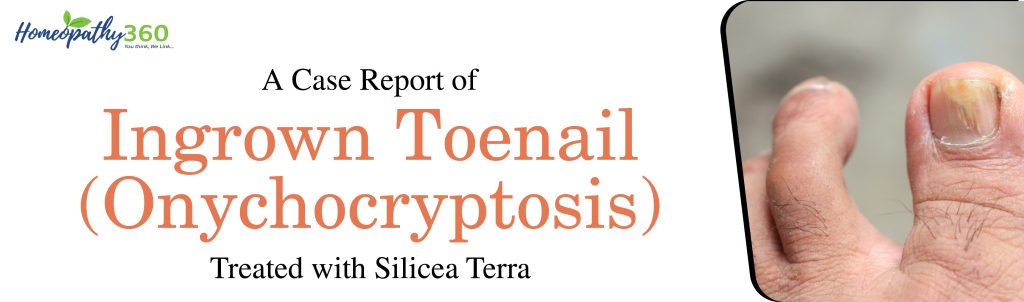
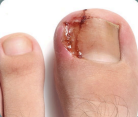
Typical clinical features include redness, swelling, and later purulent discharge or granulation tissue at the nail margin. In severe cases the lateral nail fold may hypertrophy (pincer nail deformity). By clinical severity, ingrown nails are often categorized as mild (nail-fold swelling and pain), moderate (increased swelling, infection, or ulceration) and severe (chronic inflammation with marked tissue overgrowth). For example, one review states: “Ingrown toenails are classified into three categories: mild, moderate, and severe”. (See Figure 1 for a typical presentation of an ingrown toenail at the time of initial consultation.)
Types:
Based on Anatomical Location
1. Lateral Ingrown Toenail
○ Most common type
○ Nail grows into the skin on the side of the toe
○ Usually affects the big toe
2. Central Ingrown Toenail (Pincer Nail or Omega Nail)
○ Nail curves excessively from both sides, pinching the nail bed ○ Can cause severe pain and pressure
3. Distal Ingrown Toenail
○ Less common
○ Nail grows forward and downward, embedding into the tip of the toe
�� Types Based on Severity (Stages)
1. Stage I (Mild)
○ Redness, slight swelling, and pain on pressure
○ No pus or drainage
○ May be reversible with conservative care
2. Stage II (Moderate)
○ Increased swelling, pain, and possible pus discharge
○ Infection may be present
○ Granulation tissue may start to form
3. Stage III (Severe)
○ Chronic inflammation with hypertrophic granulation tissue
○ Significant pain, persistent infection, and nail deformity
○ Often requires surgical intervention
�� Other Classifications
● Congenital Ingrown Nail – Present from birth due to nail shape or skin overlap ● Acquired Ingrown Nail – Due to trauma, tight shoes, improper nail trimming ● Recurrent Ingrown Nail – Comes back repeatedly despite treatment
Etiology:
The etiology of onychocryptosis is multifactorial. Trauma to the toe (e.g. from shoes, injury, or repetitive impact) can drive nail edge into the skin. Improper nail trimming (cutting nails too short or in a rounded shape) and tight or pointed footwear force the nail borders into the soft tissue. Excessive sweating and poor foot hygiene may soften the skin, making penetration easier. Certain nail abnormalities (thick or highly curved nails, pincer nails) predispose to ingrowth. Familial cases and congenital forms (excess lateral nail fold tissue) also occur. In our patient’s case, a history of blunt toe trauma likely contributed to chronic ingrowth.
Diagnosis:
Diagnosis of ingrown toenail is made clinically by inspection. The condition is “usually evident” on examination. Key findings include the nail plate digging into the periungual skin, associated inflammation, and sometimes granulation. Differential diagnoses such as subungual exostosis or tumors are uncommon and usually excluded by imaging if suspected. Given the classic appearance, no laboratory tests are required. (Further staging can be done, but in practice the presence of pain, discharge or granulation suffices to grade severity.)
Case Presentation:
Overview:
A 31-year-old male presented in June 2024 with a 2-year history of ingrown toenail on the left great toe. He reported onset of symptoms immediately following a motorcycle accident in June 2022, in which the toe was hit by blunt trauma. Since that time he experienced persistent pain on pressure to the toe, itching and a hard “crusty” feel along the nail fold, occasional minor bleeding, and visible clots under the nail. He had not sought any prior medical or surgical treatment for the toe.
On examination, the lateral edge of the left hallux nail was curved inward and partially embedded in the swollen periungual skin. The adjacent skin was erythematous and tender, with some serous crusting and a small amount of blood clot under the nail fold .
There was no systemic fever or lymphangitis. The findings were consistent with a chronic ingrown toenail (onycho-cryptosis) of moderate severity. The big toe nail was not grossly
deformed beyond the ingrowth at the lateral corner. Neurological and vascular status of the foot was normal.
No radiography was performed as there was no suspicion of underlying bony lesion. Clinical diagnosis: Left hallux ingrown toenail (onychocryptosis), chronic; likely Mozena stage II–III (acute inflammation with some granulation).
History of Present Illness:
● Incident: Motorcycle fell onto right great toe while patient wore Crocs; immediate stinging pain, redness, swelling.
● Initial Response: Applied water; noticed blood under nail, persistent pain, and toenail gradually turning black.
● Progression (weeks to months):
○ New nail growth started ingrowing under the old damaged nail.
○ Area remained tender; the nail was thin and ingrown.
○ Patient self‑trimmed overgrowth with difficulty as growth continued. Treatment History:
● No medical consultation post‑injury.
● Self-care: cleaning the toe, rough trimming.
● No antibiotics, anti‑inflammatories, topical steroids, or professional debridement used Past Medical History:
● No diabetes, peripheral vascular disease, or systemic conditions.
● No history of repeated nail infections or prior similar conditions.
Family History:
Father: DM
Mother: HTN
Physical generals:
Reddish, Painful, crust like presentation on the right toenail with hardness, blood clot. Tenderness is present.
1. Thermal reaction: CHILLY
2. Appetite: 2 meals per days
3. Thirst: 8-9 glasses/ L per day , increased.
4. Desire: salty food,sweet food.
5. Aversion: milk
6. Urine: D- 2 times, N-2 times, colour: yellowish
7. Stool: D_ N_ , Character : : clayish
8. Sleep: 7-hours , Refreshing
9. Dreams: cannot remember
10.Perspiration: Moderate mostly on scalp during sleep; odour:
odourless
● Appearance of Patient:
The patient looks lean and thin.
Mental generals:
● The patient is always absent minded.
● He says his concentration is difficult
● Always anxiety about his future
● Sad feeling about his health
Particular Symptoms:
● Skin eruption is crusty
● Skin eruption, herpetic and stinging.
● His right big toe nail has an ingrown toenail with ulceration.
General Examination:
BP-120/80mm of hg, pulse-72 bpm, RR-18/min
Analysis and Evaluation of Symptoms:
| Sl. No. | Symptoms | Rubrics | Analysis | Evaluation |
| 1) | The patient is always absent minded. | MIND-ABSENT MINDED | MENTAL GENERAL | ++ |
| 2) | He says his concentration is difficult | MIND CONCENTRATION difficult | MENTAL GENERALS | ++ |
3) Skin eruption is crusty
SKIN-ERUPTION crusty
PARTICULAR +++
| Sl. No. | Symptoms | Rubrics | Analysis | Evaluation |
| 4) | Skin eruption, herpetic and stinging. | SKIN-ERUPTION herpetic-scaly-dry-me aly | PARTICULAR | +++ |
| 5) | His right big toe nail has ingrown toenail | EXTREMITIES NAILS;complaints of-ingrowing toenail | PARTICULAR | +++ |
| 6) | Stool is clayish | STOOL-CLAYISH | PHYSICAL GENERAL | ++ |
| 7) | Aversion- milk | GNERAL- FOOD AND DRINKS- milk agg | PHYSICAL GENERAL | ++ |
Repertorial Analysis:
● SILICEA TERRA- 20/9
● CALCAREA CARB- 15/8
● SEPIA- 16/7
● NITRIC ACID- 12/6
Repertorisation was done by synthesis repertory. After Repertorisation Silicea terracover the maximum number of rubrics and gain highest marks. Then after contacting with homoeopathic materia medica of various author, SILICEA TERRA was prescribed.
Repertory/Software used:
● Synthesis Repertory
Prescription:
RX
1) SILICEA 200/ TDS X 7DAYS
4 GLOBULES ( no.30) X 7DAYS EARLY MORNING.
2) SAC LAC 200/ 1 DRANCHUM
4 GLOBULES ( no.30) X BD
3) CALENDULA MOTHER.
7-8 DROPS OF CALENDULA IN LUKEWARM WATER, SOAKED IN A COTTON BALL AND APPLY ON THE AFFECTED TOE NAIL.
Follow Up:
● July 2024(1 month): Follow-up – marked decrease in pain and swelling. Rx
SAC LAC 200/ 1 DRANCHUM
4 GLOBULES ( no.30) X BD
● September 2024 (3 months): Follow-up – near-complete healing; nail regrowing normally.
Rx
SAC LAC 200/ 1 DRANCHUM
4 GLOBULES ( no.30) X BD
● December 2024 (6 months): Follow-up – complete resolution; no pain or recurrence. Rx
SAC LAC 200/ 1 DRANCHUM
4 GLOBULES ( no.30) X BD
At a 1-month follow-up (July 2024), the patient reported significant reduction in pain. The toe was less tender on touch, and the swelling of the nail fold had decreased. Some crusting persisted but granulation tissue appeared reduced. The Silicea dosage was then reduced to twice daily. At the 3-month follow-up (September 2024), the lateral nail fold inflammation had almost resolved. The ingrown portion of the nail had receded slightly away from the skin, and a healthy nail margin was growing out. By the 6-month follow-up (December 2024), the ingrowth had fully resolved: the nail was straight and no longer embedded, the skin was healed without discharge or scarring, and the patient reported no pain at all.
There was no recurrence of the ingrown nail during the 6-month observation period. Images/Reports:
| Before | During | After |


Conclusion:
This given case demonstrates how well homoeopathy works on ingrown toenails especially when the symptoms closely match the profile of a remedy.
Silicea Terra 200 is administered on an empty stomach. 75% of the symptoms had subsided by the next 3 days and the patient felt better with no recurrence of the symptoms.
Management:
The patient was prescribed Silicea terra 200C potency, three times daily for one week. He was instructed to take the remedy sublingually and to change its frequency as directed thereafter. Additionally, Calendula officinalis mother tincture was applied externally: the patient soaked the affected toe in warm water with a few drops of Calendula Q for 10–15 minutes, twice daily, and then dabbed Calendula tincture on the inflamed nail fold. Calendula was used for its known wound-healing antiseptic properties(5). No allopathic medications were given, and the patient was advised to wear loose footwear and keep the toe clean.
Discussion:
This case demonstrates homeopathic management of a chronic ingrown toenail that had been present for two years following trauma. The remedy Silicea terra was chosen based on the clinical picture of slow-healing, suppurative inflammation around the nail, and a chronic tendency for the condition to recur. Silicea (Silica) is a homeopathic remedy traditionally indicated for suppurative, chronic conditions of the nails and skin, particularly where pus formation or granulations are involved. Its pathogenetic profile includes a tendency for nails to become brittle, misshapen or ingrowing. One source notes: “Silicea terra … stimulates growth of new [nails]. Ingrowing toenails.”. Thus, it aligns with a “splinter-like” pain and granuloma formation under the nail, as seen in this patient. The improvement after the remedy – reduction of discharge, gradual normalizing of nail growth, and eventual cure – is consistent with Silicea’s reputed action on chronic ingrown nails.
In addition, Calendula was used externally for its antiseptic and wound-healing properties. Homeopathic literature (and historical dermatology practice) recognizes Calendula officinalis as an effective topical agent to prevent or treat infection and promote healing in wounds.(5)
For example, one dermatology source notes that Calendula “is the homeopathic preparation made from the marigold plant, [and] is an antiseptic” that “gets rid of the redness and infection” in wounds(5). In our case, regular Calendula soaks helped keep the toe clean and reduce local inflammation, complementing the internal remedy. No antibiotics were used, and the toe healed without surgical intervention, underscoring the role of the remedies and supportive care.
The patient’s full recovery after six months – with no recurrence at final follow-up – suggests that the homeopathic regimen successfully addressed the pathological process. Notably, the patient had previously declined any treatment, and conventional options (nail surgery or antibiotics) were not attempted. According to standard medical references, chronic ingrown nails often require partial nail removal and matricectomy to prevent recurrence. In contrast, this patient’s case was resolved non-surgically. Of course, single-case reports have limitations, but this outcome is consistent with other homeopathic case reports where Silicea improved chronic nail conditions.
No adverse effects were reported. The regimen was well-tolerated, and compliance was excellent. The improvement timeline (noticeable by 1–3 months, complete by 6 months) is plausible for homoeopathic therapy in a chronic condition.
Limitations: As with any single case, we cannot generalize causality. The placebo effect or the natural course of the lesion might have contributed. However, the chronicity (2 years without improvement) followed by relatively rapid healing after remedy suggests a therapeutic effect. Longer follow-up would be ideal to confirm sustained cure beyond 6 months.
Therapeutic Intervention:
After case taking on a standard case taking Performa, totality of symptoms was built for the patient based on mental generals, physical generals, constitution, miasmatic background, family history etc. as per the homoeopathic principles.
After Repertorisation, the top medicines were SILICEA, CALCAREA CARB, SEPIA, NITRIC ACID. After carefully analyzing the mental and physical generals of the patient, considering the reportorial result and referring back to homoeopathic materia medica similimum was prescribed. Individualized homoeopathic treatment was started with Silicea. 200/ 2 dose early morning in empty stomach three times daily for one week which is followed by saclac and external application of calendula mother tincture everyday.
Result:
Timeline of events:
● June 2022: Motorcycle accident injures left great toe; ingrown nail symptoms begin. ● June 2024 (Month 0): First consultation – chronic ingrown toenail diagnosed; prescribed Silicea terra 200C and Calendula officinalis MOTHER TINCTURE. ● July 2024(1 month): Follow-up – marked decrease in pain and swelling. ● September 2024 (3 months): Follow-up – near-complete healing; nail regrowing normally.
● December 2024 (6 months): Follow-up – complete resolution; no pain or recurrence.
Conclusion:
This case report illustrates a successful homeopathic approach to chronic ingrown toenail using Silicea terra supported by topical Calendula. The patient achieved complete healing within 6 months, avoiding surgery. Silicea’s known indications for nail involvement and Calendula’s antiseptic action(5) are consistent with the patient’s improvement. We suggest that homeopathic constitutional management can be considered in similar cases of onychocryptosis, particularly when patients seek a non-surgical option. Further studies would be valuable to corroborate these findings.
References:
In the interest of brevity, only key sources are listed below. Additional standard references were consulted for background on ingrown toenail (onychocryptosis) etiology and management.
1. D.S. Rajbala et al., Non-surgical treatment of in-growing toe nail: a five-year experience of 161 patients. Int J Curr Med Pharma Res 2019;5(6):4014–4019. (Ingrown nail classification) journalcmpr.com.
2. Naveen S et al., Ingrown toenails: A current perspective. Indian J Dermatol Venereol Leprol 2012;78(6):726–733. (Onychocryptosis review) ijdvl.comijdvl.com.
3. S. Baran et al., Ingrown nail: A comprehensive review. J Am Acad Dermatol 2019;81(6):1278–1288. (Online supplement details).
4. Pal P, Saha S, Manjurrani M. Nails and Silicea: Homeopathic management of nail disorders. Int J Health Sci Res 2020;10(8):263–269. (Silicea in nail disorders).
5. Hilton L. Wound healing’s homeopathic side. Dermatol Times 2006;27(11):24–25. (Calendula antiseptic use) dermatologytimes.com.
6. American Academy of Family Physicians. Management of the Ingrown Toenail. Am Fam Physician 2009;79(4):303–309. (Standard medical management). 7. Reference- Schroyen’s F.SYNTHESIS 2.0 App Belgium: trademark Zeus-soft;2009
About the Author:
Dr Debasmita Das Md (Hom.) Scholar, Department – Organon of Medicine and Homoeopathic Philosophy, Government Homoeopathic Medical College and Hospital, Bhopal, Madhya Pradesh
About the Co-Author:
Dr. Babita Shrivastava, Professor and HOD, Department of Organon of Medicine and Homeopathic Philosophy, Government Homoeopathic Medical College and Hospital, Bhopal, Madhya Pradesh, India
Dr. Suresh Chandra Awasthi, Professor, Department of Organon of Medicine and Homeopathic Philosophy, Government Homoeopathic Medical College and Hospital, Bhopal, Madhya Pradesh, India