Abstract
Haemorrhoids are a common anorectal disorder frequently associated with chronic constipation, dietary indiscretions, and sedentary lifestyle. Conventional treatment often provides symptomatic or temporary relief and may require invasive procedures. Homoeopathy, through individualized case-taking and holistic prescription, offers a non-invasive and effective therapeutic approach. This article presents a case of external haemorrhoids successfully managed with homoeopathic medicine based on characteristic physical generals, particulars, and constitutional traits.
Keywords: Haemorrhoids, Piles, Homoeopathy, Individualization, Case Report
Introduction
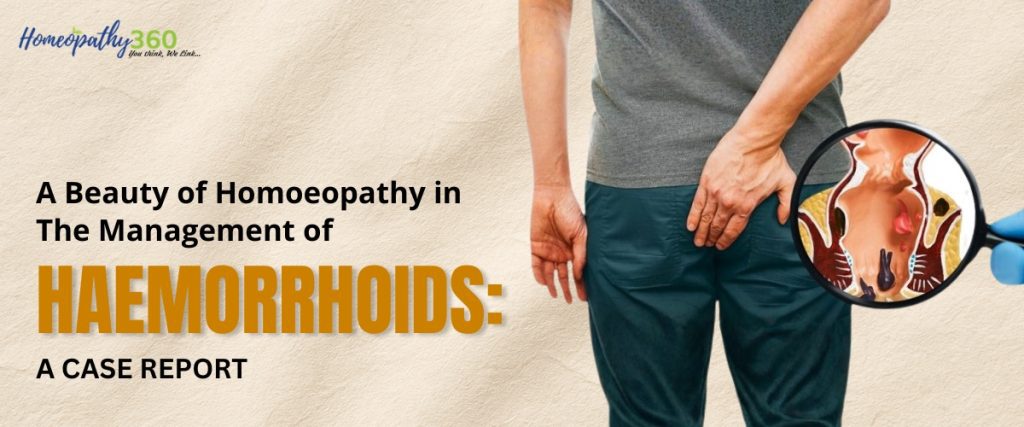
Haemorrhoids, commonly known as piles, are dilated venous plexuses of the anal canal. The term is derived from the Greek words haima (blood) and rhoos (flowing). They commonly result from chronic constipation, prolonged straining during defecation, low-fiber diet, and faulty bowel habits. Homoeopathy aims at treating the patient as a whole by addressing not only the local pathology but also the underlying constitutional and lifestyle factors, thereby offering long-term relief.
Case Presentation
Patient Profile
● Name: ABC
● Age / Sex: 43 years / Male
● Religion: Hindu
● Marital Status: Unmarried
● Occupation: Employed
● Socio-economic Status: Middle class
Chief Complaints
1. Burning pain in anus with swelling, aggravated by touch – since 6 months 2. Itching in anal region – since 6 months
3. Bleeding and pain while passing stool – since 6–7 days
4. Constipation with hard and unsatisfactory stool – since 1 month
5. Abdominal pain associated with constipation – since 1 month
History of Present Illness
The patient was apparently well six months ago when he developed burning pain in the anus, particularly after consumption of chicken and spicy food. After one month, he noticed swelling at the anal region, which was sensitive to touch. Initially, bleeding was absent, but itching was present.
He underwent traditional treatment and experienced temporary relief. However, the complaints recurred after four months. For the past 6–7 days, bleeding and pain during defecation were noted, associated with hard, unsatisfactory stool and abdominal discomfort due to constipation.
Past History
● Chicken pox in childhood – treated with allopathic medicines
● Viral fever 6 years ago – treated with allopathic medicines
Family History
● Father: Hypertension
● Mother: Rheumatoid arthritis
● Brother: No significant illness
Physical Generals
● Appetite: Normal (three times daily)
● Desire: Cheese
● Aversion: Not specific
● Thirst: 2–3 litres per day
● Urine: 5–6 times/day, normal
● Stool: Constipated, hard, unsatisfactory, with bleeding (1–2 drops)
● Perspiration: As per season
● Sleep: Adequate and refreshing (6–7 hours)
● Dreams: Routine daily activities
● Thermal Reaction: Hot patient
Personal History & Life Space
The patient belongs to a middle-class family with one younger brother. He completed his education in Madhya Pradesh and later shifted to Vadodara and Surat for employment. He reported stress related to family pressure regarding marriage but was unable to express his concerns openly.
Clinical Examination
Local Examination
● Inspection: External haemorrhoid present at the 7 o’clock position
Analysis and Evaluation of Symptoms
● Burning pain in anus
● Swelling and sensitivity of haemorrhoids
● Itching in anal region
● Bleeding during stool
● Pain aggravated during defecation and walking
● Constipation with hard, unsatisfactory stool
● Bashful disposition
Repertorial Totality
● Mind – Bashful
● Rectum – Haemorrhoids; burning
● Rectum – Haemorrhoids; sensitive
● Rectum – Itching
● Rectum – Bleeding during stool
● Rectum – Pain during stool
● Rectum – Constipation; hard stool
Prescription and Follow-Up
Rx: Pulsatilla 30
● 3 doses, once daily in the morning for 3 days
● Followed by placebo for 7 days
Follow-up Findings
● Burning pain: Absent
● Swelling: Absent
● Bleeding during stool: Absent
● Itching: Occasionally present
● Constipation: 70% improvement
Next Prescription: Phytum – one dose, stat
● Followed by placebo for 7 days
Discussion
This case demonstrates the effectiveness of individualized homoeopathic treatment in haemorrhoids. The remedy selection was based on characteristic local symptoms, physical generals, and constitutional traits. Homoeopathic intervention not only relieved the local pathology but also improved bowel habits, thereby reducing recurrence. Early intervention and holistic case-taking played a crucial role in achieving sustained improvement.
Conclusion
Homoeopathy provides a safe, effective, and non-invasive approach in the management of haemorrhoids. Individualized remedy selection, along with dietary and lifestyle advice, can lead to significant symptomatic relief and improved quality of life. This case highlights the scope of homoeopathy in managing common anorectal conditions without surgical intervention.
References
1. Goligher JC. Surgery of the Anus, Rectum and Colon. 5th ed. London: Baillière Tindall; 1984.
2. Parks AG. Pathogenesis and treatment of haemorrhoids. BMJ. 1956;2:454–458. 3. Bailey P. Homeopathic Psychology. New Delhi: B Jain Publishers; 2011.
4. Boericke W. Pocket Manual of Homoeopathic Materia Medica. New Delhi: B Jain Publishers; 2007.
5. Boger CM. Boenninghausen’s characteristics and repertory. New Delhi: B. Jain Publishers; 1931.
6. Allen HC. Keynotes and Characteristics with Comparisons. New Delhi: B Jain Publishers; 2005.
7. Kent JT. Lectures on Homoeopathic Materia Medica. New Delhi: B Jain Publishers; 2003.
8. Hahnemann S. Organon of Medicine. 6th ed. New Delhi: B Jain Publishers; 2002.