
Keywords
Hering, Law Of Cure, HELAT, Practical, Clinical
Abstract
Hering’s law of cure can be called the guide to physician in the path to the highest ideal of cure. According to the law of direction of cure, the cure must take place from above downwards, from within outwards, from the more important organ to the less important organ & in the reverse order of the appearance of symptoms. The development of the Hering’s Law Assessment Tool (HELAT) helps to monitor patient responses, and its scores give us value of clinical improvement in patients with rheumatoid arthritis. Still there is disagreement about its directional validity of symptoms. Although while practical evidence supports the occurrence of Hering’s Law in many homoeopathic cases, its status as a scientific law remains a topic of discussion.
Introduction
Hering’s law of cure is also known as “the law of direction of cure”. This is formulated by the famous homeopath, Dr. Hering. He is also called as the “Father of American Homeopathy”. The Hering’s law of cure for a homoeopath is like a compass to a navigator and sailor.
History related to the formulation of Hering’s law
- With the first publication of his Materia Medica Pura in 1811, Hahnemann inaugurated a new arrangement of the symptoms: from above downwards, from inside outwards, but also from the parts to the generals.
- In 1828, Hahnemann published his first observations and theories on chronic diseases.
During the treatment of chronic diseases of non-venereal origin with antipsoric remedies, the last symptoms are always the first to disappear, “but the oldest ailments and those which have been most constant and unchanged, among which are the local ailments, are the last to give way.” - In 1845, Hering published in the preface of the first American edition of Hahnemann’s Chronic Diseases – an extract of an essay which was never published elsewhere, called “Guide to the Progressive Development of Homœopathy”. In this essay, Hering writes: “Every homœopathic physician must have observed that the improvement in pain takes place from above downward; and in diseases, from within outward.
- . In 1865, he published an article in the first volume of The Hahnemannian Monthly called “Hahnemann’s three rules concerning the rank of symptoms”. Hering states in this article that: “Hahnemann states, in his treatise on Chronic Diseases, American translation p.171: Symptoms recently developed are the first to yield. Older symptoms disappear last.
- In 1875, Hering published the first volume of Analytical Therapeutics of the Mind in which he stated that “only such patients remain well and are really cured, who have been rid of their symptoms in the reverse order of their development”.
Origin of the term “Hering’s law
The earliest mention found in the homeopathic literature dates from 1911, in an article published by Kent in the first volume of the Transactions of the Society of Homœopathicians called “Correspondence of Organs, and the Direction of cure. Kent writes :
There is scarcely anything of this law in the literature of homœopathy, except the observation of symptoms going from above to the extremities. Kent was the one that officialized the term “Hering’s law” and so inadvertently popularized the concept of law of direction of cure &
by using the name of Hering created false and misleading historical assumptions. These are actually Hahnemann’s observations, his experience what he gathered during his practice regarding direction of disappearance of signs and symptoms in patient, further explained by Hering and wrongly termed by Kent as a Hering law of cure.
According to the law of direction of cure, the cure must take place:
- From Above Downwards
When a similimum is administered to a patient, the annihilation of symptoms will take place from the proximal anatomical parts to the distal anatomical parts of the body or from the axial part to the apendicular part of the body.
Example: if a patient suffering with “polyarthritis” is given a curative remedy, the joints that are close to the trunk (proximal) will get better first, and then the joints away from the body (distal). 2. From Within Outwards
The homeopathic remedy always first eases the inner vital organs and then proceeds to the outer parts of the body. This is the reason why after the administration of a remedy the patient “feels better” in his inner self, in spite of the existence of the disease in the physical parts.
Example:
In cases of “rheumatic fever”, joints are affected first and then it progress to the heart. In such cases, when a remedy is administered it cures the cardiac symptoms first and finally the joint problems. This is because the curative process is starting from the innermost organ heart, to the outer joints.
3. From the More Important Organ to the Less Important Organ
The curative process is opposite to the disease process. The disease proceeds from less important organ to the most important organ. The curative process is always from the more important organ to the less important organ.
Example:
A patient with complaints of both respiratory as well as skin disorders, after receiving a homoeopathic remedy, respiratory complaints disappear first then the skin symptoms disappear as the curative process is starting from the more important organ to the less important organ.
4. In the Reverse Order of the Appearance of Symptoms
During the “case taking”, the physician arranges these diseases in the order of their appearance i.e. in chronological order.
Example-
A patient’s history reveals that he has been suffering with oozing itchy skin eruptions since 20 years, constipation and bleeding hemorrhoids since 5 years and bronchial asthma with dry cough and breathlessness since 2 years. If in such a case a similimum remedy is administered, it will remove the symptoms of the bronchial asthma first, then the symptoms of hemorrhoids and finally the symptoms of skin eruptions.
Hering’s law of cure according to Dr. J. T. Kent-
From centre to circumference is from above down-ward, from within outwards, from more important to less important organs. Every homoeopathic practitioner who understands the art of healing, knows that symptoms which go off in these directions remain away permanently. Moreover, he knows that symptoms which disappear in the reverse order of their coming are removed permanently.
Hering’s law of cure by Dr. Stuart Close-
Cure take place in a definite, orderly manner and direction. Normal vital processes, cellular, organic and systemic, begin at the center and proceed outwardly. Figuratively, if not literally, life is a centrifugal force, radiating, externalizing, concentrating and organizing spirit into matter “from above, downward.” In the same sense disease is a centripetal force, opposing, obstructing, penetrating toward the center and tending to disorganization. The progression of all chronic diseases is from the surface toward the center; from less important to more important organs-“from below upward.”
Hering’s law of cure by Dr. GEORGE vithoulkas
If cure is in progress, symptoms will manifest at levels which are progressively of less crucial importance to the freedom of the individual to express fullness and creativity in life. He places some significance to the return of old symptoms during the course of treatment but does not quote it as Hering’s Law.
Hering’s law of cure by Dr. Gerhard Koehler
He devotes little space to Hering’s Law and states it simply as Hering noting that cure may be expected when the direction of symptom eradication proceeds from within outwards, from above down and from the present time to earlier times.
Hering’s law of cure by Dr. Garth Boericke
He refers to it as Hering’s rule but not as a law.
Practical evidence for Hering’s Law of Cure
In a non-randomized exploratory study, 80% of patients treated with homeopathic remedies showed improvement that followed Hering’s direction of cure, with statistical significance, suggesting a consistent pattern in symptom resolution when remedies are well-matched to the patient’s symptoms. It was observed that maximum number of cases i. e., 80% followed the direction of cure whereas 4% followed the direction of cure after second Prescription. Only a small proportion of case i. e., 16% did not follow the direction of cure given by Hering. It is evident to observe that the cases Which followed the Hering’s direction of cure, resulted in Marked/moderate improvement in the presenting complaints, Whereas cases which did not follow Hering’s direction of Cure resulted in mild/no improvement.
What is HELAT?
Until 1880, the year of Hering’s death, however, this issue had not yet arisen with such acuteness. What is less well known is that Hering also provided this rule with an important instruction regarding the ranking of symptoms.
The development of the Hering’s Law Assessment Tool (HELAT) provided a structured way to monitor patient responses, and its scores were predictive of clinical improvement in patients with rheumatoid arthritis, indicating that the law’s principles may have measurable outcomes in practice . Case reports also describe instances where symptom changes followed the law’s predicted sequence, reinforcing its use as a guide for evaluating the permanence and quality of cure in homeopathic practice .
In this population, ‘healing from centre to periphery’ was the most commonly reported response and ‘reversal of order of symptoms’ was reported least. All responders achieved a total HELAT score of three or more during homeopathic Treatment.
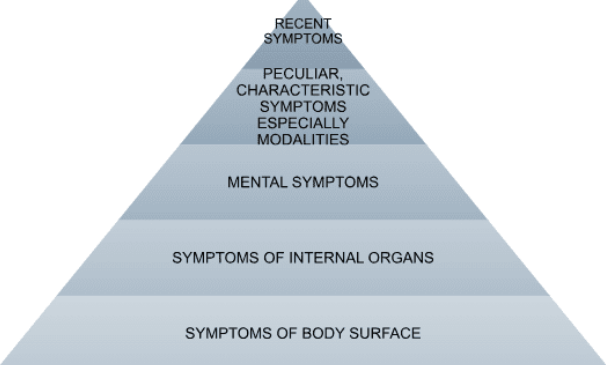
THE HIERARCHY OF SYMPTOMS
Recent symptoms are given the utmost importance while symptoms of body surface are given the least importance as shown in the diagram above.
Conclusion
These findings suggest that Hering’s Law of Cure may have practical applications in homeopathic treatment, although there is disagreement about its directional validity. , some authors debate whether Hering’s Law is a universal law or more of a clinical observation, emphasizing the need for further rigorous research. Overall, while practical evidence supports the occurrence of Hering’s Law in many homeopathic cases, its status as a scientific law remains a topic of discussion. From reviewing the literature, it seems unlikely that the law formulated by Kent in 1911 is a fair represention of Hering’s overall understanding of a direction of cure and that neither Kent nor anyone else has been able thus far to clinically demonstrate that the original observations of Hahnemann constituted in fact a perfect law of nature.
References
- Dr. G. Nagendra Babu- Comprehensive study of organon – an attempt to understand the organon of medicine as a scientific treatise- B. Jain Publishers- 2018
- Dr. Stuart Close- The Genius Of Homoeopathy- lectures and essays on homoeopathic philosophy- B. Jain Publishers – 2020
- Dr. James Tyler Kent- Lectures on Homoeopathic Philosophy with classroom notes and word index- B. Jain Publishers- 2019
- Dr. Heiner Frei – Die Heringsche Regel Und Ihre Auswirkung Auf Die Hierarchie Der Symptome- Zeitschrift Fur Klassiche Homoopathie- 1999
- Dr. Hugh Harrison- the development and use of hering’s law assessment tool (HELAT) in clinical trials- Homeopathy research institute article- issue 18- winter 2012
- Dr. Ila Yadav – A Non – Randomized Exploratory Study to Elucidate Hering’s Direction of Cure – International Journal of Science and Research (IJSR) – ISSN: 2319-7064 – SJIF (2020): 7.803
- Dr. S. Hahnemann- Materia Medica Pura – volume – 1 – 1811
- Dr. S. Hahnemann – The Chronic Diseases- their peculiar nature and their homoeopathic cure – edition – 1 – 1828
- Dr. C. Hering – Guide to the Progressive Development of Homœopathy – 1845
- Dr. C. Hering – Hahnemann’s three rules concerning the rank of symptoms – 1865
- Dr. C. Hering – Analytical Therapeutics of the Mind – 1875
- Dr. george vithoulkas – THE SCIENCE OF HOMOEOPATHY
- Dr. Gerhard Koehler – The Handbook of Homœopathy, Its Principles and Practice
- Dr. Garth Boericke – A Compendium of the Principles of Homœopathy -1929
- Dr. Bidani’s centre for homoeopathy – facts about hering’s law
- Dr. Sue Muller- homeopathy nz – vol. 21 – no.1 – februrary 2001
- Dr. Chandran Nambiar K C – redefining homoeopathy – 2011