Introduction –
Recurrent infections represent one of the most persistent challenges in internal medicine, especially among pediatric, geriatric, and immunocompromised populations. From chronic sinusitis and tonsillitis to urinary tract infections (UTIs), repeated illness not only hampers quality of life but often leads to over-dependence on antibiotics, drug resistance, and weakened host immunity. In this context, homoeopathy offers a holistic and patient-specific approach, targeting both the underlying susceptibility and the acute state.
Instead of merely suppressing infections, homoeopathy strengthens the vital force, enhancing immune resilience and preventing recurrence. This article explores how individualized homoeopathic treatment can serve as an effective preventive strategy, especially in the management of recurrent UTIs, tonsillitis, and sinusitis.
Recurrent Infections: A Clinical Overview –
Recurrent infections are defined by frequent, often cyclical, episodes of the same illness within a short span of time. Clinically, they arise due to:
- Incomplete eradication of pathogens
- Structural abnormalities (e.g., in the urinary tract)
- Hormonal/metabolic factors (e.g., diabetes mellitus)
- Emotional stress and immune dysregulation
Conventional treatment frequently involves long-term antibiotics, immunizations, or even surgical interventions like tonsillectomy. While these approaches offer acute relief, they often do not address the patient’s predisposing susceptibility. As a result, recurrence continues.
The Homoeopathic Perspective –
Homoeopathy understands recurrent infections as manifestations of an internal predisposition or miasmatic background. It does not treat infections as isolated events but as expressions of the constitutional imbalance of the individual. Key principles include:
- Individualization: Every patient’s symptoms, emotions, thermals, and reactions are considered.
- Miasmatic understanding: Deep-seated tendencies like Psora (susceptibility), Sycosis (overgrowth), and Tubercular (instability) are addressed.
- Constitutional remedy: Selected to match the patient’s entire physical and psychological makeup.
Over time, the body becomes more resistant to the recurring infection, and fewer or no episodes are seen.
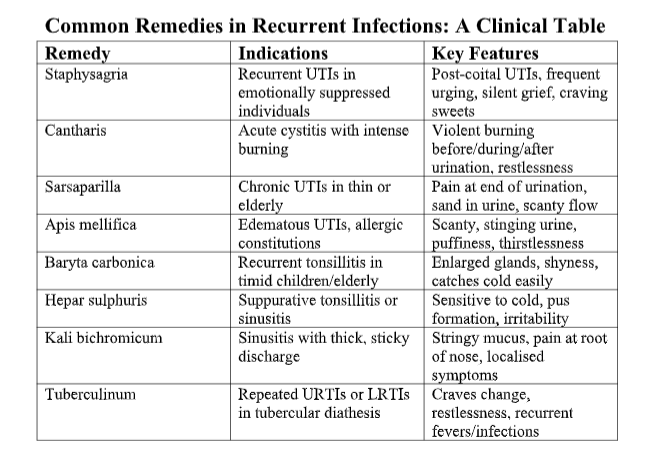
Expanded Remedy Insights:
Staphysagria
- Etiology: Grief, humiliation, suppressed anger
- UTI pain after catheterization or intercourse
- Frequent urging with little output
- Emotionally sensitive, suffers silently
- Warm-blooded, craves sweets
Cantharis - Sudden onset of cystitis
- Intense burning pain
- Constant desire to urinate with scanty flow
- Restlessness, anxiety
- Hematuria in some cases
Sarsaparilla - UTI with pain at end of urination
- Cloudy urine, sandy sediment
- Used in stone-formers
- Thin, debilitated constitutions
- Worse in cold
Apis mellifica - Stinging, burning pains
- Puffy face or extremities
- Worse in heat; no thirst
- Allergic diathesis or nephrotic picture
- Edema with urinary complaints
Baryta carbonica - Children or elderly with poor immunity
- Enlarged tonsils, glands
- Prone to frequent URTIs
- Timid, shy personality
- Chilly and sluggish development
Hepar sulphuris - Suppuration tendency in throat or sinuses
- Oversensitive to pain, noise, cold
- Better with warmth and covering
- Intolerant and irritable disposition
- Thick, yellow discharges
Kali bichromicum - Thick, ropy mucus in sinuses
- Sinus pain over frontal area
- Punctual, localized complaints
- Worse in cold weather, early morning
- Stubborn, sluggish patients
Tuberculinum - Recurrent chest colds, bronchitis, or sinusitis
- Change-loving, restless
- History of TB or strong family predisposition
- Emaciation despite good appetite
- Variable thermals, mentally quick
Case Illustration: Recurrent UTI in an Elderly Woman
A 62-year-old postmenopausal woman presented with recurrent urinary tract infections over 3 years, averaging 5–6 episodes annually. Each was managed with antibiotics. She complained of burning urination, suprapubic heaviness, and frequent urging. Cultures revealed E. coli. She also had controlled diabetes and hypertension.
She described a silent grief post-widowhood, avoided confrontation, and wept privately. She craved sweets and was warm-blooded. A past history of post-coital cystitis was also noted.
Prescription:
Staphysagria 200C – single dose, repeated monthly × 3 months.
Outcome:
Over 9 months, no further UTI episodes occurred. Emotional wellbeing improved, no antibiotics were needed, and blood sugars remained stable.
This case demonstrates how constitutional homoeopathy can effectively reduce the frequency of infections by addressing deep susceptibility rather than just the acute presentation.
Advantages of Homoeopathic Prevention
- Reduces antibiotic resistance
- Strengthens immune resilience
- Addresses emotional and systemic predispositions
- Safe for long-term use, including elderly and comorbid patients
- Encourages holistic lifestyle care
Limitations & Considerations
- Not a replacement for emergency intervention
- Requires skilled case-taking and follow-up
- May need miasmatic prescribing for deep chronic cases
- Patients must commit to long-term care and observation
Conclusion
Recurrent infections signify a failure of internal regulation not just exposure to microbes. By treating the person constitutionally and miasmatically, homoeopathy offers a preventive model of care that modern medicine increasingly seeks. Its role in reducing antibiotic use and improving natural immunity makes it highly relevant in today’s clinical context.
References
- Nayak C, Singh V, Singh K, Oberai P, Varanasi R, Arya JS, et al. Management of recurrent upper respiratory tract infections in children with homoeopathy: A multicenter observational study. Homeopathy. 2011;100(4):214–8.
- Oberai P, Seetha A, Varanasi R, Dey SK, Shitanshu S, Mishra A, et al. Homoeopathy for prevention of influenza-like illness: A multicenter, prospective, randomized, placebo-controlled clinical trial. Indian J Res Homoeopathy. 2015;9(1):25–33.
- Manchanda RK, Shah R, Acharya R, Jadhav C, Bagai U. Homoeopathy in Healthcare: Effectiveness, Appropriateness, Safety, Costs and Utilization. New Delhi: Central Council for Research in Homoeopathy; 2012.
- Witt CM, Lüdtke R, Willich SN. Homeopathic treatment of patients with chronic sinusitis: A prospective observational study with 8-year follow-up. BMC Ear Nose Throat Disord. 2009;9(1):7.Boericke’s Materia Medica, William Boericke
- Allen HC. Keynotes and Characteristics with Comparisons of Some of the Leading Remedies of the Materia Medica. New Delhi: B. Jain Publishers; Reprint 2002.
- Hahnemann S. The Chronic Diseases: Their Peculiar Nature and Their Homœopathic Cure. Translated by L. H. Tafel. New Delhi: B. Jain Publishers; Reprint 1995.
- Farrington EA. Clinical Materia Medica. New Delhi: B. Jain Publishers; Reprint 2001.
- Banerjea SK. Miasmatic Diagnosis: Practical Tips with Clinical Comparisons. Kolkata: Narayana Verlag; 2010.