Abstract
The external eruption is not the disease itself, but merely a local symptom of a deeper internal disorder. If removed externally, the internal psora progresses unchecked. (1)
The eruption, which is the external sign of psora, if driven in by external means, gives rise to chronic diseases of the most varied kind. (2)
Aphorism – 5: Useful to the physician in assisting him to cure are the particulars of the most probable exciting cause of the acute disease, as also the most significant points in the whole history of the chronic disease, to enable him to discover its fundamental cause, which is generally due to a chronic miasm. In these investigations, the ascertainable physical constitution of the patient (especially when the disease is chronic), his moral and intellectual character, his occupation, mode of living and habits, his social and domestic relations, his age, sexual function, etc., are to be taken into consideration. (3)
Aphorism – 217: In these diseases we must be very careful to make ourselves acquainted with the whole of the phenomena, both those belonging to the corporeal state. (ms, and also, and indeed particularly, those appertaining to the accurate apprehension of the precise character of the chief symptom, of the peculiar and always predominating state of the mind and disposition, in order to discover, for the purpose of extinguishing the entire disease, among the remedies whose pure effects are known, a homoeopathic medicinal pathogenetic force – that is to say, a remedy which in its list of symptoms displays, with the
greatest possible similarity, not only the corporeal morbid symptoms present in the case of disease before us, but also especially this mental and emotional state.(3)
Key Words – Contact dermatitis, eczema, corporeal diseases, psora, mental diseases, hepar sulph
Introduction – The term ‘eczema’ derives from the Greek word ‘to boil’ and is synonymous with the other descriptive term, ‘dermatitis’. Eczema describes a clinical and histological pattern, which can be acute or chronic and has several causes. Acutely, epidermal oedema (spongiosis) and intra-epidermal vesiculation (producing multilocular blisters) predominate, whereas with chronicity there is more epidermal thickening(acanthosis). Vasodilatation and T-cell lymphocytic infiltration of the upper dermis also occur. (4)
Classification of eczema – Endogenous (Atopic, seborrhoeic), Exogenous (Irritant, allergic, photo-allergic, chronic actinic dermatitis), Characteristic patterns and morphology (Asteatotic, discoid, gravitational, lichen simplex, pompholyx) (4)
The Clinical Morphology of Eczema
Acute – (Scaling, Erythema, oedema, usually typically ill defined, Papules, vesicles and occasionally bullae, Exudation, fissuring). Chronic – May be as above but less oedema, vesiculation and exudate, Lichenification: skin thickening with pronounced skin markings, secondary to chronic rubbing and scratching, Fissures and dyspigmentation. (4)
Etiology – Genetic factors, fillaggrin genes, ABCA12 gene, immune related genes (IL4, IL13, IL31) , Environmental factors, Overactive immune system. (5)
Investigation
Bacterial and viral swabs for microscopy and culture are important in suspected secondary infection. Bacterial swabs are commonly positive, particularly for staphylococci, although clinical assessment is required to ascertain whether swab results are of clinical significance and whether antibiotic treatment is required. Individuals with atopic eczema have an increased susceptibility to herpes simplex virus (HSV) and are at risk of developing a widespread infection, eczema herpeticum. The presence of small, punched-out lesions on a background of worsening eczema suggests the possibility of secondary HSV infection. Skin scrapings to rule out secondary fungal infection should also be considered. Total IgE and specific IgE tests and skin prick tests are not routinely undertaken in atopic eczema as they are not usually helpful, although they may occasionally be indicated in some cases as directed by the history. Patch tests should be performed if contact allergic dermatitis is suspected (see Box 27.23 below). Skin biopsy is not usually required unless there is diagnostic doubt. (4)
Incidence and Prevalence – The lifetime prevalence of eczema is about 15% to 30% in children and 2% to 10% in adults. About 60% of cases will develop the disease within the first year of life. The prevalence of eczema is more common in rural areas than in urban ones. This incidence emphasizes the link between lifestyle and environmental factors in the mechanisms of Atopic dermatitis. (5)
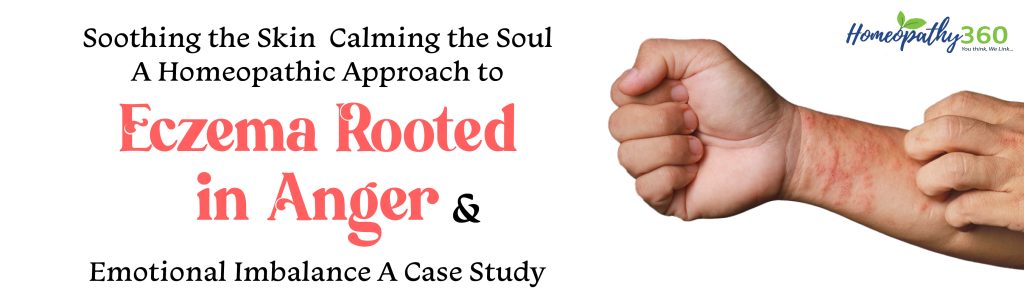
A CASE PROFILE- A 24-year-old male labour from a low socio-economic background in a rural area visited our OPD at Govt Homeopathic Hospital in Pulighar, Bhopal, Madhya Pradesh, India, on 08 May 2024, complaining of dark-coloured eruptions, oozing, and cuts on the extensor surface of both hands. The eruptions had been present for approximately 2 years and caused severe itching at night and aggravated after bathing and water exposure. Initially, it started as some vesicular eruptions. The patient had received allopathic treatment eight months prior to coming to our OPD. After allopathic treatment, the eruptions improved completely but reappeared severely.
Past History- no significant medical history
Family History- NAD.
Physical Generals –
His appetite was good, thirst was average, drinking 3 – 4 litres of water per day. Specific desire for sour food, Aversion to fats and rich food. Perspiration is cold after a little exertion of the body and is offensive. His bowels move satisfactorily and regularly. Doesn’t have refreshing sleep due to itching. On examination – his vital parameters are normal.
Mental Generals –
Anger suppressed
Anxiety at night
Hurry and impatience
Thinks of killing
Very hasty speech.
Particulars
Eczematous skin eruption
Back of hand
Itching intense
Crusty eruptions
Dark coloured
Eruptions very sensitive to touch
Bloody discharge
Evaluation of Symptoms
1.Anger suppressed
2. Anxiety at night
3. Hurry and impatience
4. Thinks of killing
5. Very hasty speech
6. Thermal chilly
7. Desire for sour food
8. Perspiration: cold after little exertion of mind and body.
9. Perspiration offensive
10. Eczematous eruptions on the back of hand.
11. Crusty eruptions, dark coloured.
12. Eruptions are very sensitive to touch and bloody discharge.
Totality of Symptoms –
1. Anger suppressed
2. Anxiety at night
3. Hurry and impatience
4. Thinks of killing
5. Very hasty speech
6. Thermal chilly
7. Desire for sour food
8. Perspiration: cold after little exertion of mind and body.
9. Perspiration offensive
10. Eczematous eruptions on the back of hand.
11. Crusty eruptions, dark coloured.
12. Eruptions very sensitive to touch and bloody discharge
Analysis of Symptoms –
| Mental generals | Physical generals | Particulars |
| Anger Suppressed Anxiety at Night Hurry and Impatience Thinks of killing Very hasty speech | Thermals are very chilly Desire for sour food Perspiration cold after little exertion of body Perspiration offensive | Eczematous eruptions on the back of hand. Crusty eruptions, dark colored. Eruptions very sensitive to touch and bloody discharge |
Dominant Miasm- Psora and Syphilis
Selection of Repertory
Synthesis/Isis Software
Repertorial Sheet –
Repertorial Analysis –
Hepar Sulph 29/12, LYCO. 20/10, SEP. 20/10, LACH. 18/10, ARS. 19/9
Selection of Remedy with Justification –
On the basis of totality of symptoms hepar sulph was prescribed.
Prescription –
Hepar sulph 1M/1 Dose.
Sac lac 30BD for 1 month.
Follow Up

BEFORE: 08/05/2024

AFTER : 12/06/2024
Reference:-
(1) Hahnemann S. Chronic Diseases, their Particular Nature & their Homoeopathic Cure. New Delhi: B.
Jain; c2023.
(2) Hughes, R. (1933). The Principles And Practice Of Homoeopathy Ed. 1st.https://archive.org/details/in.ernet.dli.2015.96598
(3) Hahnemann, S. C. (1849). Organon of medicine, tr. by R.E. Dudgeon.
383.https://archive.org/details/organonmedicine01hahngoo g
(4) Davidson, S. (1952). Davidson’s principles and practice of medicine 24th ed full version. https://archive.org/details/davidsons-principles-and practice-of-medicine-24th-ed-full-version
(5) Nemeth, V., Syed, H. A., & Evans, J. (2025). Eczema. In StatPearls. StatPearls Publishing.
AUTHOR
DR Sameer Lohar – MD scholar, Department of organon of medicine and Homoeopathic philosophy .
Govt. Homoeopathic medical college and hospital.Bhopal ,Madhya Pradesh.
UNDER THE GUIDANCE
DR RAKESH SONKUSRE – Associate professor , Department of organon of medicine and homeopathic philosophy
Govt. Homoeopathic medical College and hospital , Bhopal , Madhya Pradesh