Family Background and Education
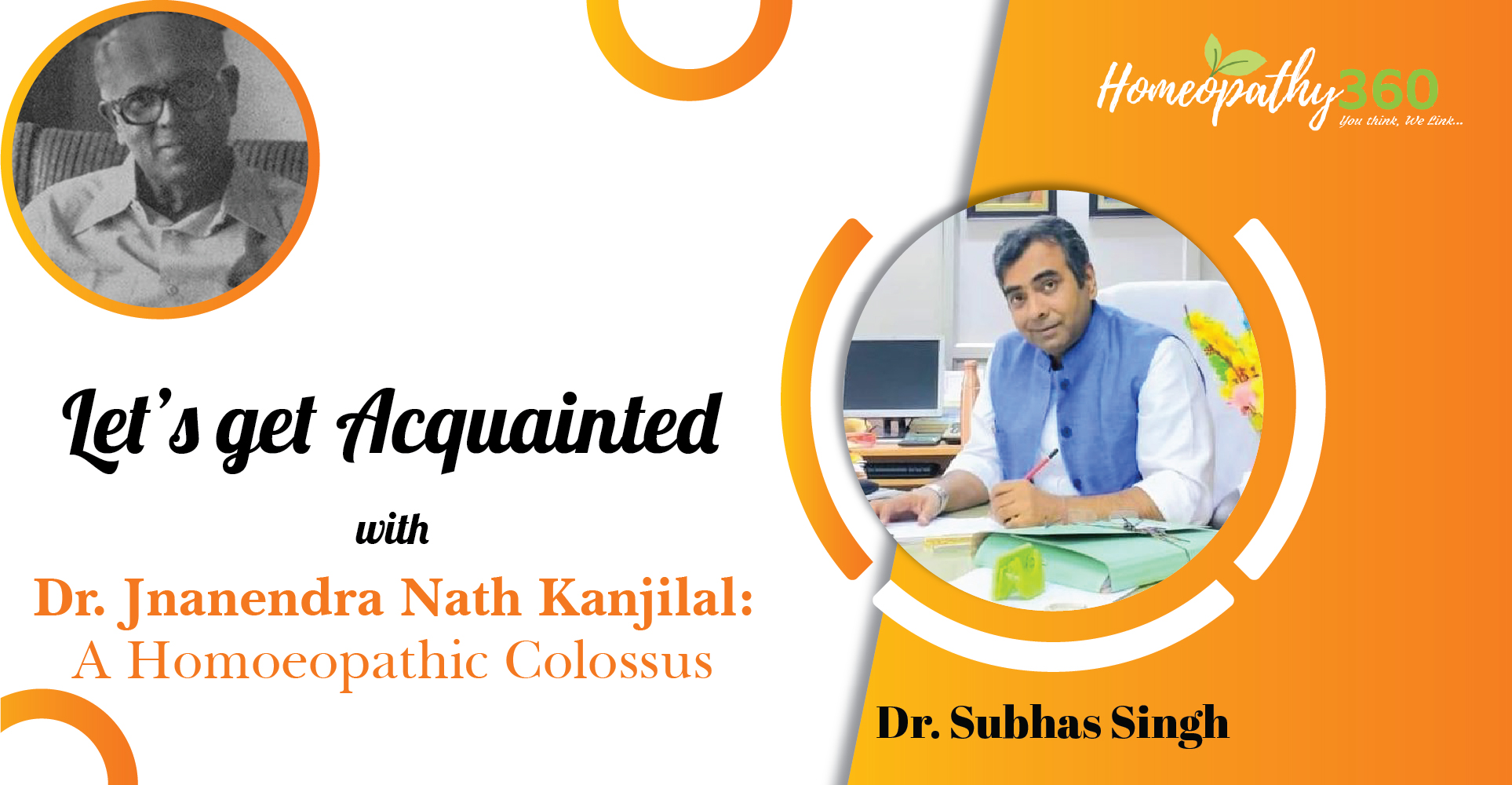
Dr. Jnanendra Nath Kanjilal was born on 30th August 1908 in a small village of Deapara district, in the then East Bengal (Bangladesh). He belonged to a low middle class family. His father was Mr. Jatindra Nath Kanjilal and mother was Mrs. S. Kanjilal. He was the 3rd child amongst 7 brothers and 1 sister. He was enrolled in a primary school in Deapara but had to leave his native place for further studies as there was a lack of secondary school or college. He thus stayed near Daulatpur, Khulna district in the then East Bengal for completing his secondary schooling and college education. Dr. Kanjilal supported himself financially in Deapara as a home tutor and domestic servant. Despite these challenging situations, he stood first in Matriculation Examinations with highest marks in Mathematics and Sanskrit. He completed his high school from Daulatpur College in 1928, with distinction in Mathematics and passing with First Division. His Medical education was financed by his elder brother. He took admission in L.M.F. course, from Campbell Medical School, Kolkata, now N.R.S. Medical College, as he could not get admitted to MBBS degree due to some unavoidable circumstances. Before starting his clinical practice in 1938 at a small village called Daulatpur near Khulna, now a part of Bangladesh, he took admission in 1929 for higher medical studies and completed his medical education in 1936 from the prestigious Carmichael Medical College, Kolkata, now R.G. Kar Medical College.
Tryst with Homoeopathy
Though he was an intelligent student, he also had a keen interest in the country’s freedom movements against the British. During his practice at Khulna, Kanjilal, the devoted freedom fighter was jailed for participating in a protest along with some of his companions. He first encountered Homoeopathy during his jail time. As he was an avid reader, he devoted his time to delve into the principles and fundamentals of the Similia at the dimly lit prisons at Khulna. He embraced this new approach to healing and immersed himself in its practice. A severe epidemic of Cerebral Malaria struck his village in 1940 because of which he experienced a life-altering course in ways he could never have imagined. He achieved remarkable success with homoeopathic treatments in managing the epidemic outbreak, instilling in him a profound sense of commitment and respect for the Homoeopathic science.
The Academician
He had shifted his clinical practice to Kolkata after independence. With a successful clinical practice in Kolkata, his approach to patient care and his prescriptions harmoniously aligned with the principles outlined in the Organon. He was associated with D. N. De Homoeopathic Medical College and Hospital, Kolkata, where he taught various subjects such as Pathology, Clinical Medicine, Materia Medica, Philosophy and Gynaecology. A strong advocate of Hahnemannian principles, he often stated that “Scientific training distinguishes a therapist from a quack”. He used to offer reprints from his rare book collections to the interested readers so that the Homoeopathic knowledge can be spread far and wide.
Homoeopathic Associations
He was the founder of the West Bengal Homoeopathic Federation. He was also the only member of the All India Homoeopathic Medical Association (Life member and a General Council member) and the Central Council of All India Institute of Homoeopathy simultaneously. He united the two antagonistic All India Associations to form The Homoeopathic Medical Association of India (HMAI). He was bestowed the coveted chair of the “President of Honour for Life” as a token of gratitude and acknowledgement for the services he had rendered to the Homoeopathic profession. He was the Assistant International Vice President for India of the International Homoeopathic Medical League and also President of the All India Homoeopathic Editors Guild. Till his retirement, he was an active participant at the International Congresses His command over different homoeopathic subjects, knowledge about the rules and regulations and respect in the Homoeopathic profession was such that no National Committee appointed by the Government of India was constituted without him. Some of these were the Research Committee, Homoeopathic Pharmacopoeia Committee, Planning Commission Task Force etc. His commitment to the principles of Homoeopathy can be rendered by the fact that he immediately submitted his resignation letter on the inclusion of patents in Homoeopathic Pharmacopoeia, at a meeting at the Homoeopathic Pharmacopoeia Committee of the Drug Technical Advisory Board of India, when his objections were being overruled. No mixtures were hence allowed.
Publications
Dr. J.N. Kanjilal’s contribution through his literary works is also outstanding. He covered several vital topics through articles and editorials like that in Hahnemannian Gleanings. He was an Advisor of the Homoeopathic Heritage and editor of Journal of the Homoeopathic Medical Association of India.
Some of his literary works include:
- Classification of symptoms and their importance in case taking • Repertorization- How to utilize symptoms of the case for finding out the similimum with the help of Repertory
• Knowledge about correct prescription - Importance of different types of repertories in Homoeopathic Practice
• Cases illustrating methods of Repertorization
• Homoeopathic First Aid in War situation
• Hypertension: Its Rational Management and Homoeopathic Treatment
• Homoeopathy and National Crisis
• The Problems of Homoeopathic Pedagogy
• Homoeopathy- The Only Curative Therapy
• Homoeopathic Conferences
• Knowledge of Disease - Metamorphosis of an Allopath
- Case records
- The Miasmatic Approach: Its Importance in Homoeopathic Prescribing.
- What Every Homoeopath Must Know In Order To Save Homoeopathy For The Human Race Repertorization’ is an important and basic book for the students of Homoeopathy wanting to learn the art of case taking and selecting the similimum with the aid of a repertory, thus making prescriptions perfectly with the principles of the Organon of Medicine.
Demise
Dr. Kanjilal was a busy homoeopath even until a year previous to his demise. He used to attend seminars and meetings while also taking out time to attend to his patients. He passed away on 11th March, 1985, leaving a void in the Homoeopathic field
About the Authors
Prof. (Dr.) Subhas Singh1, Dr. Rumsha Tamkeen2, Dr. Vignesh S.2, Dr. Jyotidarshanee2, Dr. Binay Pratap Singh2, Dr. Vaishnavi Achrekar2, Dr. Jasna Moideen V. M2.
1H. O. D., Organon of Medicine, National Institute of Homoeopathy, Kolkata 2Postgraduate Scholar, National Institute of Homoeopathy, Kolkata