Abstract:
Recurrent respiratory tract infections (RRTI) are a common cause of morbidity in paediatric age groups and significantly affect growth, immunity, and quality of life. Conventional management often involves repeated use of antibiotics and symptomatic drugs. Homeopathy, based on individualized constitutional treatment and Materia Medica, offers a holistic approach to improve immunity and reduce recurrence. This article presents the successful homeopathic treatment of a 8-year-old male patient, Miss XYZ, suffering from chronic Upper Respiratory Tract Infection (URTI) and recurrent digestive complains. This case illustrates the holistic and personalized nature of homeopathic treatment and its efficacy in treating recurring paediatric respiratory infections.
Keywords
Recurrent Respiratory infections, Paediatric age, Individualized Homeopathy, Case Report
Introduction
In the current landscape of pediatric medicine, the prevalence of “multimorbid” presentations—where a child suffers from simultaneous or alternating chronic conditions—poses a significant therapeutic challenge. Among the most frequent of these are recurrent upper respiratory tract infections (URIs) coupled with functional digestive disturbances. While conventional protocols often treat these as separate systemic issues requiring diverse pharmacological interventions, classical homeopathy views them as interconnected expressions of an underlying constitutional susceptibility.
This article presents a detailed case report of an 8-year-old male child struggling with the dual burden of recurrent respiratory infections and chronic digestive troubles. This case demonstrates how a single, carefully selected homeopathic remedy can address disparate symptoms across the respiratory and gastrointestinal tracts. By detailing the diagnostic process and the subsequent clinical improvement, this report underscores the role of homeopathy in providing a gentle, effective, and evidence-based alternative to polypharmacy in paediatric care.
Case Report: –
Preliminary data: –
Name: – XYZ
Date:-27/11/2025
Age: – 8 years
Sex: – Male
Presenting Complains: –
A 8-year-old child having complain of recurrent nose block along with the sneezing and sometimes coughing the frequency of episodes were twice in a month the condition was aggravated after taking cold drinks, in cold air and at night since 1 year.
The patient was also having complain of difficulty while passing stool he has to strain a lot while passing stool and sometimes he used to cry while passing stool this complain started before 6 months.
Past history: – Not specific
Family history: – father – allergic rhinitis, grandmother – HTN
Physical Generals: –
- Thermal reaction-: Chilly
- Thirst: Sufficient
- Desire: sour food and chocolate
- Urine: No complain
- Stool: D once, Character: hard in consistency had to strain while passing & pale-yellow colour
- Perspiration: L- Forehead and nape of neck, profuse odour- not present
Mentals generals: –
- Disposition & Temperament: The patient generally exhibits a calm and placid demeanour. He displays sudden irritability and anger specifically when things are not given to him as requested.
- Activity & Volition: There is a marked physical indolence and a strong aversion to physical exertion. He shows a sedentary preference, spending excessive time in front of digital screens (TV and mobile).
- Reaction to Contradiction: When coerced by parents to engage in physical activities, he exhibits a passive-aggressive resistance. Rather than open rebellion, he chooses to disobey silently, retreating to a corner to sit quietly before returning to his preferred sedentary habits. He will do things which he wants to.
- Cognitive Profile: He is academically proficient, showing good intelligence. However, his processing speed for memorization is slow; he requires frequent and repeated revisions to retain information, indicating a need for intellectual reinforcement.
- Social Interaction: He displays initial reservedness and mild social anxiety (timidity) when encountering strangers. This is not a permanent withdrawal, as he possesses the ability to gradually adapt and mix easily with others once a sense of familiarity is established
Clinical Diagnosis: Recurrent Upper Respiratory Tract Infection (ICD-11: CA07.0) with Allergic Rhinitis (ICD-11: CA08.0) and Functional Constipation (ICD-11: DD90.0).
Analysis and evaluation of symptoms: –
| Sr no. | Symptoms | Analysis of symptoms |
| 1. | sudden irritability and anger specifically when things are not given to him as requested | Mental generals |
| 2. | Indolent | Mental generals |
| 3. | Reservedness | Mental generals |
| 4. | Stool dry hard has to strain a lot while passing | Physical generals |
| 5. | Thermally chilly | Physical generals |
| 6. | Perspiration profuse more on nape of neck and forehead | Physical generals |
| 7. | recurrent nose block along with the sneezing and sometimes coughing aggravated after taking cold drinks, in cold air and at night. | Characteristic particular |
Totality of symptoms: –
- Indolence
- Reservedness
- Stool dry hard has to strain a lot while passing
- Perspiration profuse more on nape of neck and forehead
- Recurrent nose block along with the sneezing and sometimes coughing aggravated after taking cold drinks, in cold air and at night.
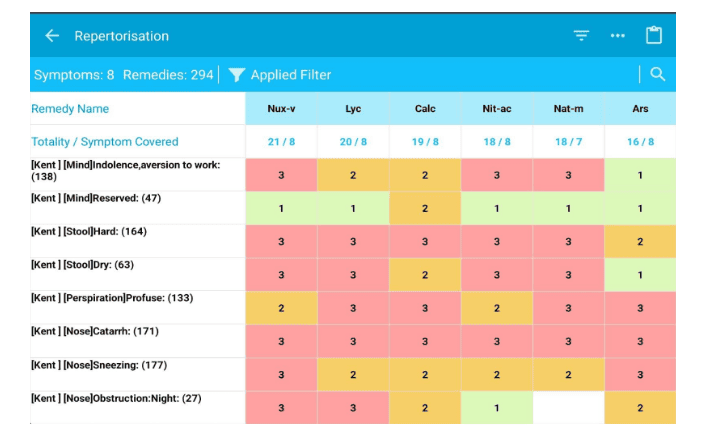
Repertorial analysis: –
Selection of medicine with potency: –
Based on the repertorial result and symptoms similarity calc. carb. 200 was given 2 doses per week and follow up assessment was done for every 15 days.
Follow up assessment: –
| Date | Complaints | Prescription |
| 12/12/25 | Better in constipation consistency of stool soft sneezing decreased Nasal obstruction still present at night and due to cold air | RxCalc. carb. 200 2 dose per week SL bd for 15 days |
| 29/12/25 | Much better in constipation No sneezing present during episode Only 1 episode came Nasal obstruction as it is | Rx Calc. carb. 200 1 dose per week SL bd for 15 days |
| 13/1/26 | No sneezing No episode in last 15 days Complain of dry hard stool from 7 days | Rx Calc. carb. 200 1 dose per week SL bd for 15 days |
| 29/1/26 | No sneezing One episode in last 15 days No Complain of dry hard stool | Rx SL bd for 15 days |
| 11/2/26 | No sneezing No episode in last 15 days No Complain of dry hard stool | Rx SL bd for 15 days |
| 27/2/26 | No sneezing No episode in last 15 days No Complain of dry hard stool | Rx SL bd for 15 days |
| 9/3/26 | No sneezing No episode in last 15 days No Complain of dry hard stoolThirst increased than before and appetite also improved | Rx SL bd for 15 days |
Conclusion: –
By utilizing homeopathic medicine selected on the basis of symptom similarity and an individualized approach, a curative response can be achieved. This case report highlights how medicine prescribed through an individualized constitutional approach can significantly improve the quality of life (QOL) in children suffering from recurrent respiratory tract infections and simultaneous digestive troubles.
References: –
- Kent JT. Repertory of Homoeopathic Materia Medica. Reprint edition. New Delhi: B. Jain Publishers.
- World Health Organization. International classification of diseases, 11th revision (ICD-11). Geneva: WHO; 2022.