
CASE STUDY REPORT:
The Psychodynamic Landscape of Somatic Distress
Homeopathy as a Dynamic Therapeutic Approach in Diabetes Management
Author
Dr. Ronak Chauhan M.D.(Hom.)
Professor – Department of Repertory
E- Mail – [email protected]
Address:- A/29, Parshottam nagar Society, Harni- Warasiya Ring Road, Near
Panchsheel complex, Vadodara
Mobile: 9662556899
Abstract: Type 2 Diabetes Mellitus is increasingly recognized as a psychosomatic disorder where chronic mental stress and maladaptive thought processes disrupt endocrine stability. Classical homeopathy focuses on these specific psychodynamic and cognitive patterns to select an individualized remedy capable of restoring metabolic equilibrium.
The understanding of chronic disease has increasingly shifted away from rigid biological reductionism toward a unified model of mind and body. When we look at metabolic disorders like Diabetes Mellitus through a psychodynamic lens, the condition ceases to be merely a structural failure of pancreatic beta cells or peripheral insulin resistance. Instead, it can manifest as a somatic (physical) crystallization of deep-seated, unresolved emotional conflicts and chronic psychological stress.
In classical homeopathy, the therapeutic goal directly mirrors the principles of psychodynamic exploration. By viewing physical pathology as the outer expression of an internal, energetic, and psychological disharmony, classical homeopathy seeks to trace the dynamic thread connecting a patient’s emotional history to their physical pathology.
Keywords: Type 2 Diabetes Mellitus; Psychodynamics; Classical Homeopathy; Repertorization; Argentum nitricum; Calcarea fluorica.
Introduction
Diabetes Mellitus is conventionally defined as a chronic, progressive metabolic disorder characterized by persistent hyperglycemia resulting from defects in insulin secretion, insulin action, or both. Within the framework of modern biomedical literature, the therapeutic paradigm focuses primarily on structural targets: preserving pancreatic beta-cell mass, mitigating peripheral insulin resistance, and modulating hepatic glucose output. However, this purely biochemical lens frequently isolates the endocrine system from the central nervous system, overlooking the profound etiologic and exacerbating roles played by chronic psychological distress, maladaptive cognitive patterns, and underlying psychodynamic vulnerabilities.
From a psychosomatic and psychodynamic perspective, the human organism functions as an unbreakable mind-body continuum. Chronic somatic pathologies, including metabolic syndromes, are often physical crystallizations of long-standing internal conflicts, repressed emotional strain, and specific behavioural temperaments.
When an individual operates under a continuous state of cognitive or emotional disharmony, the brain’s limbic system activates the Hypothalamic-Pituitary-Adrenal (HPA) axis and the Sympathomedullary (SAM) system. This sustained neuroendocrine activation triggers a prolonged, systemic release of counter-regulatory stress hormones, primarily:
- Cortisol: Which directly stimulates gluconeogenesis in the liver and decreases glucose uptake in skeletal muscle, actively driving up insulin resistance.
- Catecholamines (Adrenaline and Noradrenaline): Which inhibit insulin secretion from the pancreas and stimulate glycogenolysis, creating a state of metabolic volatile stress.
In classical homeopathy, this physiological cascade mirrors the foundational concept of a disrupted Vital Force. Homeopathic philosophy posits that physical symptoms are not the disease itself, but rather the terminal expressions of a deeper, dynamic disturbance originating in the patient’s mental and emotional spheres.
Among the hierarchy of symptoms utilized in classical homeopathic case-taking, the patient’s unique thought processes, emotional reactions, and psychiatric dispositions are afforded the highest priority. When a psychological trigger interacts with a specific emotional constitution, it imprints a unique symptomatic signature on the individual. Therefore, targeting the unique psychological framework of the patient allows the clinician to address the upstream neuroendocrine drivers of the disease, rather than merely managing its downstream physical bioproducts.
Case:
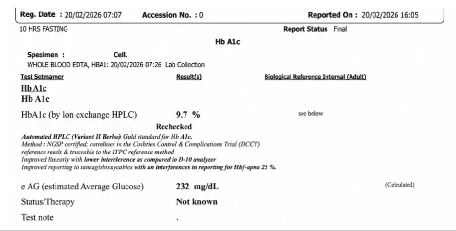
C/o: A 49 years female patient presented with a complaint of recurrent episodes of Urinary tract infection which was treated with regular course of antibiotics off and on. After undergoing routine blood and urine investigations the blood sugar level was high and the patient was diagnosed as suffering from Diabetes. The patient having off and on complaint of pain in soles which aggravates after exertion. Also having a complaint of hyperacidity in which a patient feels nauseating and has to vomit to get relief for which she is taking allopathic medicines.
Past History: Hystrectomy done before 10 years because of uterine fibroids
Iron deficiency anemia treated with allopathy before 7 years
Cervical lymphadenopathy treated with homoeopathy before 3 years
Physical general:
Appetite: craving for sweet
Thirst: Small quantity at long intervals
Stool: Constipated, hard
Sleep: Disturbed when any problem is there in family, keeps thinking about that
Dreams: cannot remember
Mental State:
he patient belongs to upper middle class family living in a nuclear family with her husband and two children. Since last 4 years she developed anxiety about the future of her daughter and financial issues of home. Because of this two she developed anticipation and started to worry on in all situations. She likes to travel but not to the same place. She developed problems in taking decision. Feels confused at times and cries on matters. She is afraid of diabetes and confused what to do.
Totality of Symptoms:
- Anticipatory anxiety
- Brooding on past events
- Fear of disease
- Pain in soles after exertion
- Hyperacidity better after vomiting
- Cries on small matters
- Confusion
- Indecisive
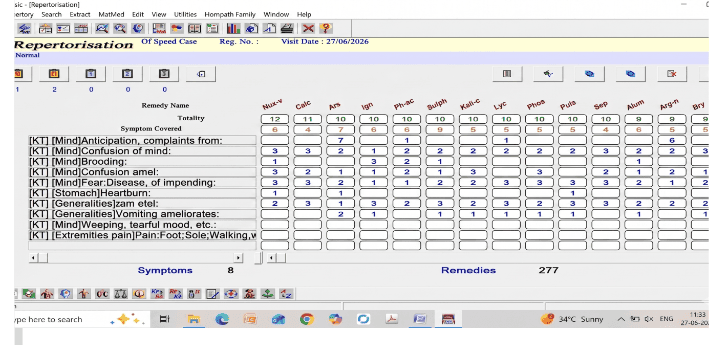
Prescription: Arg Nit 200- 4 pills – in morning
Calc Flour 6x- 2 pills – three times a day for 15 days
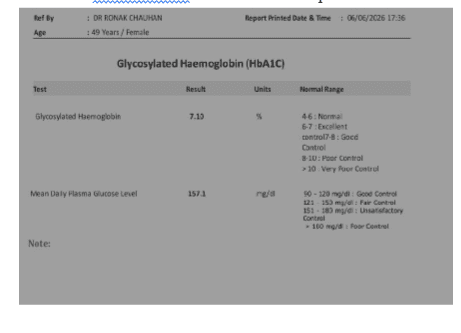
Follow-up: After starting medicine patient reported better in constipation and hard stool. She can sleep well. The repetition of Arg Nit 200 was reduced to 3 dose per week and patient was advised to follow certain exercise and diet plan. After 4 months her Hba1c decreased 7.10 and FBS reduced to 157.
Discussion
The resolution of this case underscores the profound therapeutic value of matching a homeopathic remedy to the specific cognitive and emotional architecture of the patient. Repertorization of this 49-year-old female’s case shifted the focus away from generic physical symptoms like polyuria or polydipsia, focusing instead on her core behavioral and psychological patterns.
The selection of Argentum nitricum was driven by a distinct psychodynamic triad:
- Anticipatory Anxiety: A constant state of nervous dread regarding upcoming events.
- Somatic Craving: A marked desire for sweets, which paradoxically aggravates both her mental anxiety and physical glycemic levels.
Physiologically, a continuous state of anticipatory anxiety keeps the sympathetic nervous system chronically activated. This persistent “fight-or-flight” state triggers a sustained release of counter-regulatory hormones like cortisol and catecholamines, both of which actively promote glycogenolysis and insulin resistance. By administering Argentum nitricum 200C, the treatment directly targeted this underlying neuroendocrine driver.
Complementing this dynamic prescription, Calcarea fluorica 6X was utilized as a cellular tissue remedy. In long-standing diabetes, tissue elasticity declines, and microvascular changes pose a long-term risk. Calcarea fluorica acts on the structural integrity of cellular membranes and blood vessels, providing crucial physiological support while the deep-acting constitutional remedy balances the vital force.
The systematic decline in the patient’s blood glucose levels directly paralleled her emotional stabilization. As her hurried thought process slowed and her anticipatory anxiety cleared, her body’s homeostatic mechanisms successfully re-established glycemic control. This dual clinical outcome demonstrates that the physical pathology was deeply intertwined with her psychological state.
Conclusion
This case demonstrates that Type 2 Diabetes Mellitus can be effectively treated at its root by addressing the patient’s unique psychodynamic framework. When chosen through systematic Repertorization of distinctive mental symptoms and cognitive patterns, an individualized homeopathic remedy can help resolve long-standing metabolic dysfunction.
The combination of a high-potency dynamic remedy (Argentum nitricum 200C) targeting the mind-body axis, paired with low-potency tissue salts (Calcarea fluorica 6X) for physiological support, offers a reliable clinical framework. This psychosomatic approach provides a non-invasive, highly personalized path for managing chronic metabolic disorders safely and effectively.