Understanding Susceptibility Through Trauma, Personality Types and Epigenetics: A Conceptual Review Integrating the Enneagram Model with Homoeopathic Philosophy
Abstract
Susceptibility is a fundamental concept in homoeopathy that determines an individual’s responsiveness to environmental influences, disease processes, and therapeutic interventions. Classical homoeopathic philosophy emphasizes that disease develops only when the organism possesses the necessary susceptibility. Contemporary research in trauma psychology and epigenetics has demonstrated that life experiences, particularly emotional trauma, can modify biological processes and influence disease vulnerability. The Enneagram of Personality provides a framework for understanding personality structures shaped by early life experiences and emotional coping patterns. This conceptual review explores the interrelationship between trauma, epigenetic mechanisms, personality patterns, and susceptibility from a homoeopathic perspective. Integrating these perspectives with the teachings of Samuel Hahnemann described in the Organon of Medicine may provide a deeper understanding of individualized case-taking and remedy selection. Such interdisciplinary integration strengthens the holistic philosophy of homoeopathy and highlights its relevance in contemporary healthcare.
Keywords: Susceptibility, Trauma, Epigenetics, Enneagram, Homoeopathy, Individualization
Introduction
Homoeopathy is based on the principle of individualization, recognizing that each patient manifests disease in a unique manner. One of the most important concepts underlying this principle is susceptibility. Susceptibility determines whether an individual will develop disease when exposed to environmental or internal disturbances.
The concept was extensively discussed by Samuel Hahnemann in the Organon of Medicine, where disease is described as a dynamic disturbance of the vital force rather than merely a structural or material pathology. According to this philosophy, disease develops only when the organism is susceptible to a particular influence.
Modern scientific disciplines have provided additional insights into susceptibility. Trauma research demonstrates that emotional experiences significantly influence long-term health outcomes. Similarly, epigenetics has revealed how environmental factors may alter gene expression without modifying the underlying genetic code.
Personality psychology also contributes to understanding susceptibility. The Enneagram of Personality describes nine personality archetypes that reflect characteristic emotional coping strategies developed in response to early life experiences. These patterns may influence physiological responses to stress and therefore contribute to disease susceptibility.
This article explores the relationship between trauma, epigenetic regulation, personality structure, and homoeopathic susceptibility in order to provide a more comprehensive understanding of disease development.
Susceptibility in Homoeopathic Philosophy
The concept of susceptibility occupies a central position in homoeopathic philosophy. According to Hahnemann, disease-producing influences cannot affect every individual equally. Instead, their action depends upon the internal state of the organism.
In the Organon of Medicine, several aphorisms emphasize this principle. Aphorism 30 explains that the human organism is capable of being affected by morbific influences only when it possesses the appropriate susceptibility. Aphorism 31 states that disease-producing agents cannot affect every individual under all circumstances, because their action depends upon the receptivity of the organism. Aphorism 32 further clarifies that disease arises when external influences disturb the dynamic equilibrium of the vital force in a susceptible individual.
Thus, susceptibility represents the interaction between the internal constitution of the organism and external influences such as environmental conditions, emotional experiences, and lifestyle factors.
Trauma and Its Influence on Susceptibility
Psychological trauma is increasingly recognized as a major factor influencing long-term health outcomes. Traumatic experiences such as loss, abuse, neglect, humiliation, or prolonged stress can profoundly affect emotional development and physiological regulation.
Trauma has been shown to alter several biological systems, including:
- the neuroendocrine stress response
- immune system functioning
- emotional regulation mechanisms
- neural development and cognitive processing
Individuals exposed to early life trauma often exhibit heightened stress reactivity and increased vulnerability to chronic diseases such as cardiovascular disorders, autoimmune diseases, depression, and anxiety disorders.
In homoeopathic case-taking, emotional shocks and significant life events often provide important clues for understanding the patient’s susceptibility and the origin of chronic illness.
Epigenetics: A Biological Perspective on Susceptibility
Epigenetics refers to modifications in gene expression that occur without changes in the DNA sequence. Environmental factors such as nutrition, toxins, psychological stress, and lifestyle can influence epigenetic mechanisms.
Research has demonstrated that trauma and chronic stress can produce epigenetic alterations affecting immune regulation, inflammatory responses, and neuroendocrine function. These changes may increase susceptibility to various physical and psychological disorders.
From a homoeopathic perspective, epigenetics may offer a modern biological explanation for the inherited predispositions and chronic disease tendencies described in classical miasmatic theory.
The Enneagram Personality Model -The Enneagram of Personality describes nine fundamental personality types organized into three emotional centers.
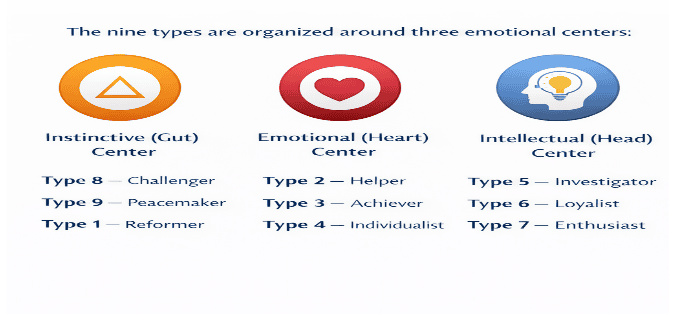
Each personality type represents a distinct pattern of emotional motivation, defense mechanisms, and coping strategies developed in response to life experiences. These personality patterns may influence how individuals respond to stress and illness.
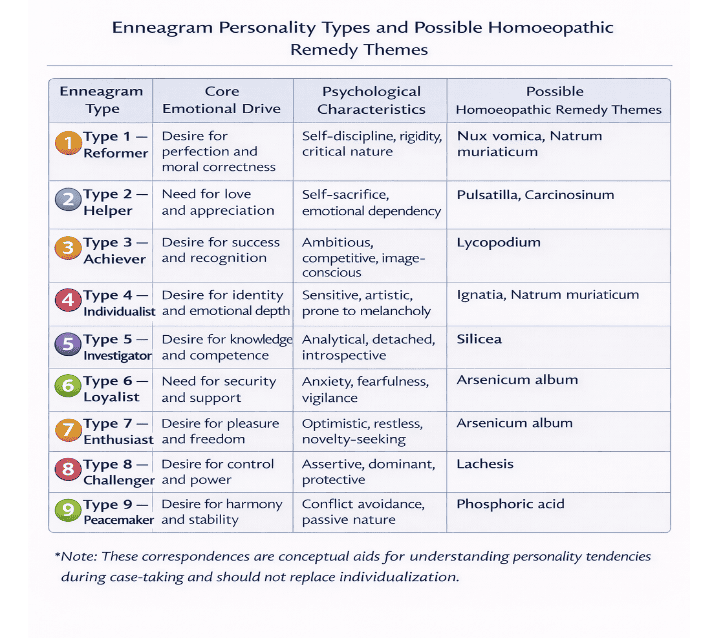
Conceptual Relationship Between Enneagram Types and Remedy Themes
The Enneagram of Personality provides a systematic model describing nine fundamental personality archetypes. Each type represents a characteristic way of perceiving the world, responding to stress, and managing emotional conflicts.
In clinical practice, these personality patterns may help practitioners identify underlying emotional themes that correspond with remedy pictures described in classical homoeopathic literature.
Understanding personality patterns may assist the homoeopathic physician in:
- identifying recurring emotional patterns
- understanding the patient’s coping mechanisms
- recognizing underlying psychological conflicts
- refining remedy selection through mental and emotional characteristics
For instance, a patient displaying the anxiety-driven vigilance typical of Enneagram Type 6 may correspond to remedy pictures characterized by fear and insecurity, such as Arsenicum album. Similarly, individuals exhibiting strong perfectionistic tendencies characteristic of Type 1 may reflect remedy pictures involving rigidity and self-discipline.
Integrating personality models with classical homoeopathic case-taking may therefore enrich the process of individualization while maintaining the fundamental principles of the discipline.
Trauma-Induced Miasmatic Activation
The theory of chronic miasms proposed by Hahnemann suggests that deep-seated disease predispositions may remain latent within the organism until activated by external influences.Traumatic experiences may act as triggers that disturb the equilibrium of the vital force, thereby activating latent miasmatic tendencies. This hypothesis proposes three stages:
- latent constitutional predisposition
- environmental or emotional trigger
- manifestation of chronic disease
Such a model aligns with the homoeopathic principle that disease results from the interaction between external influences and internal susceptibility.
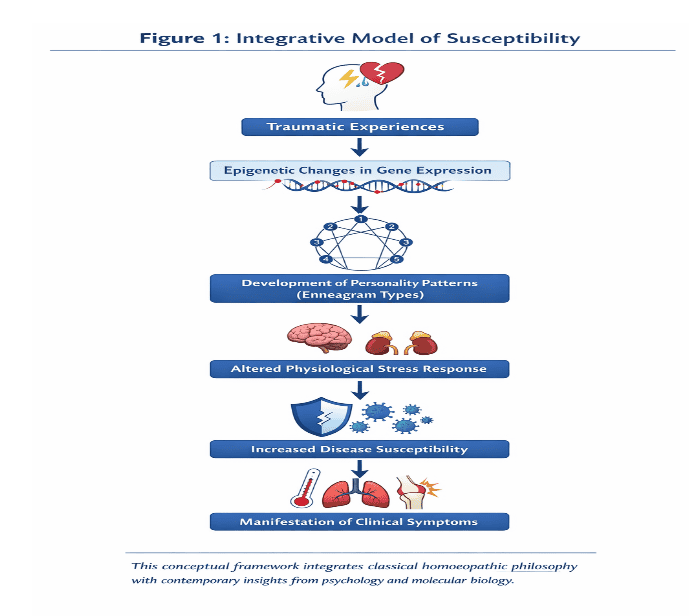
Integrated Model of Susceptibility
An integrative framework can be proposed to explain the relationship between trauma, epigenetics, personality, and disease susceptibility.
Implications for Homoeopathic Practice
Integrating trauma history, personality analysis, and biological susceptibility into homoeopathic case-taking may provide several benefits:
- deeper understanding of emotional causation
- improved individualization of remedies
- enhanced management of chronic disease
- stronger physician-patient relationships
Such interdisciplinary perspectives reinforce the holistic principles of homoeopathy.
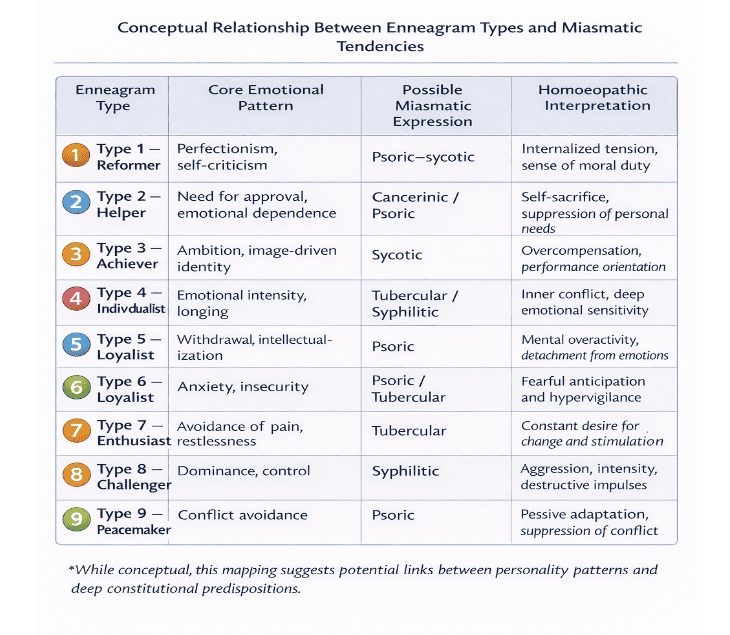
Conceptual Relationship Between Enneagram Types and Miasmatic Tendencies
Clinical Implications for Homoeopathic Case-Taking
The integration of personality typology and miasmatic theory may provide deeper insights into the psychological dimension of susceptibility. During case-taking, homoeopathic physicians often encounter recurring emotional patterns that correspond to both personality tendencies and miasmatic expressions.
For example:
- Individuals displaying Type 6 anxiety patterns may reveal psoric or tubercular susceptibility characterized by fear and insecurity.
- Type 8 personalities exhibiting strong control tendencies may correspond to syphilitic intensity and destructive emotional expression.
- Type 2 individuals who suppress their own needs for the sake of others may reflect cancerinic tendencies associated with self-sacrifice and perfectionism.
Recognizing these patterns may assist practitioners in understanding deeper constitutional states that influence remedy selection
Integrating Personality and Miasmatic Analysis
In homoeopathic practice, the goal of case-taking is to perceive the totality of the patient’s symptoms, including mental, emotional, and physical characteristics. Personality frameworks such as the Enneagram may help clinicians recognize recurring psychological themes, while miasmatic analysis provides insight into the deeper constitutional background of chronic disease.
By integrating these perspectives, practitioners may develop a more comprehensive understanding of the patient’s susceptibility and disease expression.
Such interdisciplinary exploration supports the holistic philosophy of homoeopathy, which emphasizes the unity of mind, body, and environment in the development of health and disease.
Discussion
The integration of trauma research, epigenetics, and personality psychology with homoeopathic philosophy provides a multidimensional understanding of susceptibility. While classical homoeopathic theory emphasizes the dynamic disturbance of the vital force, modern scientific discoveries offer complementary explanations for how life experiences influence biological functioning.
Personality frameworks such as the Enneagram may help practitioners recognize recurring emotional patterns that influence disease expression. When combined with careful case-taking and individualized remedy selection, these perspectives may improve therapeutic outcomes.
Further interdisciplinary research is needed to explore the relationships between trauma, personality patterns, and therapeutic responses in homoeopathic practice.
Conclusion
Susceptibility remains a central concept in homoeopathic philosophy and continues to provide valuable insights into the nature of disease. The teachings of Hahnemann emphasize that disease develops only when the organism possesses the necessary susceptibility.
Modern research in trauma psychology and epigenetics offers scientific perspectives that complement these classical ideas. The integration of personality frameworks such as the Enneagram with homoeopathic philosophy may further enhance understanding of individual susceptibility and disease manifestation.
Such interdisciplinary integration strengthens the holistic approach that lies at the heart of homoeopathy and highlights its continued relevance in contemporary healthcare.
References (Vancouver Style)
- Samuel Hahnemann. Organon of Medicine. 6th ed. New Delhi: B Jain Publishers.
- Riso DR, Hudson R. The Wisdom of the Enneagram. New York: Bantam; 1999.
- van der Kolk B. The Body Keeps the Score. New York: Viking; 2014.
- McEwen BS. Stress, adaptation and disease. Ann N Y Acad Sci. 1998.
- Meaney MJ. Epigenetics and the biological definition of gene–environment interactions. Child Dev. 2010.
- Yehuda R, et al. Epigenetic biomarkers of trauma. Nat Rev Neurosci. 2015.
- Siegel DJ. The Developing Mind. New York: Guilford Press; 2012.
- Lipton BH. The Biology of Belief. Hay House; 2005.
- McGowan PO, et al. Epigenetic regulation in childhood abuse. Nat Neurosci. 2009.
- Szyf M. Epigenetics and stress. Nat Neurosci. 2013.
- Levine PA. Waking the Tiger: Healing Trauma. Berkeley: North Atlantic Books.
- Siegel DJ. Trauma and emotional development. Psychiatry Clin North Am. 2001.
- McEwen BS. Stress and the brain. Nat Rev Neurosci. 2007.
- Dethlefsen T, Dahlke R. The Healing Power of Illness. Rochester: Healing Arts Press.
- Bell IR. Complexity science and homoeopathy. Homoeopathy. 2012.
- Jonas WB, et al. Research in homoeopathy. J Altern Complement Med. 2003.
- Sankaran R. The Soul of Remedies. Mumbai: Homoeopathic Medical Publishers.
- Vithoulkas G. The Science of Homoeopathy. New Delhi: B Jain Publishers.
- Hering C. Guiding Symptoms of Our Materia Medica.
- Kent JT. Lectures on Homoeopathic Philosophy.
- Norcross JC. Psychotherapy relationships that work. Oxford University Press.