

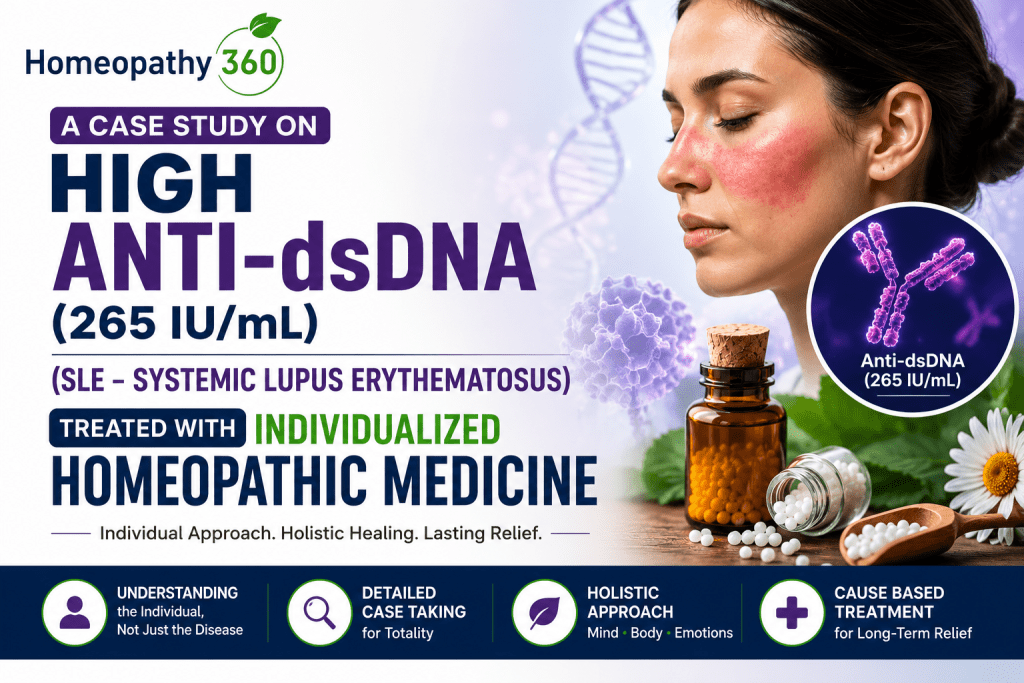
A Case Study on High Anti-dsDNA (265 IU/mL) (SLE – Systemic Lupus Erythematosus) Treated with Individualized Homeopathic Medicine by Dr. Vikas Saini: A Laboratory-Verified Serological Remission to 8.8 IU/mL
Abstract: Patients diagnosed with SLE (Systemic Lupus Erythematosus) showed fabulous improvement under Homeopathic treatment. The Anti-dsDNA levels, which were previously High.
Keywords: Homeopathy; Anti-dsDNA; Autoimmune Disorder; Serological Remission; Individualized Medicine; Systemic Lupus Erythematosus, TDS-“three times a day”
Background: Anti-double-stranded DNA (anti-dsDNA) antibodies are a hallmark of Systemic Lupus Erythematosus (SLE), correlating strongly with disease activity and renal involvement.
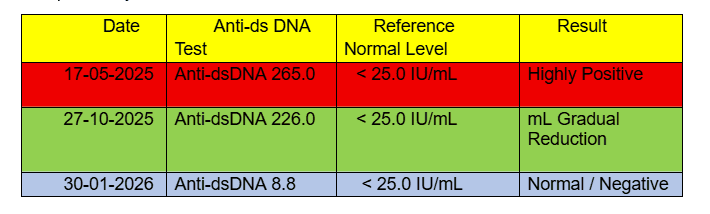
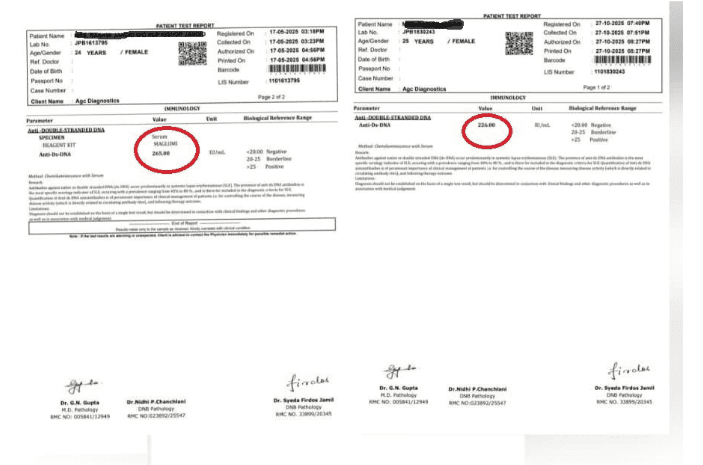
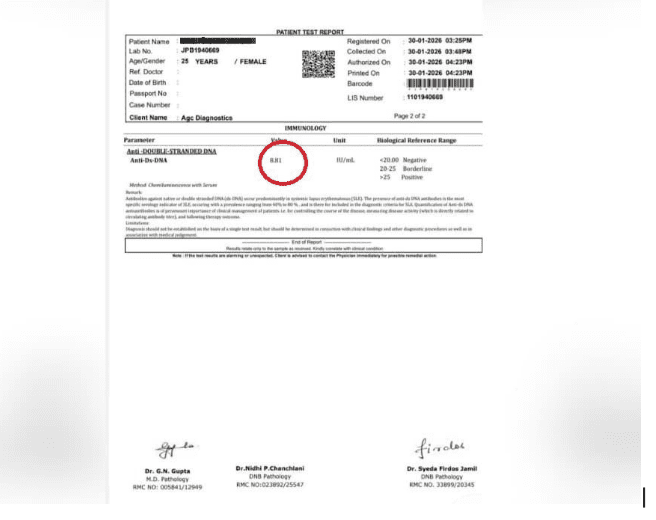
Case Summary: A patient presenting with significantly elevated levels of anti-dsDNA antibodies (265 IU/mL) underwent individualized homeopathic treatment. Over a period of eight months, serial investigations revealed a gradual decline in antibody levels—initially dropping to 226 IU/mL and eventually reaching 8.8 IU/mL, which falls within the normal reference range.
Conclusion: This case demonstrates the potential of homeopathic treatment to induce serological remission in autoimmune diseases, suggesting that the homeopathic system of medicine may play a role in immune modulation.
Introduction:
Autoimmune diseases represent a failure of self-tolerance, leading to the production of autoantibodies. The anti-dsDNA test is a critical biomarker for diagnosing SLE and monitoring its progression. While conventional medicine focuses on managing symptoms homeopathy aims to address the underlying dysregulation of the “Vital Force.” This report documents a significant laboratory-verified recovery using homeopathic principles.
SLE: Systemic Lupus Erythematosus
Systemic Lupus Erythematosus, commonly known as Lupus, is a chronic autoimmune disorder. In individuals with this condition, the immune system loses its ability to distinguish between foreign invaders and the body’s own healthy cells. Consequently, it attacks various tissues and organs, leading to persistent inflammation and potential damage to the skin, joints, kidneys, heart, and lungs.
Classification of Lupus
While SLE is the most prevalent form, affecting the entire body, medical professionals recognize several other variations:
-Cutaneous Lupus Erythematosus: Primarily localized to the skin, causing rashes and lesions.
-Neonatal Lupus: A rare condition affecting newborns, often linked to specific antibodies passed from the biological parent.
Clinical Symptoms and Manifestations:
Lupus is characterized by cycles of flare-ups (active symptoms) and remission (periods of improvement). Symptoms often develop gradually and may include:
– Joint and Muscle Pain: Persistent swelling and stiffness.
– The “Butterfly Rash”: A distinctive malar rash spreading across the cheeks and bridge of the nose.
– Chronic Fatigue: Intense exhaustion that does not improve with rest.
– Photosensitivity: Sensitivity to sunlight that can trigger skin reactions.
– Organ-specific issues: Chest pain (pleurisy), headaches, or kidney dysfunction.
Cause and Risk Factors:
The exact cause of Lupus remains unknown, but it is believed to result from a combination of factors:
-Genetics: A family history of autoimmune diseases increases susceptibility.
-Hormonal Influence: The prevalence in females suggests that hormones like Estrogen play a significant role.
-Environmental Triggers: Exposure to UV light, high stress levels, and toxins/pollutants.
-Demographics: The highest risk group includes women aged 15 to 44 .
Potential Complications:
Over time, systemic inflammation can lead to secondary health issues such as:
-Cardiovascular Disease: Inflammation of the heart muscle or arteries.
-Renal Failure: Chronic kidney damage (Lupus Nephritis).
-Neurological Impact: Seizures, memory loss, or mental health challenges like depression.
-Blood Disorders: Increased risk of anemia or blood clots.
Management and Prevention of Flares:
While there is no permanent cure, lifestyle adjustments can significantly reduce the frequency of symptoms:
Sun Protection: wear protective clothing to block UV rays, especially during peak hours.
Physical Activity: Low-impact exercises like swimming, yoga, or walking help maintain joint flexibility without overexertion.
Stress Management: Prioritizing mental health and ensuring 8 hours of sleep helps stabilize the immune system.
Case Objective:
The primary objective was to evaluate the efficacy of a constitutionally selected homeopathic remedy in reducing the high anti-dsDNA and stabilizing the patient’s immune response without the use of conventional immunosuppressants.
Methodology:
Case Report: Quantitative Remission of Anti-dsDNA Antibodies through Individualized Homeopathic Treatment.
Homeopathic Analysis: The remedy was selected based on the totality of symptoms, focusing on the patient’s unique physical makeup, thermal state, and mental-emotional triggers.
Intervention: Individualized homeopathic medicine was administered in 6c -30c-200c potency based on the patient’s sensitivity.
Monitoring: The patient was monitored every 2–3 months with laboratory investigations (Anti-dsDNA Double Standard Test) to track quantitative changes.
Date Laboratory Finding (Anti-dsDNA) Prescription (Potency & Dosage) Clinical Remark
17-05-2025 – 265.0 IU/mL (Baseline) Phosphorus 6C (Daily/BD) Treatment initiated with low potency to avoid aggravation.
July – Sept 2025 Monitoring Phase Phosphorus 30C (Weekly) Gradual increase in potency as the case stabilized.
27-10-2025- 226.0 IU/mL (Progress) Phosphorus 30C (Continued) Significant drop in level; patient showing systemic improvement.
Nov – Dec 2025 Transition Phase Phosphorus 200C (Bi-monthly)
30-01-2026- 8.8 IU/mL (Normalization) sac lac -TDS for 1 month & Complete Serological Remission. Anti-dsDNA within normal limits.
The treatment followed the principle of “Minimum Dose” and “Susceptibility.” Initially, Phosphorus 6C was administered to gently stimulate the immune system, considering the high inflammatory markers. As the patient showed positive clinical movement, the potency was graduated to 30C. Finally, to achieve deep-seated remission and address the underlying chronic, Phosphorus 200C was employed. This step-ladder approach (6C \ 30C \ 200C) ensured a steady decline in autoantibody production without any homeopathic aggravation.
Case Series Data and Results:
The table below presents a summary of the blood reports: {Date of Test, Test, Result, Interpretation}
Investigation:
CBC- Complete Blood Count
ESR- Erythrocyte Sedimentation Rate
CRP- C-Reactive Protein.
Anti-ds DNA Test
URINE-R
LFT- liver function test
RFT- renal function test
HBA1C
Chief complaints:
joint Pain, Swelling, skin rashes , weight loss, Anorexia, weakness , Constipation, Bloating.
Analysis And Evaluations
Mental Generals:
Anxiety dark in
Light Desire
Sensitive to touch
Sensitive to surroundings
Irritable during Pain
Physical Generals:
Thirst: Thirsty
Thermal State : chilly++
desire : sweet. Table salt : ++
Generals Air Open Amel.
Generals Emaciation
Generals weariness stool after
Sleep: insomnia
Modalities: <touch >open air.
Thirst: normal
Dreams: NP
Urine: Np
Sweat: np
Physical Appearance: Tall, Weak .
Repertorial charts :
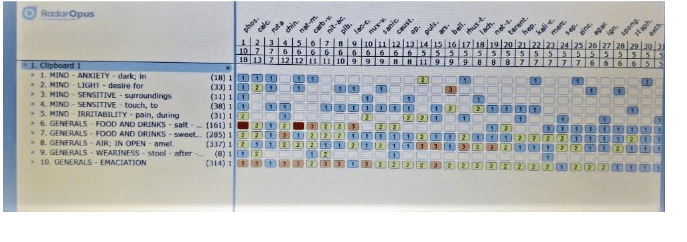
Repertorial Analysis & Remedy Selection:
After Repertorisation Analysis “Phosphorus- Medicine ” got max totality of symptoms of the case..
Pathophysiological Analysis:
In this case, the high level of 265 IU/mL indicated a significant loss of immune tolerance, where cells produced high-affinity antibodies against self-DNA.
Conclusion:
Individualized homeopathy can be an effective approach in managing autoimmune markers. The quantitative evidence provided by the Anti-dsDNA Double Standard Test validates that homeopathic results are measurable at the serological level.
Discussion:
The rapid normalization of anti-dsDNA levels—signifying a transition from a severe pathological state to a normal physiological state—demonstrates the systemic impact of homeopathic medicines. The therapeutic strategy employed—or the homeopathic approach—essentially aimed at “re-educating” the immune system. The steady decline from 265 to 226, and ultimately to 8.8, indicates that the medication initiated a profound healing process rather than merely suppressing symptoms.
Acknowledgement:
The authors would also like to thank Dr. Vijay Kumar for technical assistance in preparing the manuscript.
Conflict of interest:
The authors declare no conflict of interest.
References:
- Hahnemann, S. Organon of Medicine, 6th Edition.
- Kent, J. T. Lectures on Homeopathic Philosophy.
- Close, S. The Genius of Homeopathy. (On the action of high potencies in pathology).
- https://my.clevelandclinic.org/health/diseases/4875-lupus