Introduction
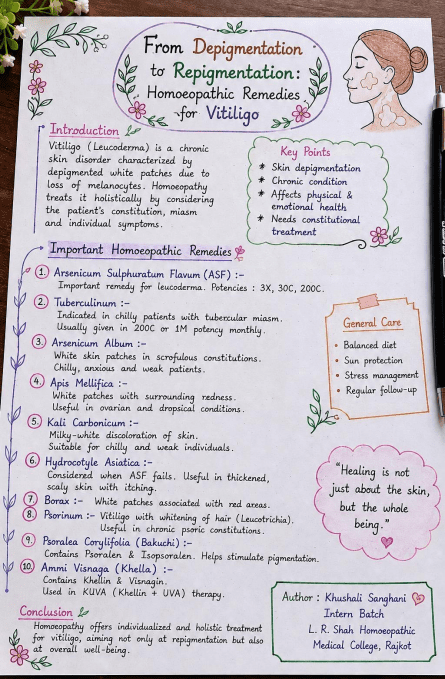
Vitiligo, also known as leucoderma, is a chronic acquired disorder characterized by the loss of melanocytes, resulting in depigmented white patches on the skin. It affects individuals of all ages and genders and may significantly impact psychological and social well being. Although the exact cause remains unclear, autoimmune mechanisms, genetic predisposition, oxidative stress, and neurogenic factors are considered important contributors.
Homoeopathy approaches vitiligo holistically, considering the patient’s constitution, miasmatic background, susceptibility, and associated symptoms rather than treating only the skin lesions. Various remedies have been recommended based on individual symptomatology and clinical experience.
1. Arsenicum Sulphuratum Flavum (ASF)
• Key Indications
One of the most frequently used remedies for vitiligo (leucoderma).
Useful in squamous syphilides and chronic skin disorders. Acts on pigmentation disturbances of the skin.
• Clinical Importance
ASF is considered one of the foremost remedies in vitiligo due to its affinity for chronic skin diseases and pigmentary changes.
2. Tuberculinum
• Key Indications
Chilly patients.
Strong tubercular miasmatic background.
Restlessness and frequent changes in symptoms.
• Clinical Importance
Often used as an intercurrent remedy to improve response to constitutional treatment and address the underlying tubercular miasm.
3. Arsenicum Album
• Key Indications
White skin patches associated with scrofulous constitution. Patients who are anxious, weak, chilly, and fastidious. Chronic skin affections with debility.
• Clinical Importance
Suitable when constitutional features correspond strongly to Arsenicum Album.
4. Apis Mellifica
• Key Indications
White patches accompanied by redness around the margins. Ovarian disorders associated with skin complaints. Dropsical tendencies.
Infantile constitutional disturbances.
• Characteristic Feature
Depigmented patches surrounded by erythematous (red) borders.
5. Kali Carbonicum
• Key Indications
Milky-white discoloration of the skin.
Patients with weakness, chilliness, and characteristic Kali Carbonicum constitution.
• Clinical Importance
Useful when the depigmentation appears intensely white and constitutional symptoms correspond.
6. Hydrocotyle Asiatica
• Key Indications
May be considered when Arsenicum Sulphuratum Flavum fails. Thickening of the epidermis.
Excessive scaling and exfoliation.
Intolerable itching, especially on soles.
Syphilitic skin manifestations.
• Additional Uses
Historically used in certain cases of leprosy and lupus without ulceration.
• Clinical Importance
Particularly useful in chronic skin diseases with marked epidermal changes.
7. Borax
• Key Indications
White depigmented areas associated with red patches. Sensitive skin and mucous membrane conditions.
• Clinical Importance
Considered when vitiligo patches coexist with inflammatory skin changes.
8. Psorinum
• Key Indications
White patches associated with whitening of hair (leucotrichia). Chronic psoric background.
Patients with poor vitality and recurrent skin disorders. • Characteristic Feature
Traditionally considered when depigmented areas involve white hair.
9. Psoralea Corylifolia (Babchi/Bakuchi)
• Botanical Importance
One of the most recognized medicinal plants for vitiligo. • Active Constituents
Psoralen,Isopsoralen,Bakuchiol,Flavonoids,Chalcones • Mechanism
Psoralens belong to the furocoumarin group and increase skin sensitivity to ultraviolet light, thereby stimulating melanocyte activity and pigmentation.
• Clinical Importance
Widely used in traditional and modern vitiligo management due to its pigment-inducing properties.
10. Ammi Visnaga (Khella)
• Active Constituents
Khellin,Visnagin
• Therapeutic Role
Used in targeted phototherapy.
KUVA Therapy
Khellin + UVA (KUVA)
Khellin acts similarly to psoralens but belongs to the furanochromone group rather than the furocoumarin group.
• Clinical Importance
Provides an alternative photosensitizing approach for repigmentation in vitiligo.
General Management and Lifestyle Measures
Dietary Recommendations
Balanced diet rich in antioxidants.
Fruits and vegetables containing vitamins A, C, and E. Adequate hydration.
Skin Care
Avoid excessive sunburn.
Use sunscreen on exposed areas.
Protect skin from trauma and friction.
Psychological Support
Stress management through meditation and relaxation techniques. Counseling when emotional distress is significant.
Regular Follow-Up
Monitor progression and repigmentation.
Adjust remedy selection according to symptom changes.
Conclusion
Vitiligo is a chronic depigmenting disorder that requires a comprehensive and individualized therapeutic approach. Homoeopathy emphasizes constitutional prescribing, miasmatic assessment, and patient susceptibility rather than merely treating
skin lesions. Remedies such as Arsenicum Sulphuratum Flavum, Tuberculinum, Hydrocotyle, Psorinum, Apis Mellifica, and others have been traditionally employed according to symptom similarity. Additionally, medicinal plants like Psoralea Corylifolia and Ammi Visnaga have gained attention because of their photosensitizing properties and potential role in promoting repigmentation. Successful management of vitiligo often depends on early intervention, appropriate remedy selection, lifestyle modification, and regular follow-up.
References :
- Boericke’s Materia Medica
- Clarke’s Dictionary of Practical Materia Medica
- Allen’s Keynotes
- Kent’s Lectures on Homoeopathic Materia Medica
- Hahnemann’s Organon of Medicine
- Modern Dermatology Textbooks on Vitiligo and Leucoderma