Efficacy of Phosphorus in Frontal Alopecia in a Female Patient: A Case Report
Abstract :
Alopecia, particularly involving the frontal region, presents a significant cosmetic and psychological burden in female patients. Conventional treatments often provide limited or temporary relief and may carry adverse effects. Homoeopathy, with its individualized and holistic approach, offers a promising alternative. This case report highlights the successful management of frontal alopecia in a female patient using the constitutional remedy Phosphorus. The case was evaluated on clinical parameters and symptomatic totality, followed by repertorial analysis. Marked improvement in hair regrowth and reduction in hair fall was observed over a period of 4 months. This case emphasizes the role of individualized homoeopathic treatment and supports the effectiveness of Phosphorus in alopecia with characteristic constitutional features.
Keywords: Alopecia, Frontal Hair Loss, Phosphorus, Homoeopathy, Constitutional Treatment
Introduction :
Alopecia refers to hair loss from any part of the body, most commonly the scalp. Frontal alopecia in females can be due to hormonal imbalance, stress, nutritional deficiency, or autoimmune factors. It not only affects physical appearance but also leads to emotional distress and reduced self-esteem.[1]
The hair growth cycle consists of anagen, catagen, and telogen phases, and disruption of this cycle leads to excessive shedding and thinning of hair [1]. Conventional treatment modalities such as topical minoxidil, corticosteroids, and hormonal therapy are commonly used but may result in incomplete recovery and recurrence [2].
Homoeopathy, as propounded by Samuel Hahnemann, considers alopecia as a manifestation of internal imbalance of the vital force. Treatment is based on individualization, considering mental, physical, and general symptoms. Remedies such as Phosphorus are indicated in cases with characteristic mental symptoms, weakness, and hair fall from the forepart of the scalp [3].
Case Presentation
Patient Information :
Name: Sangitaben Chauhan
Age: 36 years
Gender: Female
Occupation: House wife
Chief Complaint :
Hair loss from frontal region for 6 months
Gradual thinning of hair near forehead
History of Present Illness :
The patient reported progressive hair fall predominantly from the frontal region. Hair fall was more during combing and washing. No itching or scaling was present. Condition aggravated during stress and after illness.
Physical Generals :
Appetite: Increased, frequent hunger
Thirst: Increased (large quantities)
Thermal: Chilly patient
Perspiration: Profuse, especially on scalp
Mental Generals :
Anxious and fearful, especially fear of being alone
Desires company
Sympathetic and emotional
Easily startled
Past History :
History of recurrent upper respiratory infections
Family History :
Mother: Hypothyroidism
Clinical Findings :
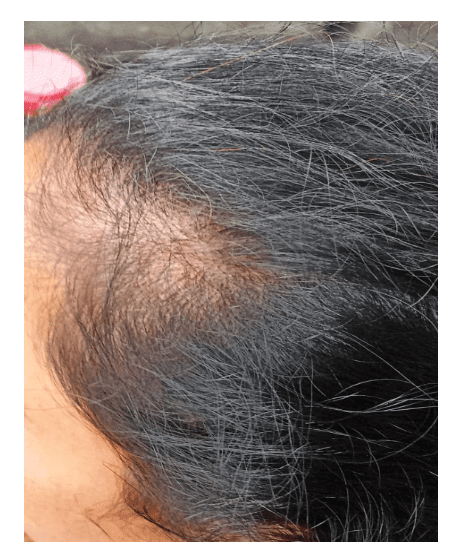
Visible thinning of hair in frontal region
No scarring or inflammation
Hair pull test: Positive
Repertorial Analysis :
Rubrics selected (Kent’s Repertory):
Mind – Fear – Alone, of being
Mind – Company – Desire for
Generalities – Food and drinks – Cold drinks – Desire
Head – Hair – Falling – Forehead

Remedy indicated: Phosphorus
Prescription
Phosphorus 200C, single dose
Followed by placebo for 4 weeks
Follow-Up and Results :
1st Follow-up (1 month)
Slight reduction in hair fall
General well-being improved
2nd Follow-up (2 months)
Image Hair fall significantly reduced
Appearance of new hair growth
3rd Follow-up (4 months)
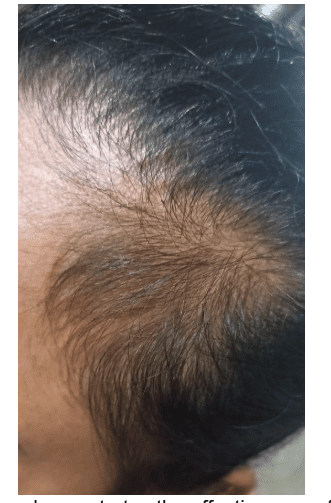
Marked improvement in frontal hair density
Hair fall almost nil
Result Assessment
Visual Progression
Before Treatment (Frontal Alopecia)
After Treatment (Hair Regrowth)
Discussion :
This case demonstrates the effectiveness of Phosphorus in treating alopecia when prescribed on the basis of totality of symptoms. The patient exhibited classical Phosphorus characteristics such as fear of being alone, desire for company, thirst for cold drinks, and sensitivity.
Homoeopathy addresses the root cause by stimulating the vital force, leading to restoration of normal hair growth. The gradual yet sustained improvement observed supports the holistic nature of treatment.
Miasmatic Analysis :
Predominantly Psoric with Tubercular tendencies
Manifested as hair fall, weakness, and hypersensitivity
Conclusion :
This case highlights that individualized homoeopathic treatment with Phosphorus can effectively manage frontal alopecia in females. It provides a safe, non-invasive, and holistic approach, improving both physical and psychological health.
Patient Consent
Written informed consent was obtained from the patient for publication of clinical details and images.
Acknowledgement
I want to express my sincere gratitude to Dr.B.R.Mishra (H.O.D. Department of Homoeopathic Materia Medica ), Dr.Hiren Parmar (Assistant Professor, Department of Homeopathic Materia Medica) at Shree Swaminarayan Homoeopathy College, Kalol for their constant support and guidance.
References (Vancouver Style) :
- Davidson’s Principles and Practice of Medicine. 23rd ed. Elsevier; 2018.
- Olsen EA. Female pattern hair loss. Int J Endocrinol Metab. 2014.
- Boericke W. Pocket Manual of Homoeopathic Materia Medica. B Jain Publishers; 2002.
- Hahnemann S. Organon of Medicine. 6th ed. B Jain Publishers; 2005.
- Dinh QQ, Sinclair R. Female pattern hair loss. Clin Interv Aging. 2007;2(2):189–199.