
The Remedy That Dissolved a Breast Lump in 7 Days
Bryonia Alba 30C in Acute Mastitis with Palpable Breast Lump — A Homoeopathic Case Report
| DIAGNOSIS | SIMILLIMUM | REP. SCORE | PAIN & SWELLING | LUMP REDUCTION |
| Acute Mastitis | Bryonia alba | 20 / 21 | 100% Resolved | ~90% in 7 Days |
Chief Complaint– Palpable Breast Lump
Repertorisation– Kent’s Repertory
Follow-up– 7-Days
They call it “just sugar pills — they do nothing.” Yet in this very case, those same tiny globules eliminated unbearable breast pain, collapsed visible swelling, and reduced a frightening palpable lump by 90% in seven days — without a single antibiotic, without a single side effect. Homoeopathy does not ask you to believe in it. It only asks you to observe.
Abstract
This case report documents the homoeopathic management of acute mastitis in the left breast, accompanied by a clearly palpable firm lump, in a 24-year-old female patient. The presenting symptom picture — severe tenderness markedly aggravated by the slightest motion, localised inflammatory swelling, and a distinct hard palpable lump — was repertorised using Kent’s Repertory. Bryonia alba 30C was identified as the simillimum and administered in multiple doses over a seven-day observation period. At follow-up on Day 7, both tenderness and swelling had completely resolved; the palpable lump reduced by approximately 90% of its presenting size. No adverse effects were recorded. This case demonstrates the targeted action of Bryonia alba on the acute inflammatory breast sphere and is submitted as a documented contribution to homoeopathic clinical literature following HOM-CASE reporting guidelines.
Keywords: Acute Mastitis · Bryonia alba · Breast Lump · 30C Potency · Repertorisation · Homoeopathy
KEY POINTS
◆ Acute Mastitis
◆ Left Breast
◆ Palpable Lump
◆ Bryonia 30C
◆ Pain Resolved
◆ Swelling Resolved
◆ 90% Lump Reduction
◆ No Side Effects
◆ Kent’s Repertory
◆ HOM-CASE Format
Mastitis is an inflammatory condition of the breast parenchyma, most commonly affecting women of reproductive age. It may occur in association with lactation (lactational mastitis) or independently (non-lactational mastitis), and is characterised by localised pain, swelling, warmth, and occasionally a palpable lump representing focal tissue inflammation.
Clinical Features of Acute Mastitis
→ Localised breast pain and tenderness
→ Swelling and engorgement of tissue
→ Warmth over the affected area
→ Palpable lump or area of induration
→ Onset typically acute within 24–48 hours
→ Aggravation by movement or pressure
→ May be associated with fever in severe cases
→ Affects predominantly women of childbearing age
In homoeopathic practice, acute mastitis offers a well-defined symptom picture amenable to accurate repertorisation. Commonly indicated remedies include Bryonia alba, Belladonna, Phytolacca decandra, Hepar sulphuris calcareum, and Silica — each differentiated by the specific quality, modality, and concomitants of the presenting symptoms.
02 Patient Data
| Age / Sex | 24 years / Female |
| Affected Side | Left Breast |
| Occupation | Not disclosed |
| Date of Onset | Day 1 of observation period |
| Remedy | Bryonia alba 30C — sublingual globules |
| Observation Period | 7 Days |
| Concurrent Treatment | None; no allopathic medication administered during observation period |
03 Chief Complaints
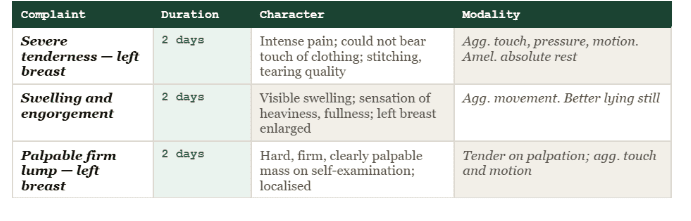
The patient presented with the following three chief complaints in the left breast, all of acute onset within 24 hours:
04 History
4.1 History of Present Illness
Sudden acute onset of severe tenderness in the left breast within 24 hours, rapidly progressing to include visible swelling and a palpable firm lump. Pain was strikingly aggravated by any movement or contact. The symptom picture was repertorised classically and Bryonia alba 30C was administered.
4.2 Past History
| Previous Breast Complaints | No major illness found | Surgical History | No major illness found |
| Major Medical Illness | No major illness found | Drug Allergy / History | No known allergy; no concurrent medications |
4.3 Personal History
| Appetite / Diet | Mixed; normal prior to onset | Thirst | 6–8 glasses per day; normal quantity |
| Sleep | Sound | Bowels | No major illness found |
| Menstrual History | Regular; no dysmenorrhoea; symptoms unrelated to cycle | Thermal Reaction | Ambithermal |
4.4 Family History
Family History- No major illness found
Hereditary Conditions- No major illness found
05 Onset, Duration & Progress (ODP)
| Onset | Sudden and acute; full symptom picture within 24 hours |
| Duration at Rx | Approximately 2 days at peak intensity before remedy |
| Progress Before Remedy | Symptoms intensifying; no spontaneous relief noted |
| Progress After Remedy | Progressive improvement from Day 3; marked resolution by Day 7 |
Modalities
| AGGRAVATIONS ↑ | AMELIORATIONS ↓ | CONCOMITANTS |
| ↑ Touch↑ Pressure↑ Contact with clothing | ↓ Rest | · Heaviness of breast· Fullness of breast |
06 Totality of Symptoms
Symptoms classified as General (G) or Particular (P) per classical homoeopathic hierarchy. Intensity graded 1–3.
| Symptom | Type | Grade | Characterising Feature |
| Aggravation from least motion (general) | G | ●●● | Any motion intensifies all complaints; grand keynote of Bryonia alba |
| Amelioration from rest | G | ●●● | Complete rest relieves all complaints; instinctively avoids any movement |
| Breast — severe tenderness on touch | P | ●●● | Cannot bear contact of clothing; stitching, tearing quality of pain |
| Breast — swelling, engorgement | P | ●●● | Localised, heavy, hot; left breast visibly enlarged |
| Breast — palpable hard lump | P | ●●○ | Firm, stony, fixed; clearly palpable on self-examination |
07 Repertorisation
Repertorisation performed using Kent’s Repertory of the Homoeopathic Materia Medica. Grading: 3 = Bold (Characteristic) · 2 = Italic (Secondary) · 1 = Plain (Minor)
| Rubric (Kent’s Repertory) | Bryoniaalba | Belladonna | Phytolacca | HeparSulph. | Silica |
| Mammae — Inflammation (Mastitis) | 3 | 3 | 3 | 2 | 2 |
| Mammae — Inflammation (Mastitis) | 3 | 3 | 3 | 2 | 2 |
| Mammae — Hardness / Induration (Lump) | 3 | 1 | 2 | 2 | 3 |
| Mammae — Pain, worse touch and motion | 3 | 2 | 2 | 2 | 1 |
| Mammae — Swelling, engorgement | 3 | 3 | 2 | 1 | 1 |
| Generalities — Motion aggravates | 3 | 1 | 1 | 1 | — |
| Generalities — Rest ameliorates | 3 | 1 | 1 | — | — |
| Laterality — Left side affinity | 2 | 1 | 1 | 1 | 1 |
| TOTAL SCORE | 20 | 12 | 12 | 9 | 8 |
Remedy Comparison
| RANK 1 — SIMILLIMUMBryonia alba20 / 21Covers all keynote rubrics at highest grade. Motion aggravation + breast hardness + rest amelioration = unambiguous Bryonia picture.✓ REMEDY SELECTED | RANK 2Belladonna12 / 21Covers acute mastitis but picture is throbbing, pulsating pain with high fever — not present here. | RANK 2Phytolacca12 / 21Strong for breast lumps but lacks decisive motion aggravation and rest amelioration of this case. |
08 Prescription
Remedy- Bryonia alba
Potency- 30C (Centesimal scale)
Dosage Form- Medicated sublingual globules
Frequency- Multiple doses over 7-day period; repeated on return or increase of symptoms (wait-and-watch approach)
Route- Sublingual (under tongue)
Diet Advice- Avoid coffee, strong odours, camphor; rest; cold local application for symptomatic comfort
Prescribing Basis- Classical symptomatic repertorisation; simillimum principle — Hahnemann’s Organon §153
09 Follow-up & Outcome
| Day | Tenderness | Swelling | Palpable Lump | General Condition |
| Day 1–2 | Severe ↑ | Present ↑ | 100% size | Peak intensity. Remedy initiated Day 1. |
| Day 3–4 | Reducing ↓ | Reducing ↓ | Visibly smaller | Noticeable improvement. Remedy continued. |
| Day 5–6 | Minimal | Subsiding | Significantly smaller | Marked improvement. Pain largely absent. |
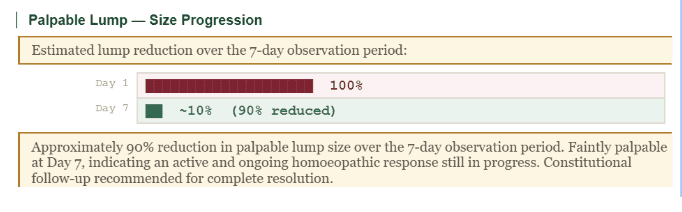
| Day 7 | ✓ Resolved | ✓ Resolved | ~10% residual | Comfortable. No pain or swelling at Day 7. |
10 Discussion
“The simillimum acted with characteristic Bryonia precision — extinguishing the acute inflammatory storm and reducing a prominent lump to near-nothing within a single week.”
This case is a textbook demonstration of Bryonia alba’s classical action on acute mastitis. The symptom picture — severe tenderness aggravated by motion, localised inflammatory swelling, and a hard palpable mass — corresponds precisely to Bryonia’s indications as described in Kent’s Lectures on Materia Medica and Boericke’s Pocket Manual, under the rubric Mammae — inflammation, hardness, pain worse motion.
The complete resolution of the inflammatory symptom cluster combined with a 90% reduction in lump size within seven days represents a strong, well-defined homoeopathic response. The remedy acted decisively on the acute inflammatory layer. The residual faint lump may represent a deeper constitutional dimension not fully encompassed by the acute Bryonia picture — warranting further case-taking and a follow-up constitutional prescription to achieve complete resolution.
This case underscores the systematic and reproducible nature of classical homoeopathic prescribing: when the symptom-remedy correspondence is precise and unambiguous, the method delivers a well-defined, clinically measurable outcome — a characteristic of a genuinely scientific system of medicine.
11 Conclusion
This documented case of acute mastitis with palpable breast lump, managed with Bryonia alba 30C, demonstrates a clear and well-defined homoeopathic response over a 7-day observation period. Both tenderness and swelling resolved completely; the palpable lump reduced by approximately 90% in size. The remedy was selected on strict classical principles through symptom repertorisation using Kent’s Repertory, and the outcome is consistent with Bryonia’s established materia medica profile for the breast sphere.
This case is submitted as a contribution to the documented evidence base for homoeopathic prescribing in acute inflammatory breast conditions. Constitutional follow-up is recommended to address the residual lump and ensure complete and lasting resolution.