Abstract:
Attention-deficit/hyperactivity disorder (ADHD) is a common and complex neurodevelopmental disorder that affects individuals across the lifespan. ADHD is often chronic with prominent symptoms and impairment spanning into adulthood. ADHD is often associated with co-occurring disorders including disruptive mood, anxiety and substance abuse. The diagnosis of ADHD is clinically established by review of symptoms and impairment. The biological underpinning of the disorder is supported by genetic, neuroimaging, neurochemistry and neuropsychological data. Consideration of all aspects of an individual’s life needs to be considered in the diagnosis and treatment of ADHD. Multimodal treatment includes educational, family, and individual support. Psychotherapy alone and in combination with medication is helpful for ADHD .
Introduction :
Attention-deficit/hyperactivity disorder (ADHD) is one of the most common mental disorders affecting children. Symptoms of ADHD include inattention (not being able to keep focus), hyperactivity (excess movement that is not fitting to the setting) and impulsivity (hasty acts that occur in the moment without thought).
ADHD is considered a chronic and debilitating disorder and is known to impact the individual in many aspects of their life including academic and professional achievements, interpersonal relationships, and daily functioning.
An estimated 8.4% of children and 2.5% of adults have ADHD. It is often first identified in school-aged children when it leads to disruption in the classroom or problems with schoolwork.
It is more commonly diagnosed among boys than girls given differences in how the symptoms present. However, this does not mean that boys are more likely to have ADHD.
Boys tend to present with hyperactivity and other externalizing symptoms whereas girls tend to have symptoms of inattention that may be less obvious (daydreaming, disorganization, forgetfulness).
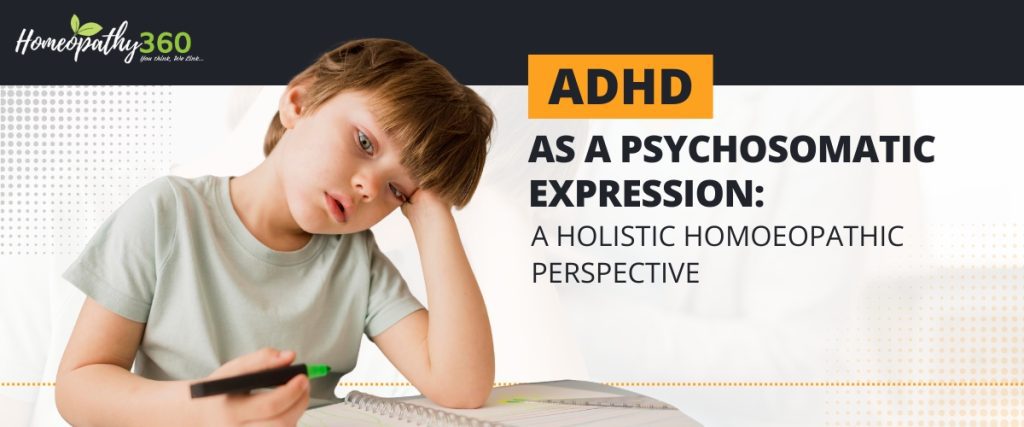
Homoeopathy offers a holistic approach, considering the individual as a whole. It views ADHD not merely as a behavioral disorder but as an expression of internal disharmony involving mind and body.
Definition:
ADHD is defined as a neurodevelopmental disorder characterized by persistent patterns of inattention and/or hyperactivity-impulsivity.
Classification :
ADHD divided into three main types:
- Predominantly inattentive presentation.
- Predominantly hyperactive/impulsive presentation.
- Combined presentation.
- Inattentive type:
Inattentive refers to challenges with staying on task, focusing, and organization.
Has problems staying focused on tasks or activities, such as during lectures, conversations or long reading.
Does not follow through on instructions and doesn’t complete schoolwork, chores or job duties.
Has problems organizing tasks and work (for instance, does not manage time well; has messy, disorganized work).
Avoids or dislikes tasks that require sustained mental effort.
Often loses things needed for tasks or daily life, such as school papers, books, keys, wallet, cell phone and eyeglasses.
Forgets daily tasks, such as doing chores and running errands. Older teens and adults may forget to return phone calls, pay bills and keep appointments.
- Hyperactive-impulsive type:
Hyperactivity refers to excessive movement such as fidgeting, excessive energy, not sitting still, and being talkative.
Fidgets with or taps hands or feet, or squirms in seat.
Not able to stay seated (in classroom, workplace) when remaining seated is expected.
Runs about or climbs where it is inappropriate (or, in adults, feeling restless).
Always “on the go,” as if driven by a motor (uncomfortable being still for long times, often seeming difficult to keep up with).
Has difficulty waiting for his or her turn, such as while waiting in line.
Interrupts or intrudes on others (for instance, cuts into conversations, games or activities, or starts using other people’s things without permission). Older teens and adults may take over what others are doing.
- Combined type:
This type of ADHD is diagnosed when both criteria for both inattentive and hyperactive/impulse types are met.
ADHD is typically diagnosed by mental health providers or primary care providers.
A psychiatric evaluation for ADHD often includes a description of symptoms from the patient and caregivers, completion of scales and questionnaires by patient, caregivers and teachers, complete psychiatric and medical history, family history, and information regarding education, environment, and upbringing.
It may also include a referral for medical evaluation to rule out other medical conditions.
Etiology:
- Biological Factors:
Genetic predisposition
Neurotransmitter imbalance (especially dopamine)
Brain structure differences
- Environmental Factors:
Parenting style
. Excessive screen exposure
Academic stress
- Psychosomatic Factors:
Emotional neglect or insecurity
Suppressed anger or grief
Family conflicts
Early childhood trauma.
Children with ADHD have reduced grey and white brain matter volume and demonstrate different brain region activation during certain tasks .
Further studies have indicated that the frontal lobes, caudate nucleus, and cerebellar vermis of the brain are affected in ADHD .
Several non-genetic factors have also been linked to the disorder such as low birth weight, premature birth, exposure to toxins (alcohol, smoking, lead, etc.) during pregnancy, and extreme stress during pregnancy.
Pathophysiology:
Genetic Factors + Environmental Factors
↓
Neurotransmitter Imbalance
(↓ Dopamine, ↓ Norepinephrine)
↓
Prefrontal Cortex Dysfunction
↓
Front striatal Circuit Abnormality
↓
Executive Function Deficit
↓
Basal Ganglia Dysfunction
↓
Default Mode Network Dysregulation
↓
Delayed Cortical Maturation
↓
Clinical Manifestations
(Inattention • Hyperactivity • Impulsivity)
Clinical Features:
- Inattention Symptoms:
Difficulty sustaining attention
Easily distracted by external stimuli
Makes careless mistakes
Poor concentration in studies
Frequently loses things (books, pencils, etc.)
Avoids tasks requiring mental effort
Forgetfulness in daily activities
- Hyperactivity Symptoms:
Constant fidgeting (hands/feet)
Inability to sit still
Runs or climbs excessively (in children)
Talks excessively
Restlessness (even in calm situations)
Difficulty engaging in quiet activities
- Impulsivity Symptoms:
Difficulty waiting for turn
Blurts out answers
Acts without thinking
Risk-taking behavior.
- Emotional Features:
Irritability
Easily angered
Oversensitivity to criticism
- Cognitive Features:
Poor executive function
Difficulty in planning & organizing
Time management issues
Weak memory (especially working memory)
- Behavioral Features:
Disruptive behavior in class
Difficulty following rules
Poor academic performance
Social problems (peer conflicts)
- Physical / Associated Features:
Sleep disturbances
Fatigue (despite hyperactivity)
Clumsiness (in some cases)
Homoeopathy Concept of Adhd:
In homoeopathy, ADHD is not considered merely a neurodevelopmental disorder but a dynamic disturbance of the vital force, expressed through mental, emotional, and physical symptoms.
- Disturbance of Vital Force:
ADHD reflects imbalance in the vital force
Symptoms (hyperactivity, inattention) are expressions of this disturbance
Disease is not local but affects the whole individual
- Individualization:
Each ADHD child presents differently
No “one remedy” for ADHD
Remedy selection based on:
Mental symptoms (most important)
Emotional traits
Physical general
- Totality of Symptoms:
Diagnosis is not the basis of prescription
Totality includes:
Mental: restlessness, poor concentration
Emotional: irritability, fear, anger
Physical: sleep disturbance, activity level
- Mind-Body Unity:
Mind and body are inseparable
Emotional conflicts → behavioral symptoms
ADHD seen as psychosomatic expression
- Role of Constitution:
Each child has a unique constitutional type
Treatment is deep-acting and long-lasting.
Miasmatic Analysis of Adhd:
| MIASM | CORE NATURE | ADHD FEATURES |
| Psora | Deficiency | Inattention, anxiety, poor focus |
| Sycosis | Excess | Hyperactivity, impulsivity |
| Syphilis | Destruction | Aggression, violent behavior |
| Tubercular | Instability | Restlessness, dissatisfaction |
Homoeopathy Medicine in ADHD
Stramonium:
Indications: Used for children with violent tantrums, intense fear, or night terrors. They may show excessive hyperactivity, fear of darkness, or feel threatened by imaginary things.
Personality Type: Fearful, restless, and aggressive.
Hyoscyamus Niger:
Indications: Beneficial for children who exhibit extreme hyperactivity and impulsiveness. They may interrupt conversations, behave inappropriately, and show attention-seeking behavior.
Personality Type: Mischievous, overactive, and sometimes jealous.
Tuberculinum:
Indications: Given to children with frequent mood swings, restlessness, and a tendency to feel bored easily. They may be prone to destructive behavior or constantly seek new stimulation.
Personality Type: Restless, dissatisfied, and rebellious.
Tarentula Hispanica:
Indications: Suitable for children who are hyperactive, fidgety, and constantly on the move. They may be excessively sensitive to music, react aggressively when frustrated, and engage in impulsive activities.
Personality Type: Energetic, impatient, and unpredictable.
Calcarea Phosphorica:
Indications: Often prescribed to children with learning difficulties and delayed cognitive development. These children may struggle with focus and feel overwhelmed with mental tasks.
Personality Type: Forgetful, slow learners, and easily frustrated.
Lachesis Mutus
Indications: For individuals with talkative, impatient, and argumentative tendencies. They may feel frustrated when not the center of attention and show bursts of irritability.
Personality Type: Competitive, expressive, and emotionally intense.
Advantages of Homoeopathy in Adhd:
- Individualized Care: Homeopathy treats each person uniquely, considering their mental, emotional, and physical characteristics.
- Non-Addictive and Safe: Unlike stimulants, homeopathic remedies are non-addictive and do not cause dependency or withdrawal symptoms.
- Minimal Side Effects: When prescribed by a qualified practitioner, homeopathic remedies are gentle and safe, even for young children.
- Holistic Approach: Homeopathy considers not just the behavioral symptoms but also the underlying triggers, such as emotional trauma, stress, or environmental factors.
Challenges of Limitations:
Lack of Standardized Protocols:Homeopathic treatment is highly individualized, which makes it challenging to conduct large-scale clinical trials.
Time-Consuming Process: Results may take time to manifest, requiring patience and regular follow-ups with the practitioner.
Need for Trained Practitioners: Since remedies are tailored to each individual, it’s crucial to consult a qualified and experienced homeopath.
Discussion:
The psychosomatic model provides a deeper understanding of ADHD by linking emotional and physical health. Homoeopathy aligns with this perspective by addressing the root cause rather than suppressing symptoms.
It emphasizes restoring balance within the individual, allowing natural healing.
Conclusion: A Gentle Path of Homoeopathy Management:
ADHD can be challenging to manage, especially for those seeking alternatives to conventional medications due to their potential side effects. Homeopathy offers a natural, safe, and personalized approach that addresses not just the symptoms but also the underlying emotional and psychological patterns contributing to ADHD.
While more research and clinical trials are needed to establish its efficacy on a larger scale, many individuals have benefited from homeopathic care as part of an integrative treatment plan. By fostering emotional balance and improving focus, homeopathy offers hope for those seeking a gentler, long-term solution to managing ADHD.
If you or your child is struggling with ADHD, consult a qualified homeopathic practitioner to explore how this holistic approach might support your journey to better health and well-being.
Reference:
- Kaplan and Sadock’s Synopsis of Psychiatry Sadock, B.J., Sadock, V.A. Kaplan & Sadock’s Synopsis of Psychiatry. 11th ed. (Pathophysiology and clinical features)
- Diagnostic and Statistical Manual of Mental Disorders DSM-5American Psychiatric Association. Diagnostic and Statistical Manual of Mental Disorders (DSM-5). 5th ed. Washington, DC; 2013. (Diagnostic criteria for ADHD)
- The American Psychiatric Association Publishing Textbook of Psychopharmacology, Sixth Edition. Edited by:Alan F. Schatzberg, M.D., Charles B. Nemeroff, M.D., Ph.D
- Robin, A.L. &Barkley, R.A. (1999). ADHD in Adolescents: Diagnosis and Treatment.
- Hahnemann, S. Organon of Medicine, 6th ed. New Delhi: B. Jain Publishers; 2002.
- (Aphorisms 3, 5, 7, 210–230 for mental diseases & vital force)
- Materia Medica Pura
- Hahnemann, S. Materia Medica Pura. New Delhi: B. Jain Publishers.
- Lectures on Homoeopathic Materia Medica
- Kent, J.T. Lectures on Homoeopathic Materia Medica. New Delhi: B. Jain Publishers
- Essence of Materia Medica
- Vithoulkas, G. Essence of Materia Medica. New Delhi: B. Jain Publishers.
- Repertory of the Homoeopathic Materia Medica:
- Kent, J.T. Repertory of the Homoeopathic Materia Medica. New Delhi: B. Jain Publishers.
- Schroyens, F. Synthesis Repertory. Latest Edition 9.1.B. Jain Publishers.