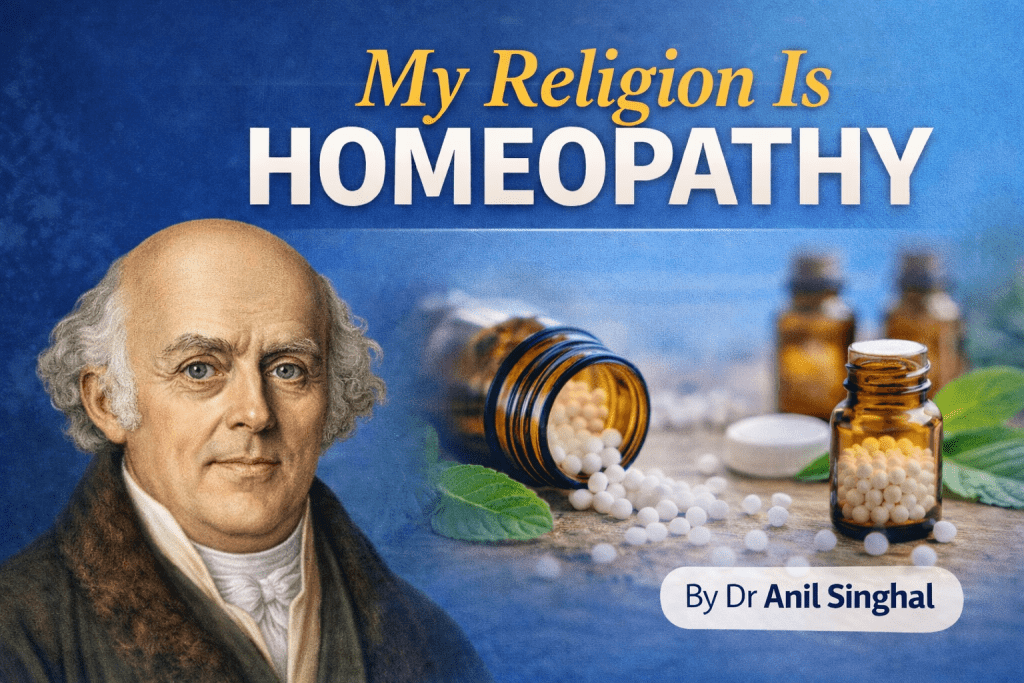
My Religion Is Homeopathy
This evening, after returning from the clinic, I sat quietly in my free time. The day’s work was over, but the mind was not still. This week is the birthday of Samuel Hahnemann. Once again, 10th April is approaching, and with it comes World Homoeopathy Day. Across the world, homeopaths, students, teachers, practitioners, and researchers will remember the founder whose thought gave direction to a therapeutic system that continues to shape lives, clinics, classrooms, and hopes. In such evenings, when outer work becomes silent, inner thoughts often begin to speak more clearly.
As I sat absorbed in my own reflections, a few words suddenly flashed in my mind with unusual force: I am a homeopath. My religion is homeopathy. My past, since 1984, is homeopathy. My present is homeopathy. My future is homeopathy. These words did not come to me as a slogan. They came like an inner recognition. They seemed to gather, in a single stream, my years of study, my practice, my struggles, my convictions, my reading, my teaching, and my continuing effort to remain faithful to the spirit of this healing art.
At once I remembered the well-known words spoken by Dr. John Henry Clarke in his presidential address of October 1906:
“If any one wishes to know what is my religion, I reply, I am a Homœopath. My politics ? I am a Homœopath . My fatherland ? Homœopathy . With me, Homœopathy is first, and second, and third, and everything else that is desirable comes after that.”
Whenever I read these words, I do not read them merely as historical rhetoric. I read them as the expression of a state of mind. They reveal a depth of commitment, a dedication of purpose, and a seriousness of identity that modern professional language rarely captures. Clarke was not merely praising a doctrine. He was revealing what happens when a system of healing enters the very centre of one’s life.
These words have always moved me, but today they touched me differently. Perhaps age, experience, and the long companionship of practice change the way one receives such sentences. A young student may hear passion in them. A practitioner of many decades hears also responsibility. To say that homoeopathy comes first is not merely to declare affection for it. It is to submit oneself to its discipline, to its principles, to its demands of observation, patience, sincerity, and moral restraint. It is to ask oneself whether one is still worthy of the science and art one professes.
For me, homoeopathy has not been a passing interest. It has accompanied the greater part of my conscious intellectual life. Since 1984, when I entered its stream as a student, it has remained before me in one form or another – in books, in clinics, in cases, in failures, in recoveries, in questions, in insights, in Materia medica, in Repertory, in Organon, and in the quiet astonishment that sometimes comes when the simillimum truly acts. Time has altered many things around me, but this central companionship has remained. That is why, when I say that my past is homeopathy, my present is homeopathy, and my future is homeopathy, I do not feel that I am exaggerating. I feel that I am simply naming the truth of my own journey.
On Hahnemann’s birthday, therefore, I do not wish only to offer homage in a ceremonial way. I wish to examine the quality of our own commitment. What does homoeopathy mean to us today? Is it only a qualification, a profession, a subject of examination, a means of livelihood, or a conference theme? Or does it still live in us as a disciplined calling? Hahnemann did not give the world a casual method. He gave a way of thinking, a way of observing, a way of prescribing, and above all a way of taking the suffering human being seriously. To remember him rightly is to renew our seriousness toward that inheritance.
This is my message to our fraternity. To students, I would say: study deeply, patiently, and honestly. Do not be satisfied with superficial familiarity. Read the masters, read the provings, read the materia medica with reverence and discrimination. To practitioners, I would say: let your clinics remain schools of observation and humility. Do not let routine extinguish wonder. To teachers, I would say: transmit not only information, but also intellectual integrity and moral tone. To researchers, I would say: build evidence, but do so without losing the soul of homoeopathy, without diluting its principles into something unrecognizable. Every generation receives this inheritance anew, and every generation must decide whether it will merely possess it, or truly serve it.
World Homoeopathy Day should not be only an occasion for greetings, banners, or formal remembrance. It should also be a day of inward reckoning. Are we worthy heirs of Hahnemann? Are we preserving clarity where confusion grows? Are we strengthening conviction where indifference spreads? Are we adding honesty to knowledge, and service to skill? A profession remains alive not merely because institutions continue, but because living men and women continue to carry its spirit with sincerity.
When Clarke spoke his fiery words in 1906, he spoke from a time of struggle, conviction, and identity. More than a century later, those words still have the power to awaken us. They remind us that homoeopathy has never advanced by apathy. It has moved forward through faithfulness, labour, thought, sacrifice, and a certain inward flame. If that flame weakens, institutions alone cannot save the system. But if that flame remains alive, then even difficult times can become times of renewal.
On this coming 10th April, as we remember Hahnemann and celebrate World Homoeopathy Day, I offer my respectful greetings to all members of our fraternity across the world. May students grow in understanding. May practitioners grow in wisdom. May teachers grow in influence. May researchers grow in depth and honesty. May each one prosper in whatever good work he or she undertakes in homoeopathy. May your study be fruitful, your practice compassionate, your teaching inspiring, and your research meaningful. And may the spirit of homoeopathy continue to guide us with clarity, dignity, and healing force in the years ahead.
–
Dr. Anil Singhal, MD (Hom.) is a senior homeopathic practitioner based in Gurugram and the author of Boger’s Legacy (2nd edition), a work exploring the enduring relevance of Dr. C.M. Boger. Known for his thoughtful commitment to classical homeopathy, he writes in a reflective narrative style that blends clinical insight with philosophical depth and educational clarity. He has been in active practice since 1990 and has served as visiting faculty at Bakson Homeopathic Medical College, Nehru Homeopathic Medical College, and Dr. Sur Homeopathic Medical College.
He currently serves as a reviewer for Homoeopathic Links (an international peer-reviewed journal published by Thieme), Similia (The Australian Homoeopathic Association, Australia), the 14th Australian Homoeopathic Medicine Conference 2026 (Australia), the International Journal for Fundamental and Interdisciplinary Research in Homoeopathy (India), and The Hahnemannian Homoeopathic Sandesh (India).