Individualized Constitutional Homoeopathic Management of Pediatric Psoriasis: A Case Report
Abstract
Background: Psoriasis is a chronic immune-mediated inflammatory dermatosis that may significantly impair quality of life, especially in pediatric patients. Long-term conventional therapy may produce adverse effects, particularly when lesions involve sensitive areas such as the genital region.
Case Summary: 12-year-old male child presented with erythematous, dry, scaly eruptions initially over the glans penis, later spreading to the abdomen and lower limbs, associated with intense itching aggravated after hot bath. He also complained of chronic constipation with stools passed on alternate days. Based on detailed case taking and reportorial analysis using Complete Repertory, Calcarea carbonica was selected as the constitutional remedy.
Intervention And Outcome: The patient was prescribed Calcarea carbonica in ascending potencies (30CH,200CH,1M) followed by placebo. Gradual reduction in itching and scaling was observed, with progressive regression of lesions. Complete resolution of eruptions and normalization of bowel habits occurred within four months without recurrence.
Conclusion: This case demonstrates the effectiveness of individualized constitutional homoeopathic treatment in pediatric psoriasis, emphasizing holistic management and sustained recovery.
Keywords: Psoriasis, Pediatric psoriasis, Homoeopathy, Constitutional treatment, Calcarea carbonica
Introduction: Psoriasis is a chronic inflammatory skin disorder characterized by well-demarcated erythematous plaques covered with silvery white scales. It arises from a complex interplay of genetic predisposition, environmental triggers, and immune dysregulation leading to keratinocyte hyperproliferation. Pediatric psoriasis accounts for a considerable proportion of cases and may present with atypical distribution, including genital involvement, which can cause discomfort and psychosocial distress. Conventional management primarily includes topical corticosteroids, immunomodulators, and phototherapy. However, prolonged use of topical steroids, particularly in sensitive areas, may lead to adverse effects and recurrence. Homoeopathy emphasizes individualized constitutional prescribing based on totality of symptoms and miasmatic background, aiming at long-term restoration of health. This case highlights such an approach.
Case:
Preliminary Data:
Name of patient: xyz
Age: 12 years
Sex: Male
Date Of First Consultation: October 2025
Chief Complaints:
1. Itching and eruptions on glans penis
2. Spread of eruptions to abdomen and lower limbs
3. Constipation passing stools on alternate days
History of Presenting Complaints:
Complaint began with itching and eruptions on the glans penis, which caused marked discomfort. Gradually, similar eruptions appeared on the abdomen and lower limbs, suggestive of progressive skin involvement The itching was persistent and troublesome, compelling the child to scratch, itching aggravated by hot bath . Along with skin complaints, the patient had a history of constipation, characterized by bowel movements occurring on alternate days. No history of discharge, pain, or bleeding from the lesions was reported. There was no history of any local application of steroidal ointments.
Past History
No history of major illness such as asthma, tuberculosis, or recurrent infections
No history of similar skin complaints in the past
Family History
No known family history of psoriasis or other chronic skin disorders
Physical Generals
Appetite: Normal
Thirst: Moderate
Perspiration :scalp
Desire :eggs
Bowels: Constipated; stools passed on alternate days
Urine: Normal
Sleep: disturbed (itching)
Thermal reaction: chilly
Mental Generals
• Calm and mild-natured child
• No marked fears or anxieties
• Emotionally stable
General Physical Examination
• Built and nourishment appropriate for age
• No pallor, cyanosis, or lymphadenopathy
Local Examination (Skin)
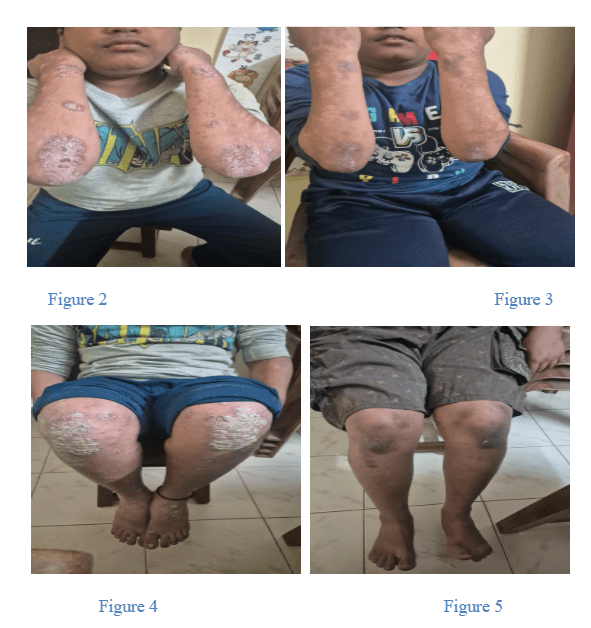
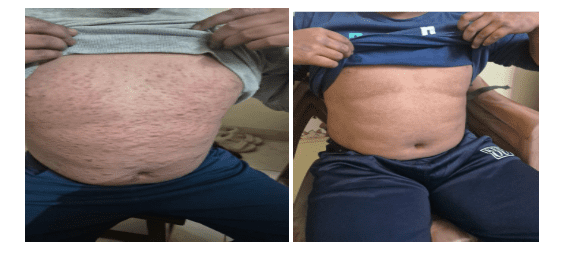
• Dry, erythematous, scaly eruptions
Initial involvement of glans penis
• Later spread to abdomen and lower limbs
• Intense itching present
Miasmatic Diagnosis
Predominant Psoric miasm
Totality Of Symptoms
- Psoriatic eruptions
- Dry eruptions
- Scaly eruptions
- Itching aggravated after hot bath
- involvement of genital region
- desires eggs
- Chronic constipation
- Thermally chilly
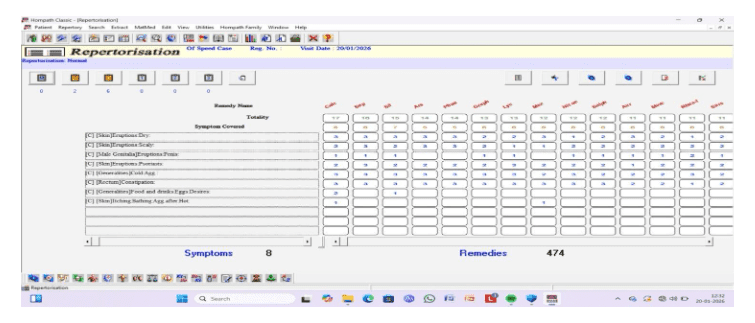
Repertory Selected: Complete repertory
Reportorial Chart : (Fig. 1)
Remedy Selection And Potency:
Calcarea carbonica 30 CH
Followed by placebo
Follow-Up:
| Date | Symptom | Treatment |
| 30 October 2025 | •Itching slightly reduced•No new eruptions•Constipation persisted but less discomfort | Calcarea carbonica 200CH |
| 20 November 2025 | •Marked reduction in itching•Lesions on glans penis started regressing•Abdominal eruptions lighter in appearance•Bowels more regular | Calcarea carbonica 1 M |
| December2025 | •Significant improvement in skin lesions•Scaling reduced•Only faint discoloration remained•Constipation much improved | Placebo |
| January2026 | •Complete disappearance of eruptions•No itching•Normal bowel movements•General health improved | Placebo |
Result:
The patient showed complete and sustained recovery within four months following a single constitutional dose of Calcarea carbonica, without recurrence or suppression.
Conclusion:
This case demonstrates the effectiveness of individualized homoeopathic constitutional treatment in managing pediatric psoriasis. By addressing the patient as a whole rather than focusing solely on local lesions, lasting cure was achieved. Calcarea carbonica proved to be a well-indicated remedy, acting deeply on both skin pathology and associated bowel dysfunction.
BEFORE AFTER
Co-Author – Dr Geeta B Adi. — MD(Hom) Prof and Guide Repertory department of repertory
References :
- Hahnemann S. Organon of Medicine. 6th ed. New Delhi: B. Jain Publishers; 2002.
- Boericke W. Pocket Manual of Homoeopathic Materia Medica. New Delhi: B. Jain Publishers; 2007.
- Kent JT. Repertory of the Homoeopathic Materia Medica. New Delhi: B. Jain Publishers; 2006.
- Murphy R. Homoeopathic Medical Repertory. New Delhi: B. Jain Publishers; 2002.
- Kumar B, Dogra S. Dermatology and Sexually Transmitted Diseases. New Delhi: Elsevier; Latest edition.
- Griffiths CEM, Barker JN. Pathogenesis and clinical features of psoriasis. Lancet. 2007;370:263-271.
- Pariser DM, Bagel J, et al. National psoriasis foundation clinical consensus on disease severity. J Am Acad Dermatol. 2007;57:512-518.
- Central Council for Research in Homoeopathy. Guidelines for Case Reporting in Homoeopathy. New Delhi: CCRH; Latest edition.
- Vithoulkas G. The Science of Homoeopathy. New Delhi: B. Jain Publishers; 2002.