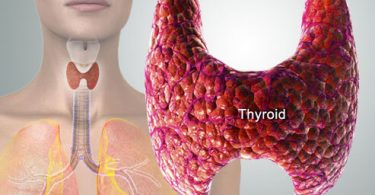
Recurrent Pediatric helminths Infestation: A Clinical, Nutritional, and Gut Microbiome Perspectives with an Individualized Homoeopathic Case Analysis
Abstract
Helminths infestation remains one of the most prevalent parasitic infections affecting children worldwide, particularly in developing regions where sanitation and hygiene conditions are inadequate. Soil-transmitted helminths such as Ascaris lumbricoides, Enterobius vermicularis, Ancylostoma duodenale and Trichuris trichiura contribute significantly to morbidity in the pediatric population. These infections are associated with gastrointestinal disturbances, anemia, malnutrition, growth retardation, and impaired cognitive development.
Recent scientific research has also highlighted the interaction between intestinal parasites and the gut microbiome, suggesting that helminths may influence microbial ecology, immune responses, and nutrient metabolism.
Conventional treatment focuses on eliminating parasites through anti-helminthic drugs, but recurrence is common due to environmental exposure and unresolved host susceptibility.
Homoeopathy approaches such conditions through individualized treatment based on constitutional characteristics, mental and physical symptoms, and miasmatic background.
This article presents a detailed case of chronic worm infestation in a 3.5-year-old child with persistent anal itching, poor growth despite good appetite, offensive discharges, and characteristic behavioral traits. Based on totality of symptoms and repertorial analysis, Sulphur 200 was prescribed with subsequent clinical improvement and disappearance of worms.
This case highlights the importance of considering pediatric helminthiasis within a broader framework that includes host susceptibility, intestinal ecology, and individualized therapeutic approaches.
Keywords
Helminthiasis, Pediatric Worm Infestation, Soil-Transmitted Helminths, Gut Microbiome, Homoeopathy, Constitutional Susceptibility, Sulphur
Introduction
Helminths infestations represent one of the most widespread chronic infections affecting humans globally and remain a major public health concern in many developing countries. Soil-transmitted helminths (STHs) infect approximately 1.5 billion people worldwide, accounting for nearly 24% of the global population.
Children are particularly vulnerable to helminths infections due to immature immune systems, frequent exposure to contaminated soil and food, and inadequate hygiene practices. More than 267 million preschool children and over 568 million school-age children live in areas where soil-transmitted helminths are intensively transmitted, requiring preventive treatment and public health interventions.
The most common helminths infecting children include:
- Ascaris lumbricoides (roundworm)
- Enterobius vermicularis (pinworm or threadworm)
- Trichuris trichiura (whipworm)
- Ancylostoma duodenale and Necator americanus (hookworm)
- Taenia Species (tapeworm)
These parasites primarily inhabit the gastrointestinal tract but can produce systemic effects through nutritional depletion, immune modulation, and chronic inflammatory responses.
Chronic helminths infection during childhood may adversely affect growth, nutritional status, immune development, and cognitive performance. Consequently, Helminthiasis represents not only an infectious disease but also a condition with potential long-term implications for child development and health.
Global Burden And Pediatric Health Impact
Helminth infections are strongly associated with socioeconomic conditions, sanitation infrastructure, and environmental hygiene. Children living in endemic regions often experience repeated exposure to parasites through contaminated soil, food, water, and poor sanitation facilities.
Chronic infestation may lead to multiple health consequences including:
Nutritional Deficiencies
Helminths can interfere with digestion and nutrient absorption by damaging intestinal mucosa and competing for host nutrients.
This may result in:
• protein-energy malnutrition
• micronutrient deficiencies
• weight loss despite adequate appetite
Anemia
Helminths attach to the intestinal mucosa and feed on host blood, leading to chronic blood loss and iron deficiency anemia.
Anemia during childhood can contribute to:
• fatigue and weakness
• reduced physical activity
• impaired immune function
Growth Retardation
Chronic intestinal parasitic infection has been associated with:
• stunted growth
• delayed physical development
• reduced physical fitness
Cognitive and Behavioral Effects
Several studies have reported associations between helminths infection and reduced cognitive performance.
Affected children may exhibit:
• poor concentration
• irritability
• disturbed sleep
• reduced academic performance
Helminths And The Gut Microbiome
Recent research in microbiome science has revealed complex interactions between intestinal parasites and gut microbial communities.
The human gastrointestinal tract contains a highly diverse microbial ecosystem that plays a central role in:
• digestion and nutrient metabolism
• immune system development
• protection against pathogens
• neurological regulation through the gut-brain axis
Helminths inhabit the intestinal lumen and mucosa and may influence this microbial ecosystem.
Studies suggest that helminths may alter the composition and diversity of gut micro biota through mechanisms such as:
• changes in intestinal mucus secretion
• modulation of immune responses
• alteration of intestinal motility
• competition for nutrients within the gut environment
These interactions may affect the balance between beneficial and pathogenic microorganisms.
Comparison of common Human Helminthes: Transmission, symptoms and clinical impact.
| Feature | Ascaris lumbricoides | Enterobius vermicularis | Hookworm (Ancylostoma / Necator) | Trichuris trichiura | Taenia (Beef / Pork) |
| Common name | Roundworm | Pinworm / Threadworm | Hookworm | Whipworm | Tapeworm |
| Type | Nematode | Nematode | Nematode | Nematode | Cestode |
| Mode of entry | Ingestion of eggs via contaminated food/water | Feco-oral route, autoinfection common | Skin penetration by larvae (bare feet) | Ingestion of eggs from contaminated soil | Consumption of undercooked beef or pork |
| Habitat | Small intestine | Cecum; eggs laid perianally | Small intestine | Colon | Small intestine |
| Activation phase | Larval lung migration → intestinal phase | Nocturnal perianal migration | Intestinal attachment and blood sucking | Heavy colonic infestation | Slow intestinal growth of adult worm |
| Key symptoms | Cough, wheeze, abdominal distension, intestinal obstruction | Perianal itching, restlessness, disturbed sleep | Anaemia, fatigue, weakness | Chronic diarrhoea, tenesmus, rectal prolapse | Weight loss, abdominal discomfort, passage of proglottids |
| Nutritional effect | Malnutrition and growth retardation | Usually mild nutritional effect | Severe iron deficiency anemia | Anaemia and poor growth | Malnutrition |
| Special danger | Intestinal obstruction, biliary migration | Sleep disturbance, vulvovaginitis in girls | Severe anemia and cardiac strain | Rectal prolapse | Neurocysticercosis (T. solium) |
| Common age group | 2–10 years | 3–12 years | Rural school-age children | Children in poor sanitation areas | Older children and adolescents |
Homoeopathic Perspective
Homoeopathy approaches disease from a constitutional perspective, emphasizing the individuality of each patient.
In cases of recurrent worm infestation, homoeopathic physicians consider not only the presence of parasites but also the constitutional characteristics of the child. Treatment is selected based on:
• mental and emotional traits
• physical constitution
• cravings and aversions
• general modalities
• miasmatic background
This individualized approach aims to strengthen the patient’s resistance and restore systemic balance.
Case Presentation
A 3.5-year-old female child was brought to the clinic with complaints of persistent worm infestation.
The child had been suffering from:
• recurrent worms in stool
• intense itching around the anal region
• symptoms persisting for approximately 1.5 years
The mother reported that previous conventional treatment did not provide lasting relief. Despite good appetite, the child exhibited poor growth in height and weight. The itching was markedly worse at night, disturbing sleep.
Chief Complaints:-
| LOCATION | SENSATION & PATHOLOGY | MODALITIES | CONCOMITANT |
| GIT Rectum Anus O – 1.5 years F – almost everday D – continuous | Worms present Itching + | No ame in allo rx< night +3 |
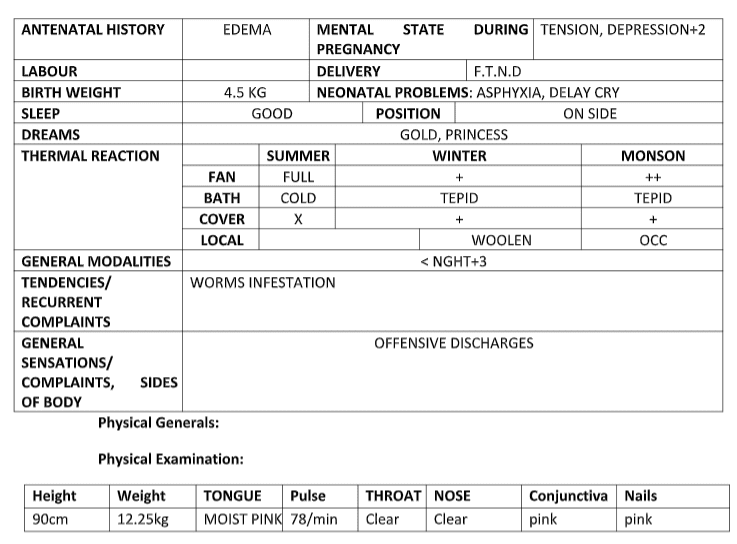
Physical Generals:
Physical Examination:
| Height | Weight | TONGUE | Pulse | THROAT | NOSE | Conjunctiva | Nails |
| 90cm | 12.25kg | MOIST PINK | 78/min | Clear | Clear | pink | pink |
Lifespace:
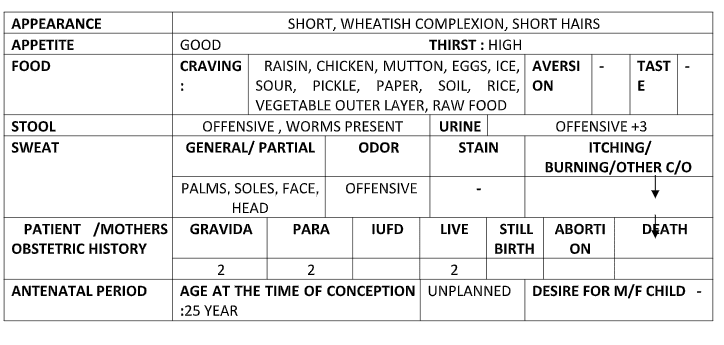
Patient born in Bihar at maternal house. At that time the family consisted of mother, father, elder brother. The patient’s father’s job is mobile so they have to shift frequently from one city to another. Father is doing a job in LNT and mother is an Urdu professor. She had done her MA in Urdu but now she has quit the job and stays at home.
Mental state during pregnancy: – During pregnancy parents were shifted to Haryana separated with other members of the family. Mother was quite anxious during pregnancy. As she was alone and had to manage the house and Ali. Mother has k/c/o hypothyroidism. It was a normal delivery and the birth weight was 4.45 kg.
Childhood:- patient is very cool and jolly in nature but she is also very obstinate+3. She speaks very much. She is very selfish+2. She doesn’t care about others. She has only concern with her work. She will please and call someone until she needs them. Once her work is over she will ignore them and do her work. She is very restless. She never takes anything to services. She becomes irritable+3 when get angry. When she becomes angry she goes to the room and does drama, digs her mouth in between the blanket and pillow and closes the room. She doesn’t have an attachment with anyone. If someone scolds her then she escapes the place and runs away and doesn’t listen to her mother. She doesn’t accept her mistake and tells lies. She has fear of height+3, swing+3. She likes to get ready and wants to wear princess dresses, likes shopping+3, lipstick, and dance. She has dreams of gold, princesses and fairy tales.
Totality:
| SR.NO | TOTALITY OF SYMPTOMS | SR.NO | TOTALITY OF SYMPTOMS |
| 1 | Anger irritable +3 | 11. | Discharge – offensive |
| 2 | Dominating+3 | 12. | Craving – chicken +3 |
| 3 | Obstinate+3 don’t commit her mistake | 13. | Craving – eggs |
| 4 | Talkative+3 | 14. | Craving – ice |
| 5 | Fear of height+3 | 15. | Craving – sour |
| 6 | Fear of swing +3 | 16. | Perspiration profuse |
| 7 | Selfish +2 | 17. | Perspiration offensive+3 |
| 8 | Desire – shopping +3, jewelry +3 | 18. | GIT – worms+2 |
| 9 | Dream – gold, princess | 19. | GIT – anus itching+3 < night +3 |
| 10 | Hunger intolerance | 20. | Eats yet not gain weight |
Repertorization Sheet:
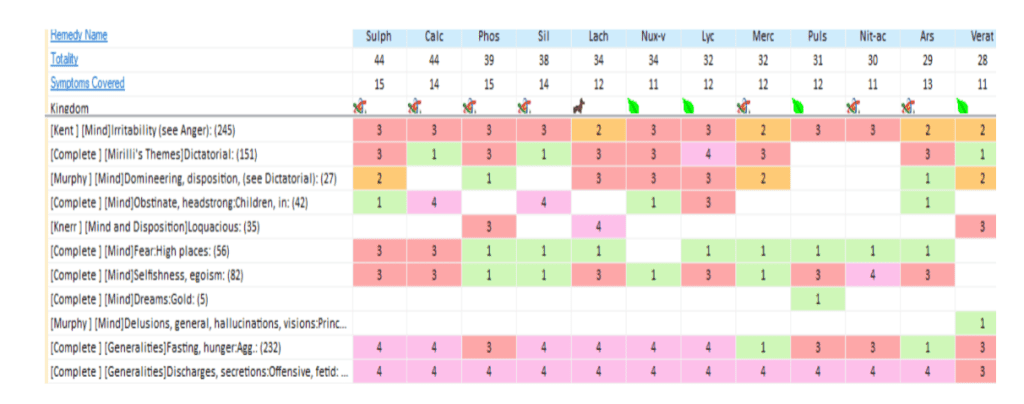
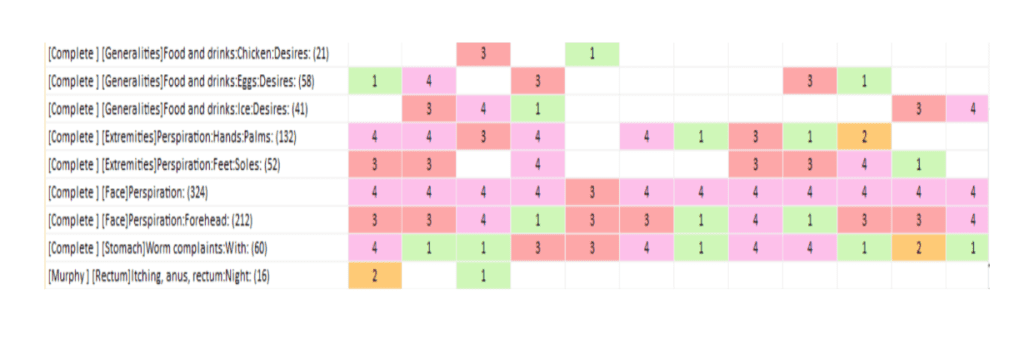
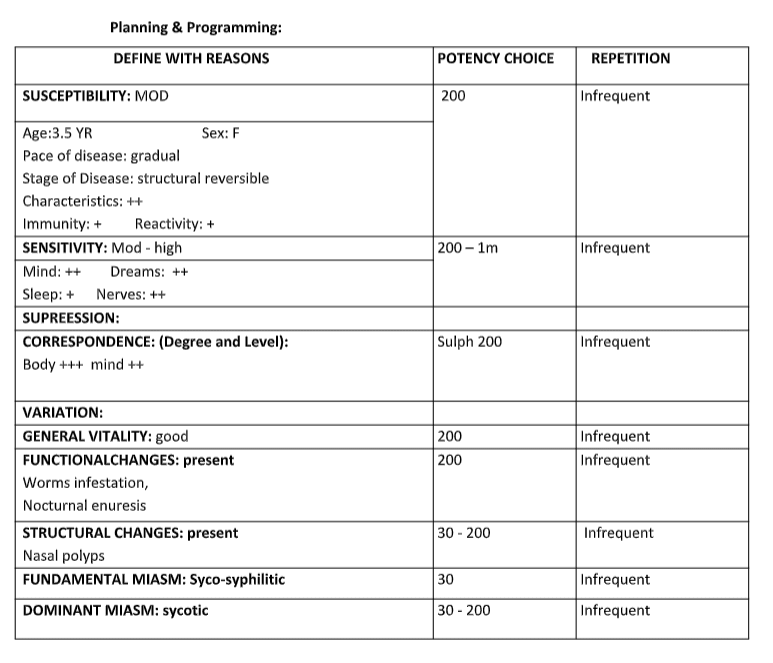
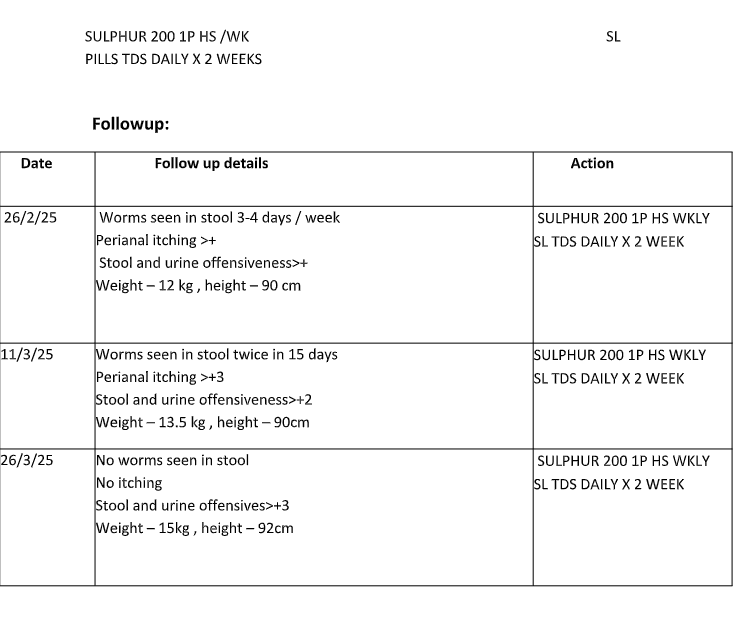
Final Treatment With Posology And Repetition On 19/2/25:
Homoeopathic Therapuetics
- CINA
Affected worm – Pinworms, roundworms
Produces a perfect picture of the wormy child. Worms colic – pain in umbilical region; abdomen hard and distend, Canine hunger and emaciated, Extreme irritability, Child screams, strikes, does not want to be touched, Grinding of teeth, Pale face with dark circles, Restless sleep, with rolling of eyes, dark rings around eyes; constant rubbing the nose; epistaxis grinding and gnashing of teeth; face ale and cold, or red and hot; loathing of food, nausea, vomiting; constipation; dry, hacking cough at night; feverishness; convulsive motions of head and limbs; itching of anus from pinworms.
- TEUCRIUM MARUM VERUM
Affected worms – ascarides, threadworm
Severe perianal itching, creeping and tingling. Child scratches until sore. Crawling sensation in rectum after stool. Itching of anus, and constant irritation in the evening in bed. With twitching, choking, and starting up frightened. Nightly restlessness, worse from warmth of bed. Frequent itching and tingling in anus, often after the evacuations. Violent sticking in anus in the evening, in bed.
3. SPIGELIA
Affected worms: Roundworms
Colicky pain, Palpitation, Nervous excitement, Pain around umbilicus, A remedy for stitches due to the presence of worms. Child refers to the navel as the most painful part. Itching, crawling and tickling in anus and rectum. Frequent ineffectual urging to stool. As of a worm rising in throat. Stools of only large lumps of mucous. Very offensive flatus. Faints at stool. Stools: of mucus with tenesmus; large lumps of mucus without feces; of feces with masses of worms; hard like sheep’s dung and enveloped in mucus.
- SANTONINUM
Affected worms: round worms, and thread worms, but not tapeworms.
Visual disturbances, Convulsions due to worms, Greenish or yellow vision, Severe worm irritation. Santonin is the favourite anthelmintic of the old school which produces colour blindness and yellow vision The alkaloid of Cina is also a remedy for round worms. It is not a safe remedy as Cina and no more efficacious. The writer has observed convulsions produced by its use in too low potency. Fetid breath, depraved appetite; thirsty. Tongue deep-red. Grinding teeth. Nausea; better after eating. Choking feeling. seized with prostration, convulsions, cramps, and icterus.
- CALCAREA CARBONICA
Affected worms: tape worms, pinworms
It is a deep constitutional anti-worm remedy. Recurrent worms; Fat, flabby child, Sweaty head, Craving for eggs, Delayed development, Headache, dark rings around the eyes, pale, bloated face; thirst; thick, bloated belly; aching about the navel; diarrhoea; easy perspiration from motion, scrofulous; Graph; ascarides, with hard stool; crawling in rectum, as from worms, itching at anus, as from pinworms.
- SULPHUR
Affected worms: round worms and tapeworms
Recurrent infestation. Dirty, offensive stools. Heat intolerance. Standing thinker, philosophical child. Unclean habits. Itching and burning of anus; piles dependent upon abdominal plethora. Frequent, unsuccessful desire; hard, knotty, insufficient. Child afraid on account of pain. Redness around the anus, with itching. Morning diarrhoea, painless, drives out of bed, with prolapsus recti. Haemorrhoids, oozing and belching. Creeping in nose, creeping and biting in rectum; nausea before meals and faintness after dinner; restlessness at night.
- CHENOPODIUM ANTHELMINTICUM
Affected worms: not specific
Old anti-helminthic remedy. Colic relieved after passing worms. Worm affections; constipation, ineffectual urging with pressure on bladder and rectum; frequent cutting pains in abdomen, especially at night; with flatulency and urging to stool; pale or yellowish color of face; scraping and burning in throat; secretion of frothy mucus from mouth and throat; dullness in head.
- FILIX MAS
Affected worms: tapeworm
A remedy for worm symptoms, especially with constipation. Gnawing and boring in bowels, aggravated by eating sweet things; constipation; loss of appetite; furred tongue, pale face, blue rings around eyes, itching of nose; irritable and cross. Worm colic, with itching of nose, pale face, blue rings around eyes. Painless hiccough.
- KOUSSO
Affected worms: tapeworm, roundworms
Indigestion; loathing; sleeplessness; weakness, with fainting; profuse and cold perspiration; emaciation; dull pain in bowels; bloatedness; constipation. Prolapsus ani. Watery diarrhoea. Stools are loose and dark.
- CALADIUM
Affected worms: pinworms
Useful when worms travel over the perineum and get into the vagina in little girls, with a tendency to excite masturbation. PRURITUS VULVAE, inducing masturbation, with burning
Maismatic Interpretation:
- PSORA
Worm symptoms are generally tuberculo-psoric, but when associated with irritation, grinding of the teeth, crawling, creeping and itching of the nose and rectum, then the manifestation is purely psoric. Thread worms.
- SYCOTIC
Wormy symptoms with severe abdominal colic; hyperactive restlessness; excessive dribbling of saliva, and twitching of the muscles are indicative of incoordination and are syco-psoric in origin.
- SYPHILIC
Convulsions from worms are a syphilitic manifestation.
- TUBERCULAR
All varieties of wormy manifestations are generally recurrent which is characteristic of the tubercular miasm. They may also be associated with allergic manifestations, even allergic dermatitis.
Discussion
Helminthes infestation in children represents a complex interaction between environmental exposure, host immunity, and intestinal ecology. Although anti-helminthic drugs can effectively eliminate parasites, recurrence remains common in endemic regions.
The present case illustrates the importance of considering host susceptibility in recurrent infections. The patient presented with a characteristic constitutional picture corresponding to Sulphur, including offensive discharges, itching, cravings, and mental symptoms. Sulphur is recognized in homoeopathic literature as a deep-acting remedy with affinity for the gastrointestinal system and skin.
The clinical improvement observed suggests that individualized homoeopathic treatment may contribute to restoring systemic balance and improving resistance.
Limitation
It should also be noted that this report represents only one clinical example within a much larger body of homoeopathic clinical practice. Homoeopathic physicians across many parts of the world routinely encounter and manage cases of recurrent helminths infestation in children using individualized treatment approaches.
However, systematic documentation and large-scale clinical evaluation of such cases remain limited in the scientific literature. Further well-designed observational studies, case series, and controlled clinical trials would be valuable in evaluating the potential role of individualized homoeopathic management in recurrent pediatric helminth infections.
Conclusion
Helminth infestations remain a significant health concern in pediatric populations, particularly in regions with poor sanitation.Beyond intestinal symptoms, chronic infection may influence growth, nutrition, immunity, and cognitive development.
This case illustrates the potential role of individualized homoeopathic treatment in managing recurrent worm infestation by addressing the patient’s constitutional susceptibility.Further scientific investigation is warranted to explore integrative approaches combining parasitology, microbiome science, and individualized therapeutics.
References
- World Health Organization. Soil-transmitted helminth infections. WHO; 2023.
- Park K. Park’s Textbook of Preventive and Social Medicine. 27th ed. Jabalpur: Bhanot; 2023.
- Harrison TR, et al. Harrison’s Principles of Internal Medicine. 21st ed. New York: McGraw-Hill; 2022.
- Nelson WE, et al. Nelson Textbook of Pediatrics. 21st ed. Philadelphia: Elsevier; 2020.
- Centers for Disease Control and Prevention. Ascariasis. CDC; 2022.
- Centers for Disease Control and Prevention. Parasites – Helminths. CDC; 2022.
- Centers for Disease Control and Prevention. Pinworm Infection (Enterobius vermicularis).
- Centers for Disease Control and Prevention. Hookworm Infection.
- Centers for Disease Control and Prevention. Trichuriasis (Whipworm)
- Centers for Disease Control and Prevention. Taeniasis and Cysticercosis
- Boericke W. Pocket Manual of Homoeopathic Materia Medica. New Delhi: B Jain; 2018.
- Kent JT. Lectures on Homoeopathic Philosophy. New Delhi: B Jain; 2015.
- Clarke JH. A Dictionary of Practical Materia Medica. New Delhi: B. Jain Publishers (P) Ltd.; 2023.
- Phatak SR. Concise Materia Medica of Homoeopathic Medicines. New Delhi: B. Jain Publishers (P) Ltd.; 2022.
- Lilienthal S. Homoeopathic Therapeutics. New Delhi: B. Jain Publishers (P) Ltd.; 2022.
- Dewey WA. Practical Homoeopathic Therapeutics. New Delhi: B. Jain Publishers (P) Ltd.; 2022.
- Banerjea SK. Miasmatic Prescribing: Its Philosophy, Diagnostic Classifications, Clinical Guidelines & Specific Therapeutic Hints. Reprinted. New Delhi: B. Jain Publishers (P) Ltd.; 2022.