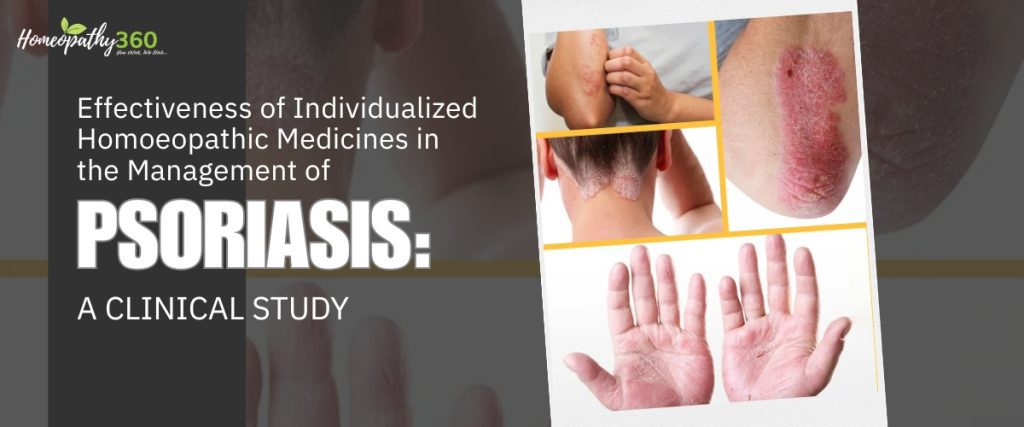
Effectiveness of Individualized Homoeopathic Medicines in the Management of Psoriasis: A Clinical Study
Abstract
Background: Psoriasis is a chronic, immune-mediated inflammatory skin disorder characterized by erythematous plaques covered with silvery scales. It significantly affects patients’ quality of life and is often associated with psychological distress. Conventional treatment provides symptomatic relief but recurrence is common. Homoeopathy, based on the principle of individualization, aims to treat the patient holistically by addressing the underlying constitutional susceptibility.
Objective: To evaluate the effectiveness and scope of individualized homoeopathic medicines in the management of psoriasis.
Methods: A prospective interventional study was conducted on 30 clinically diagnosed cases of psoriasis attending the outpatient department of a homoeopathic medical institute. Patients of both sexes were included according to ICD-10 diagnostic criteria for psoriasis (L40). Patients receiving immunosuppressive drugs or suffering from systemic illnesses were excluded. Detailed case taking was done using a homoeopathic case record format, and individualized remedies were prescribed based on totality of symptoms. The Psoriasis Area Severity Index (PASI) was used to evaluate disease severity before and after treatment. Follow-up was done every 15 days for up to six months. Statistical analysis was performed using the Shapiro–Wilk test and Z test.
Results: Out of 30 cases studied, 25 cases (83.3%) showed improvement while 5 cases (16.7%) showed no improvement. The mean
PASI score decreased significantly after treatment. Statistical analysis revealed a Z value of −5.164 with p < 0.00001, indicating a highly significant difference between pre- and post-treatment scores. The most frequently prescribed remedies were Sulphur, Natrum muriaticum, and Sepia, followed by Arsenicum album, Mercurius solubilis, Graphites, Lycopodium, Mezereum, Phosphorus, and Pulsatilla.
Conclusion: The study demonstrates that individualized homoeopathic medicines may play a beneficial role in the management of psoriasis by reducing disease severity and improving patient outcomes. Further studies with larger sample sizes and controlled trials are recommended.
Keywords: Homoeopathy, Psoriasis, PASI score, Individualized medicine, Chronic skin disease
Introduction
Psoriasis is a chronic inflammatory skin disorder characterized by erythematous plaques with well-defined borders and silvery scales. It affects approximately 1–3% of the global population, while in India the prevalence ranges from 0.4% to 2.8%. The disease has a multifactorial aetiology involving genetic predisposition, immune dysregulation, and environmental triggers such as infections, trauma, stress, and certain medications. Psoriasis is not merely a dermatological disorder; it has profound psychosocial implications including depression, anxiety, reduced self-esteem, and social isolation. Conventional management includes topical corticosteroids, systemic immunosuppressants, phototherapy, and biologic therapies. Although these approaches may provide temporary relief, recurrence and adverse effects remain significant concerns.
Homoeopathy approaches psoriasis from a holistic perspective. According to the principles laid down by Samuel Hahnemann, diseases arise from internal disturbances of the vital force and should be treated
constitutionally rather than through suppression of external symptoms. Individualization of treatment based on the patient’s totality of symptoms is a fundamental concept in homoeopathy.
This study was conducted to evaluate the scope of individualized homoeopathic medicines in the management of psoriasis using objective assessment through the Psoriasis Area Severity Index (PASI).
Aim and Objectives
Aim
To evaluate the scope and effectiveness of homoeopathic medicines in the management of psoriasis.
Objectives
1. To study the clinical presentation and characteristics of psoriasis cases.
2. To evaluate the effect of individualized homoeopathic medicines on psoriasis using PASI scoring.
3. To assess improvement through comparison of pre- and post treatment scores.
4. To identify commonly indicated homoeopathic remedies in psoriasis.
Materials and Methods
Study Design
Prospective interventional clinical study.
Study Setting
Cases were collected from the Outpatient Department (OPD) of a homoeopathic medical institute.
Study Population
Clinically diagnosed cases of psoriasis according to ICD-10 criteria (L40).
Sample Size
30 patients were included in the study.
Sampling Technique
Purposive sampling based on predefined inclusion and exclusion criteria. Inclusion Criteria
• Patients of either sex.
• Clinically diagnosed cases of psoriasis.
• Patients willing to undergo regular follow-up.
Exclusion Criteria
• Patients on immunosuppressive drugs.
• Patients suffering from other severe systemic diseases. • Patients unable to comply with follow-up schedules.
Case Taking and Prescription
A detailed homoeopathic case record was prepared for each patient. Information regarding physical generals, mental generals, past history, family history, and modalities was collected. Totality of symptoms was formed and repertorization was performed to select individualized remedies.
Outcome Assessment
Disease severity was assessed using the Psoriasis Area Severity Index (PASI).
• Baseline PASI score recorded before treatment
• Follow-up PASI scores recorded every 15 days
• Reduction in PASI score considered improvement
Follow-up Period
Each patient was followed for up to 6 months.
Statistical Analysis
Data were analysed using statistical software. Normality was tested using the Shapiro-Wilk test, and treatment effectiveness was evaluated using the Z-test for proportions.
Observations and Results
Table 1: Gender Distribution
| Gender Number Percentage | ||
| Male | 18 | 60% |
| Female | 12 | 40% |
Males were more commonly affected than females in this study.
Table 2: Distribution of Lesion Sites
Psoriatic lesions were distributed across various body parts including:
• Forearms
• Lower limbs
• Scalp
• Back
• Chest
• Hands and feet
Forearms, scalp, and lower limbs were the most frequently affected regions.
Table 3: Remedies Prescribed
| Remedy | Frequency (%) |
| Sulphur | 13.3% |
| Natrum muriaticum | 13.3% |
| Sepia | 13.3% |
| Arsenicum album | 6.7% |
| Mercurius solubilis | 6.7% |
| Graphites | 3.3% |
| Lycopodium | 3.3% |
| Mezereum | 3.3% |
| Phosphorus | 3.3% |
| Pulsatilla | 3.3% |
Sulphur, Natrum mur, and Sepia were the most frequently prescribed remedies.
Table 4: Treatment Outcome
| Outcome | Number Percentage | |
| Improved | 25 | 83.3% |
| Not improved 5 | 16.7% | |
| Total | 30 | 100% |
A majority of cases showed improvement following individualized homoeopathic treatment.
Statistical Analysis
The Z-test for proportions showed:
• Z value = −5.164
• p < 0.00001
This indicates a statistically significant difference between pre- and post treatment outcomes.
Discussion
Psoriasis is a chronic relapsing disease that significantly affects the quality of life of patients. Conventional therapies mainly focus on suppressing symptoms rather than addressing the underlying constitutional susceptibility.
Homoeopathy emphasizes individualized treatment based on the patient’s unique symptom totality. In this study, individualized homoeopathic medicines demonstrated promising results in reducing PASI scores and improving clinical outcomes.
The majority of patients (83.3%) showed improvement following treatment, which indicates a significant therapeutic response. The remedies Sulphur, Natrum muriaticum, and Sepia were most frequently prescribed, reflecting their well-known indications in chronic skin conditions.
The results are consistent with previous homoeopathic research studies which have also demonstrated improvement in psoriasis patients treated with individualized remedies.
However, certain limitations must be acknowledged:
• Small sample size
• Lack of a control group
• Limited follow-up duration
Future studies with larger samples and randomized controlled designs are necessary to further validate these findings.
Conclusion
The present study demonstrates that individualized homoeopathic medicines may be effective in the management of psoriasis. A statistically significant reduction in PASI scores was observed following treatment.
Out of 30 cases studied:
• 25 cases (83.3%) improved
• 5 cases (16.7%) showed no improvement
These findings suggest that homoeopathy can play a valuable role in the holistic management of psoriasis by addressing the underlying constitutional factors rather than merely suppressing symptoms.
Further research involving larger sample sizes and controlled clinical trials is recommended to establish stronger evidence.
Co-Author
Dr.Anjali Kulkarni HOD at GPHMC Miraj.
References
1. Dhawale ML. Principles and Practice of Homoeopathy. Mumbai: Institute of Clinical Research; 2004.
2. World Health Organization. Global Report on Psoriasis. Geneva: WHO; 2016.
3. Langley RG, Krueger GG, Griffiths CE. Psoriasis: epidemiology, clinical features, and quality of life. Ann Rheum Dis.
2005;64(Suppl 2):ii18–ii23.
4. Davidson S. Davidson’s Principles and Practice of Medicine. 20th ed. London: Churchill Livingstone; 2006.
5. Krueger G, Koo J, Lebwohl M, et al. The impact of psoriasis on quality of life. Arch Dermatol. 2001;137(3):280–284.
6. Myers WA, Gottlieb AB, Mease P. Psoriasis and psoriatic arthritis: clinical features and disease mechanisms. Clin Dermatol. 2006;24(5):438–447.
7. Hunter JAA, Savin JA, Dahl MV. Clinical Dermatology. 3rd ed. Oxford: Blackwell Science; 2002.
8. Menter A, Mansouri B. Psoriasis. 2nd ed. London: Springer; 2015. 9. Kent JT. Lectures on Homoeopathic Materia Medica. New Delhi: B Jain Publishers; 2004.
10. Hahnemann S. Organon of Medicine. 6th ed. New Delhi: B Jain Publishers; 2009.